
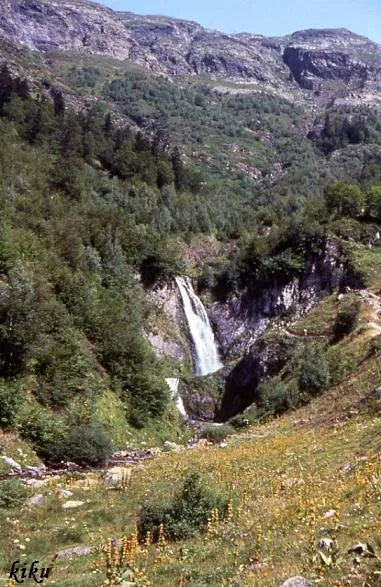
Uelh Der Sescorjada
Important surgència vauclusiana a la Vall d'Aran
EspeleoWorld
Uelh Der Sescorjada
Important surgència vauclusiana a la Vall d'Aran
Vielha e Mijaran · Val d'Aran
Length: 184 m · Depth: 95 m
Updated record
https://espeleoworld.com/en/c/uelh-der-sescorjada
Information can change. Always verify coordinates, access, weather, and cave conditions before setting out.
Important vauclusian spring in the Vall d'Aran, with a flooded conduit that reaches the -95 metre level and a total length of 184 metres. Linked to the Horat der Unhòla by dye tracing.
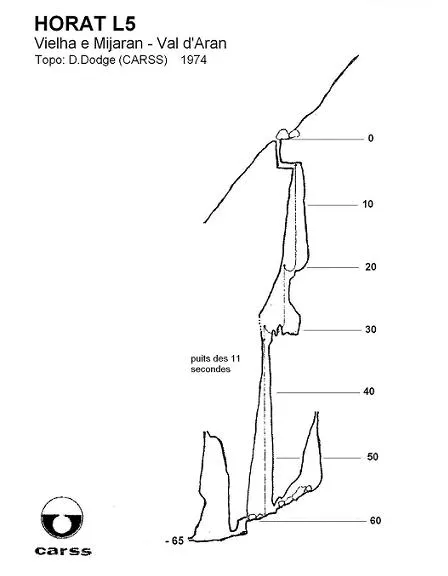
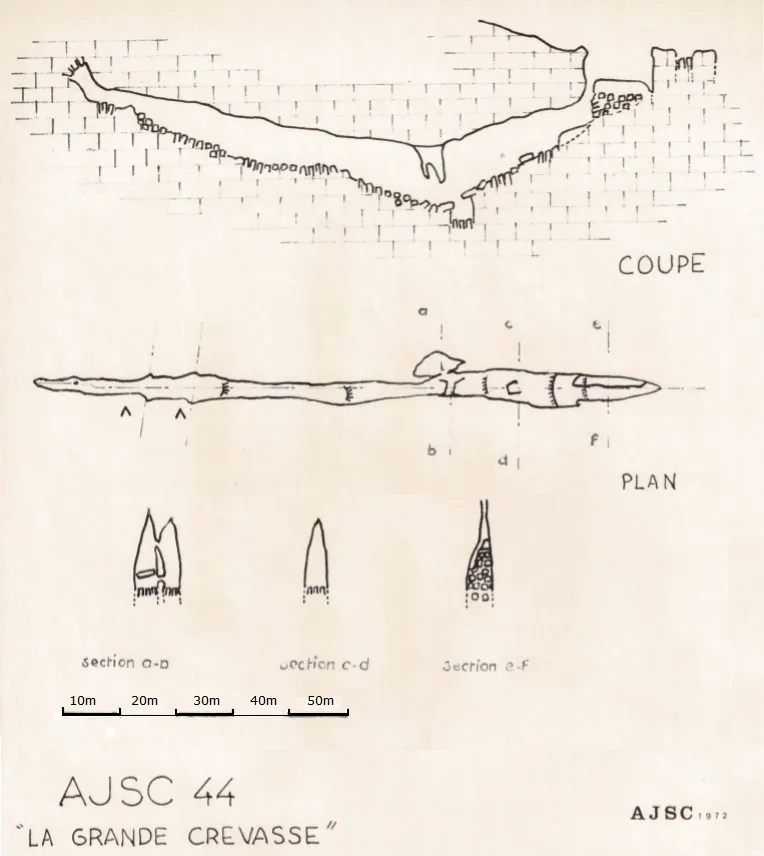
Topographic
Espeleoindex · CC BY-NC 4.0, https://creativecommons.org/licenses/by-nc/4.0/ · Image © its author.
Photos
Espeleoindex · CC BY-NC 4.0, https://creativecommons.org/licenses/by-nc/4.0/ · Image © its author.
Description
Morphology
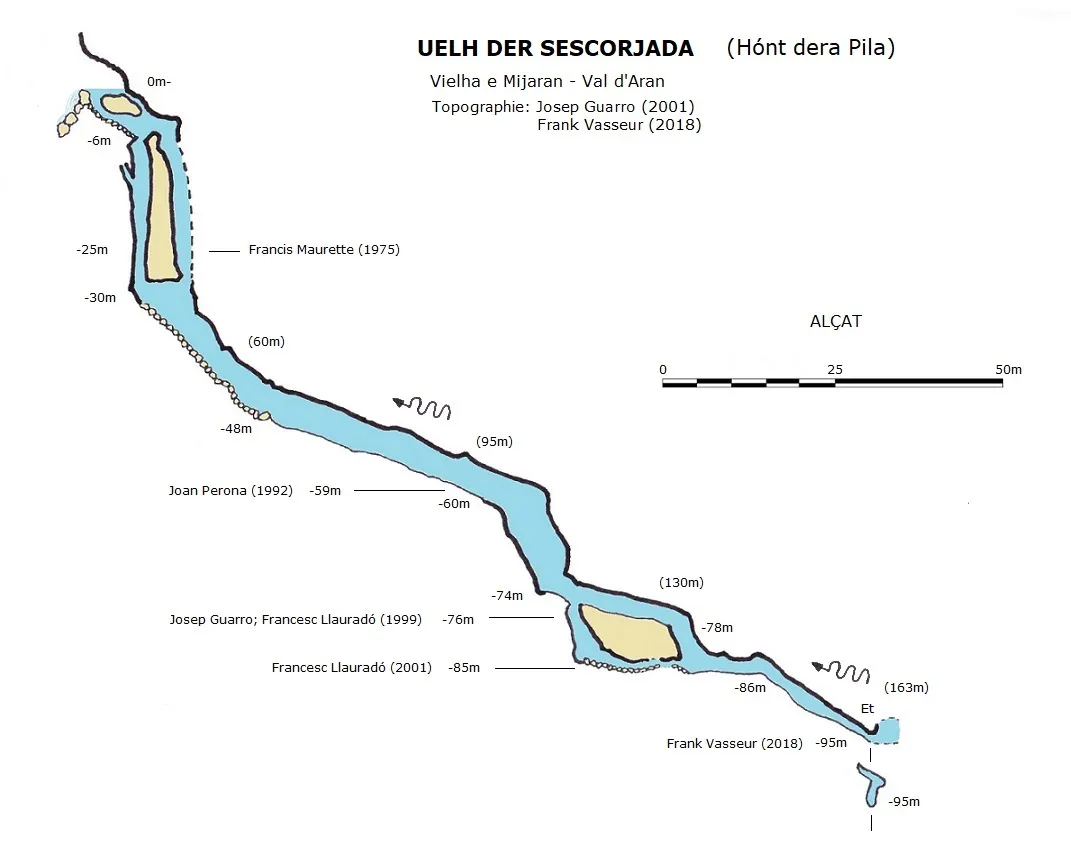
The conduit, flooded from its start, descends vertically to a little more than 25 metres of depth. From here it continues with a marked incline for some 40 metres (level -59), the point where it becomes horizontal for some 20 metres more and then plunges 10 metres more vertically and continues descending to the -85 level where in 2001 the exploration was halted by the cold and the technical difficulty, despite observing the continuation of the conduit. In the exploration carried out by Frank Vasseur in August 2018, at the -74 level, instead of descending the pitch that led to the final level of -85, he chose to follow the descending gallery to the -78 level where he descended a pitch of -8 metres, at the base of which he found the conduit that comes from the end point of the exploration carried out in 2001. From here there is a short flat gallery, which soon gains incline until reaching the -95 metre level where the gallery becomes narrow, but it can be seen that it continues; the total length is 184 metres.
Hydrology
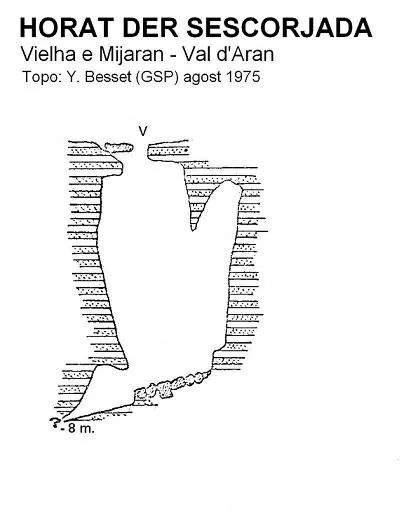
The waters infiltrating the Horat der Unhòla have as their main outlet the Uelh deth Sescorjada (Hònt dera Pila). This relationship could already be established when, at the beginning of the 1970s, FECSA engineers carried out a dye tracing with fluorescein. Another dye tracing was carried out by the Servei Geològic de Catalunya on 8 October 1990, pouring 10 kg of fluorescein into the Horat der Unhòla, giving a positive result at Sescorjada on 14 October; two days later a positive result was also detected at the Hònt deth Terme, some 3 km west of Sescorjada.
Progression
In October 1975, the Frenchman Francis Maurette of the G.S. des Pyrénées (Toulouse), carried out a first dive, reaching the -25 level in the entrance pitch and confirming the clear descending continuation. A second attempt was made in July 1992 by Joan Perona of the EC de Gràcia (Barcelona) who, without obstacles, reached the considerable depth of 60 metres. The dive was very quick and he thought he glimpsed the start of a gallery. In July 1998 a team from the SIE – CEA (Barcelona) made a new penetration with standard compressed-air equipment, also reaching the -60 level but able to confirm the continuation of the gallery. In mid-July 1999 they decided to make a preliminary dive with Nitrox, but the large flow of the spring caused the push dive to be postponed until September. On that date a push dive was carried out with Trimix equipment and oxygen decompression, and Josep Guarro reached the -76 level, the point where he decided to turn back as it was the maximum depth foreseen in the decompression tables; immediately afterwards, Francesc Llauradó also reached the end of the guide line left by Josep. It should be noted of this dive that it was the first time that cave divers from the Spanish State used equipment with gas mixtures in the exploration of a subaquatic cavity, since until then the few occasions on which push dives had been made in the State with Trimix had been carried out by foreign cave divers. It was not until September 2001 that a new push dive was prepared; this time there were two support divers, Jordi Mateo and the late Fritz Kunzel, (who died the following day in a sump of the Escuain massif) who installed the decompression cylinders at -30 and at -6. The push dive was carried out by Francesc Llauradó and Alvar Ros, each equipped with a large-capacity set 2 x 15 litres with Trimix 13/55 and a 10-litre cylinder with Normoxic Trimix 20/35 to begin the descent to -60. They also had Nitrox 40% and oxygen 100% for decompression. At the start of the descent, Àlvar Ros's inflation system for his hydrostatic wings froze, causing them to inflate involuntarily and forcing him to abort the dive. Francesc continued the descent and after repairing the guide line that Josep had installed between -60 and -76 two years earlier, he continued the descent to the -86 level, the point where he decided to turn back as he had used up the maximum planned bottom time. Without any mishap he began the long decompression and after 1 h and 45 minutes he reached the surface safe and sound. Unfortunately Francesc Llauradó died at the beginning of 2011 due to a car accident in the Dominican Republic. On 14 August 2018, Frank Vasseur carried out a dive in which he reached the -95 metre level.
User Comments (0)
No comments yet.
Be the first to share your experience!
Registered Explorations (0)
No explorations registered yet.
Register your visit to this cave!
Bibliography
- Besset, Y. (1977).- “Spéléologie au Val d'Aran (Espagne)” Ouarnède (9): 57-76. GS des Pyrénées. Toulouse.
- Cardona, F. (1989).- Grans cavitats de Catalunya. Vol. 1, 198 pp. EC de Gràcia, Barcelona
- SIE – CEA (2003).- “Uelh de Sescorjada, - 86 m.” EspeleoCat (1): 37-40. Federació Catalana d'Espeleologia. Barcelona.
- Altres dades i fotografies extretes del web: freàtic.com (Josep Guarro, SIE-CEA)
- Noves dades i topografia (2018) facilitades per Josep Guarro (Freàtic).
Nearby caves


Source: Espeleoindex (espeleoindex.com), modified. CC BY-NC 4.0, https://creativecommons.org/licenses/by-nc/4.0/