
Cova del Cau
Cavitat entre blocs al torrent de la Diablera (Montserrat)
EspeleoWorld
Cova del Cau
Cavitat entre blocs al torrent de la Diablera (Montserrat)
Bruc, El · Anoia
Length: 28 m · Depth: 10 m
Updated record
https://espeleoworld.com/en/c/cova-del-cau
Information can change. Always verify coordinates, access, weather, and cave conditions before setting out.
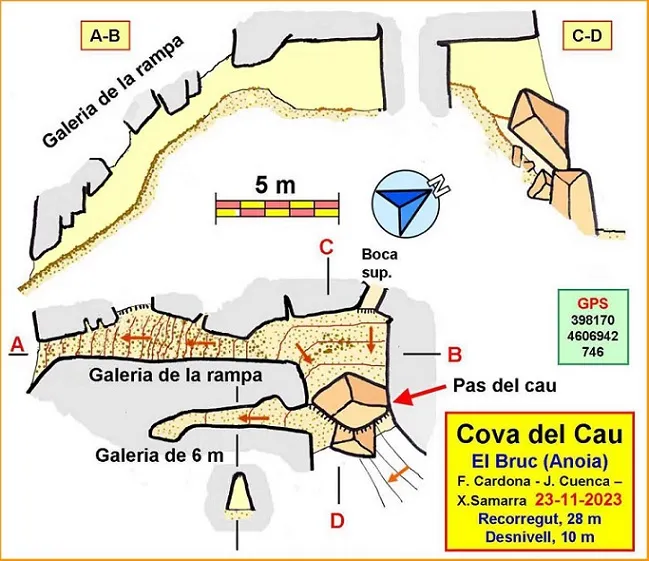
Cavity among blocks in the torrent de la Diablera, in Montserrat, with a lower gallery of 6 m and a descending ramp of 13 m. Archaeologically excavated in 1924 by Casas de Müller.
Topographic
Espeleoindex · CC BY-NC 4.0, https://creativecommons.org/licenses/by-nc/4.0/ · Image © its author.
Photos
Espeleoindex · CC BY-NC 4.0, https://creativecommons.org/licenses/by-nc/4.0/ · Image © its author.
Description
Morphology
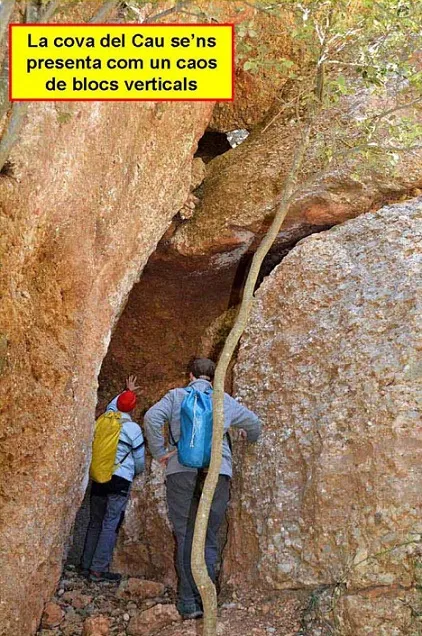
On reaching the mouth of the cave, it presents itself to us as a vertical accumulation of blocks in a kind of channel. From this lower level a rather narrow gallery with a triangular section is born, which we have called the “galeria dels 6 m” because that is its length.
To access the upper level we must drag ourselves under a block in what we have called the “pas del Cau” and which very probably inspired Casas de Müller when he named the cave. This block remains hanging, like a balcony, some 6 m above the lower level of the cave. Behind it a chamber is formed with a sloping floor, which is not comfortable to be in. In the chamber there are two windows, one opens to the outside through the highest part of the cave (in fact, it would be the upper mouth) and the other gives access to a descending ramp with a steep gradient, on the order of 45 degrees. The gallery of the ramp is 13 m long with sections open to the outside.
Progression
The floor is very unstable and as we advance we send stones rolling down, which is why the use of ropes is more than a recommendation. In its lower part, the gallery opens to the outside, where it forms a small scree of the stones that have fallen there.
History
The cavity was archaeologically excavated in 1924 by Joan Maria Casas de Müller within the framework of the archaeological investigations of the cavities at the head of the torrent de la Diablera. In the cave appeared a fragment of a skull, very deteriorated human bones, an Eneolithic vessel, highly fragmented pottery and layers of ashes. Metal Age. Precisely, it was this author who gave the cave its name.
Located by Ferran Cardona in August 2023 but, as he did not carry ropes to descend the ramp, he postponed the exploration until 23-11-2023, when the same Cardona together with Josep Cuenca and Xavier Samarra carried out the cataloguing work.
User Comments (0)
No comments yet.
Be the first to share your experience!
Registered Explorations (0)
No explorations registered yet.
Register your visit to this cave!
Bibliography
- Totes les dades, topografia i fotografies han estat extretes del web: geb.cat (del Grup d'Espeleologia de Badalona). Apunt del 11-12-2023. Dades: Ferran Cardona (EGMB), Josep Cuenca i Xavier Samarra (GEB)
Nearby caves
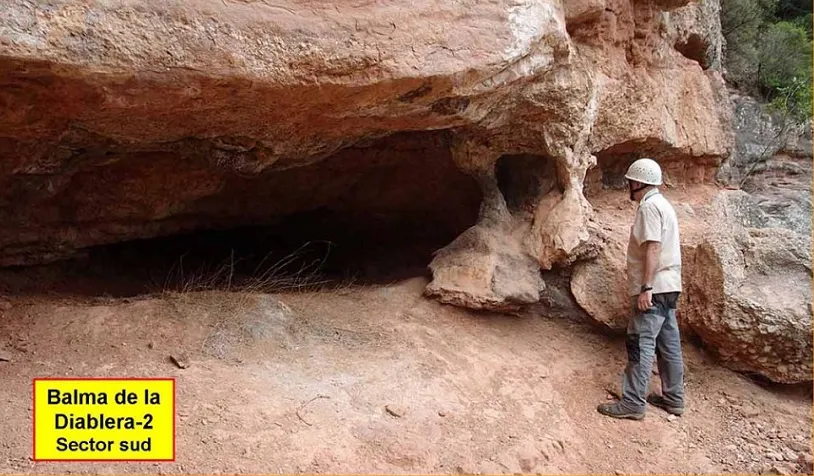
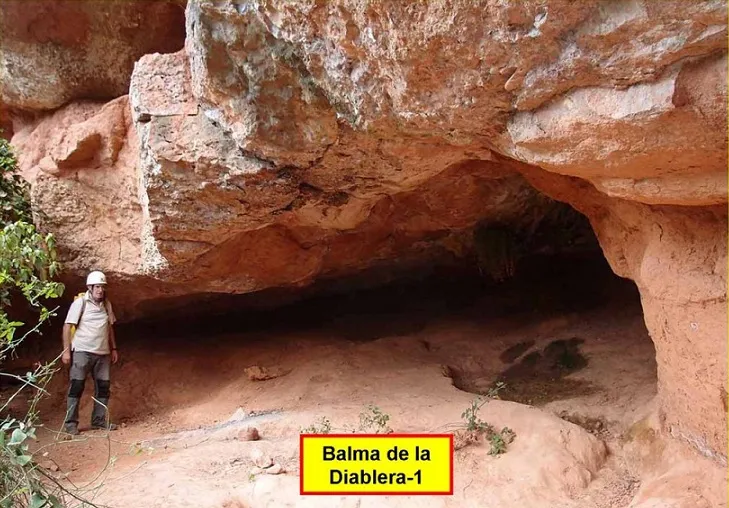


Source: Espeleoindex (espeleoindex.com), modified. CC BY-NC 4.0, https://creativecommons.org/licenses/by-nc/4.0/