
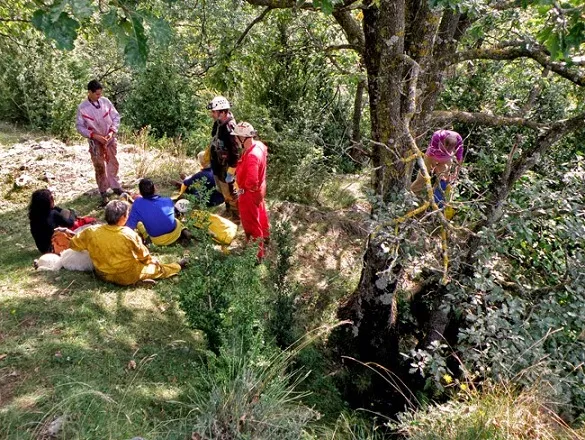
Sistema de la Bellabriga
A system of two cavities with a total length of 405 m in Llanars (Ripollès), with access via la Cova (the cave) and via the pit, including galleries, shafts, crawls and a flooded chamber.
EspeleoWorld
Sistema de la Bellabriga
A system of two cavities with a total length of 405 m in Llanars (Ripollès), with access via la Cova (the cave) and via the pit, including galleries, shafts, crawls and a flooded chamber.
Llanars · Ripollès
Length: 405 m · Depth: 38 m
Updated record
https://espeleoworld.com/en/c/sistema-de-la-bellabriga
Information can change. Always verify coordinates, access, weather, and cave conditions before setting out.
A system of two cavities with a total length of 405 m in Llanars (Ripollès), with access via la Cova (the cave) and via the pit, including galleries, shafts, crawls and a flooded chamber.
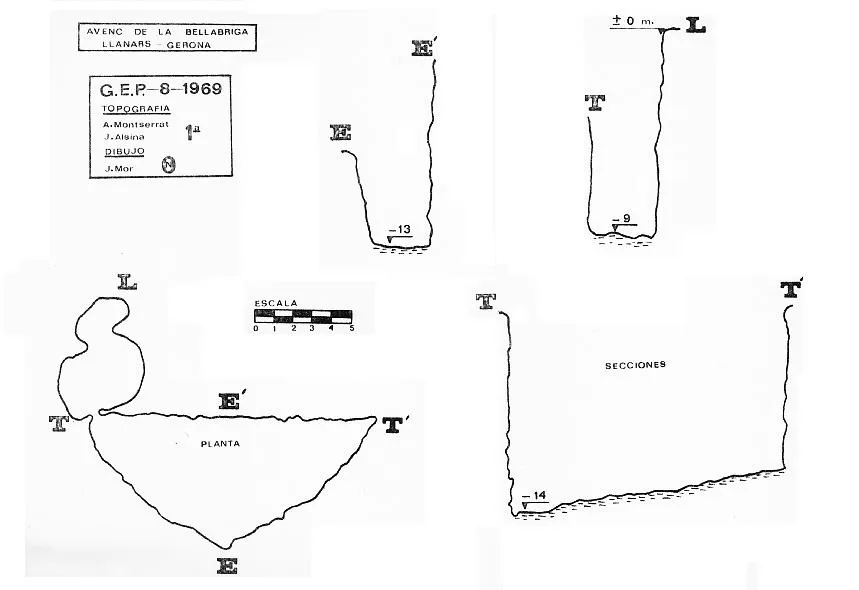
Topographic
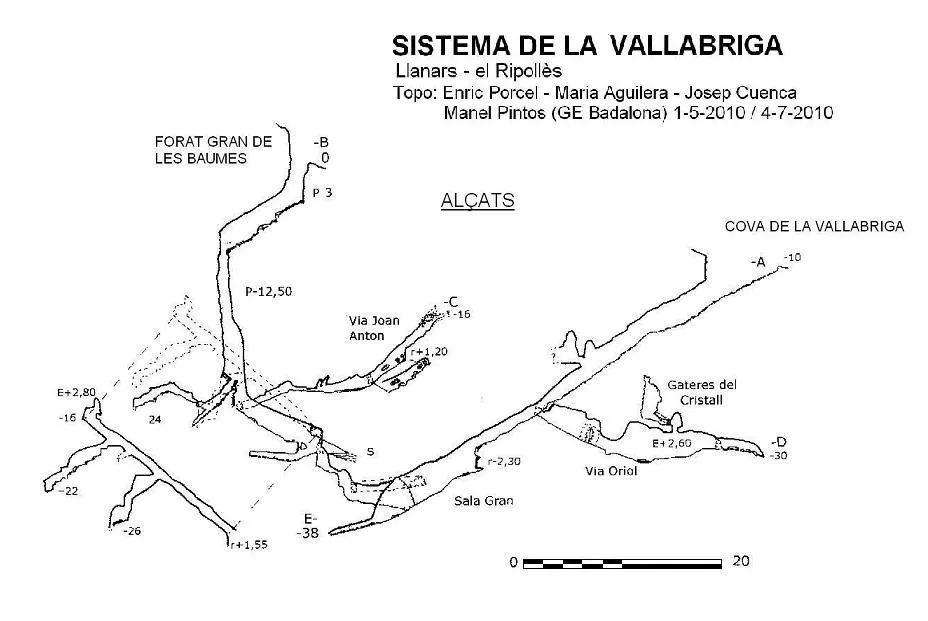
Espeleoindex · CC BY-NC 4.0, https://creativecommons.org/licenses/by-nc/4.0/ · Image © its author.
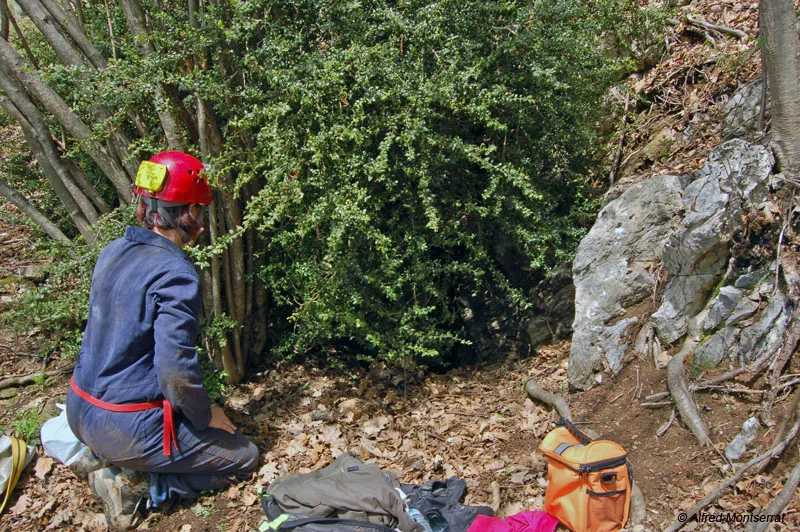
Photos
Espeleoindex · CC BY-NC 4.0, https://creativecommons.org/licenses/by-nc/4.0/ · Image © its author.
Description
Morphology
The cavity has a large entrance, inside which an oak, a chestnut and hazel trees grow. The entrance ramp has initial dimensions of 2.30x2.50 metres. At 10 metres along the passage makes a turn to the right. The Oriol gallery is 1 metre high by 4 metres wide. The E gallery is 2x1.60 metres. The entrance of the Joan Anton gallery has dimensions of 0.65x1.60 metres. The flooded gallery of the distributor chamber is 0.60x1 metre. The inclined slab has a width of 5 metres by 0.80 metres high. The longitudinal fissure of the pit is about 1.40 metres wide by 12.60 metres long. The inclined gallery on the right is 0.60x1.70 metres. The descending gallery on the W side is 1.70x0.60 metres.
Speleothems
The tiny decorated chamber of the gateres del Cristall is decorated. The decorated chamber-chimney allows climbing 3.80 metres. The passage on the right of the fork of the Joan Anton gallery is more decorated.
Hydrology
The flooded gallery is about 4 metres long and is reached by a R-1 metre. In the distributor chamber there is a flooded gallery of 0.60x1 metre that could be a sump; according to GEP data the level varies up to 2 metres and the gallery can sometimes be traversed for about 12 metres. The widest gallery, 4.60 metres long, has a strong inflow of water, with pools and mud. The gallery with a crystal-clear water channel is about 4 metres long.
Progression
Lower section, access via la Cova (the cave). On the entrance ramp, at about 6 metres, we find on the left a small crawl of 0.30x0.80 metres that reconnects with the joint of the entrance area. We will go down this ramp, which at the start has dimensions of 2.30x2.50 metres. At 10 metres along the passage makes a turn to the right. From here we can choose to continue down the ramp or else branch off to the right, where on a small ledge we observe some branches and small chambers with no continuation, except a dangerous slide that on the far right goes down parallel to the main gallery, to join it about 10 metres further down. We will continue down the steep slope for about 14 metres, where the gallery forks. Before the fork, we find a small gallery in the ceiling, quite narrow, 3 metres long with a chimney of 3 metres. At the fork we will follow the gallery on the left. The ramp becomes slippery and compact; this is the Oriol gallery, which is 1 metre high by 4 metres wide. Two metres further down there are two descending galleries on the right, which are communications with the parallel gallery that we left on the right. Nine metres later, we find a hole in the ceiling, where one must overcome an E+2.60 metres, placing ourselves in a small chamber from which a narrow horizontal crawl leads to a tiny decorated chamber, the gateres del Cristall, where we observe that there are two crawls: the left one is an ascending crawl that ends at 3 metres, with passages of 0.30 metres; the right one, also very narrow, takes us after 2.30 metres to a decorated chamber-chimney through which one can climb 3.80 metres until the turn ends. Back again in the gallery, 8 metres further on it ends with no possibility of continuation. Before reaching the end, we have on the right a low-ceiling branch that continues 3 metres further, and perpendicular to this, among the rocks, one can advance 3 metres further to the right. Returning to the fork, we will descend carefully down the gallery on the right. Also on the right and at mid-height we will see the junction of the gallery mentioned above, which comes from the entrance area. Eight metres later, beside a large block, we will descend a R-2.30 metres. On the left we see the links, already mentioned, with the gallery on the left. Advancing along the right wall of the chamber, at about 5 metres one must go through a hole in the ceiling R-1.60 metres; once past it, we find a small chamber formed by fallen blocks. From this small chamber, on the right, we continue 3 metres further to another small chamber; on the right there is a hole P-1.24 metres, which gives onto the chamber below. Opposite we have two continuations that connect immediately; the right one gives onto a small gallery with a crystal-clear water channel. This flooded gallery is about 4 metres long, reached by a R-1 metre. On the right it ends immediately, and on the left by means of another R-1 metre and a flowstone, it returns to the large chamber. From here, if we continue to the right, a gallery loops round to return again to the chamber. In this gallery is the connection with the upper sector corresponding to the entrance via the pit. The connection is not visible at first sight; one must go and find a small rise and ascend a chimney, where at the top and very well concealed, we find the passage that will take us to an ascending gallery. To finish the lower sector, if we position ourselves on the left side of the flowstone that we descended to the flooded chamber, we find in the large chamber a wide passage under the rock, which, dragging ourselves over a floor of stones, allows us to advance about ten metres and reach the deepest point of the cavity at -38 metres.
Upper sector, access via the pit. From the cave entrance, we will climb the slope about twenty metres until we find a longitudinal fissure about 1.40 metres wide by 12.60 metres long, covered with vegetation and with trees growing inside. We descend a P-3.40 metres, where just opposite we have the crawl giving access to the shaft connecting with the lower sector of the cavity. On the left the joint ends at 5.20 metres, full of vegetation. On the right at about 3 metres, we find another crawl that leads us to a descending gallery 7 metres long. It is an inclined gallery of 0.60x1.70 metres. On the right-hand part, among the blocks, a draught can be felt. Returning to the entrance of the crawl, we advance 1.50 metres where we see at the end of the joint a drop of -1.34 metres; one metre further on the gallery turns suddenly to end 1 metre later. The highest point of this gallery is at 2.30 metres. From the crawl giving access to the connecting shaft, we will descend 6.60 metres until reaching the head of a shaft of -12.50 metres; at the base we find a joint 11 metres long. On the E side, we find a wide descending gallery that we will discuss later. On the W side, following a descending gallery of 1.70x0.60 metres and about 3 metres long that leads us to a small chamber; from this we pass to another also small one where this section ends at -24 metres depth. Positioned again at the base of the shaft, via a block we descend a R-2.80 metres and find ourselves in the E gallery, of 2x1.60 metres; going up we will seek the Joan Anton gallery, located to the NW; the entrance has dimensions of 0.65x1.60 metres, we advance about 5 metres through a narrow crawl that at the end is 0.30 metres high, to come out into a wider gallery 4.60 metres long and with a strong inflow of water, with pools and mud; at the end the gallery forks into two parallel passages, connected to each other and with a strong ascending slope; the right one, more decorated, ends at 5 metres, while the left one after 4 metres brings us to a R+1.20 metres, which once overcome the gallery becomes narrower and 4 metres further on forks into two crawls that continue but the narrowness does not allow passage. (topographically this gallery coincides with the sink of the avenc de la Bellabriga). Returning to the wide gallery, we will descend the slope about 5 metres; on the right we find a gallery that turns back to connect by a tiny passage with the base of the shaft. On the left an entrance one metre long reaches a small P-1.90 metres; descending a couple of metres more we find ourselves in a distributor chamber. On the left there is a gallery of 4.50 metres that ends, but which also links with the base of the small shaft of 1.90 metres. To the N we find a flooded gallery of 0.60x1 metre, which could be a sump, according to GEP data the level varies up to 2 metres and the gallery can sometimes be traversed for about 12 metres. Back in the chamber, to the S we find a small shaft R-1.60 metres that links with the lower sector, which from below is the chimney mentioned above. Back in the chamber, in a SE direction we will climb a R+1.50 metres, ascending an inclined slab, with a slope of +40º, the width is 5 metres by 0.80 metres high. The climb is about 20 metres long, ending in a chimney of 2.80 metres. During the climb we find various branches on the left; the first gives onto two concatenated chambers, the product of collapses, which after 7 metres of delicate descent with -30º inclination the first chamber and -60º the second, ends in a cul-de-sac. The second branch, of the same characteristics as the previous one, descends about 10 metres on a steep slope.
Other details
Toponymy: Both la Cova de la Bellabriga (the cave of la Bellabriga) and the rest of the nearby cavities have always been known to the inhabitants of the area under the generic name of “les Baumes”. The only one of this group of cavities that has been documented since 1879 is the Cova de Bellabriga; this takes its name from the torrent de Bellabriga and from the spring of the same name, which was quite visited by tourists in the years 1920-30 due to its medicinal properties; it was also known by the name of “font de la magnèsia”; this spring was badly damaged due to the floods of 1940. We do not know when the hamlets of the Bellabriga de Baix and the Bellabriga de Dalt (Vallabriga on the ICC) date from, but the different authors make no reference to them at any time, and they do not appear in the list of catalogued farmhouses of the municipality of Llanars, nor do they appear in the Nomenclàtor oficial de topònims de Catalunya. In the Agenda 21 Local de Llanars, produced in 2007 by DEPLAN, for the ajuntament de Llanars and the Consell Comarcal del Ripollès, and with the support of the Diputació de Girona, the avenc de la Bellabriga appears as Geological and Palaeontological heritage. Likewise, currently on the website of the ajuntament de Llanars the “Baumes” del Clot de la Bellabriga appear, as well as the torrent de Bellabriga as toponyms. We have also verified that with the toponym of the mas Bellabriga de baix, this appears as a member of the association of mountain mare breeders of the Ripollès, and with this name it is cited in the publication “Guia dels productes agroalimentaris del Ripollès” published in 2011. We have also been able to verify that the association of owners of rustic estates of the Vall de Camprodon cites the estate of the Bellabriga de dalt in Llanars, as one of the actions carried out in 2013 for the recovery of pastures. On the other hand the toponym “Vallabriga” we have only observed in the ICC maps, apart from a reference in the Onosmasticon Cataloniae by Joan Coromines.
History
The first mention of this cave where it is called Cova de la Bella-Briga dates from the year 1879, when a single specimen of Speonomus is collected and becomes part of the Martorell collection with the designation Adelops martorelli in litt. Roca. In 1897, Norbert Font i Sagué already includes the Cova de Bellabriga in the Catàlech Espeleològich de Catalunya, referencing it with the number 82. In 1922, within the Scientific session of 5 October, of the Institució Catalana d'Història Natural, Dr. Ricardo Zariquiey Àlvarez presents the results obtained in the latest campaign, presenting the individuals collected inside a small box. He also presents the Speonomus cited above belonging to the Martorell collection. In 1924, Dr. Zariquiey presents in the Scientific session of 6 March, of the Institució Catalana d'Història Natural, the specimens of Speonomus delarouzeei sbsp.catalonicus.Jeann., collected with traps placed by Dr. Sau in the cave of Bellabriga. He also again cites the specimen of the Martorell collection, since it seems that in reality it is a Speonomus delarouzeei. The next news of the Cova de Bellabriga is provided by Dr. Español who visits it with Dr. Joaquim Mateu on 16 and 17 October 1946, to collect fauna there. It is not until 1969, when the Grup Espeleològic Pedraforca begins a series of explorations, where they survey and name the different cavities of the surroundings, respecting the already known one of Cova de Bellabriga. In 2010 the Grup Espeleològic de Badalona explores and surveys again this group of cavities, changing the name of some of them and specifically in the case of the Cova de Bellabriga/Avenc Camprodon, they rename it Cova de la Vallabriga/Forat Gran de les Baumes.
Bio
Coleoptera: Speonomus delarouzeei sbsp.catalonicus.Jeann. Tribe Sphodrini. Laemostenus complanatus Dej.
User Comments (0)
No comments yet.
Be the first to share your experience!
Registered Explorations (0)
No explorations registered yet.
Register your visit to this cave!
Bibliography
- Borràs,J;Miñarro,JM;Talavera,F.(1980).-”el Ripollès, la Garrotxa i l'Alt Empordà” Catàleg Espeleològic de Catalunya (vol.4):1-296. ed. Políglota. Barcelona.
- Español, Francisco (1952).-”Los Ptrostichidae hipogeos del pirineo español (Coleoptera Adephaga)” Actas primer congreso internacional de estudios pirenáicos San Sebastian 1950.,pp:5-19.
- Español, Francisco (1956).-”Los Bathysciitae Catalanes (col. Catopidae)”. Actes des deuxième Congrès International d'Etudes Pyrénéennes. Luchon-Pau 21 a 25 setembre 1954.,pp:109-123.
- Font i Sagué, Norbert.(1897).-”Catàlech Espeleològich de Catalunya (continuació)”. Butlletí del Centre Excursionista de Catalunya (26):107-112. CE Catalunya.
- Gargallo Busón, Ricard.(1974).-”Memoria explicativa al levantamiento topografico efectuado en la Cova de la Bellabriga”.Ildobates (V):69-72. Grup Espeleològic Pedraforca.
- ICHN. (1922).-”Sessió Científica del 5 d'octubre de 1922” Butlletí de la Institució Catalana d'Història Natural (22,nº7):121-127. Institució Catalana d'Història Natural. Barcelona.
- ICHN. (1924).-”Sessió Científica del 6 de març de 1924”. Butlletí de la Institució Catalana d'Història Natural (24,nº2-3):39-42. Institució Catalana d'Història Natural. Barcelona.
- Montserrat Nebot, Alfred (1974).-”Alt Ter” Ildobates (V):12-54. Grup Espeleològic Pedraforca.
- Montserrat Nebot,A;Mor Benedito,J.(1974).-”Cova de la Bellabriga - Avenc Camprodón” Ildobates (V):55-68. Grup Espeleològic Pedraforca.
- Porcel Caro, Enric. (2010).-”Les cavitats de la Vallabriga (Llanars, Ripollès). Exploracions (20):55-61. Espeleo Club de Gràcia.
- Fotografies extretes del blog: espeleobloc.blogspot Apunt del 21-10-2013
Nearby caves
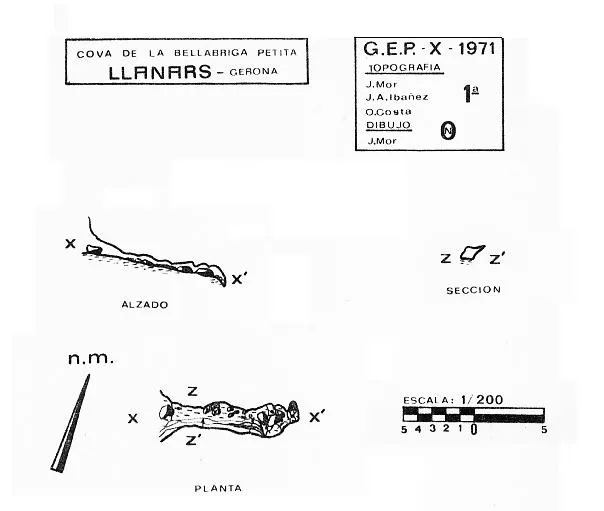
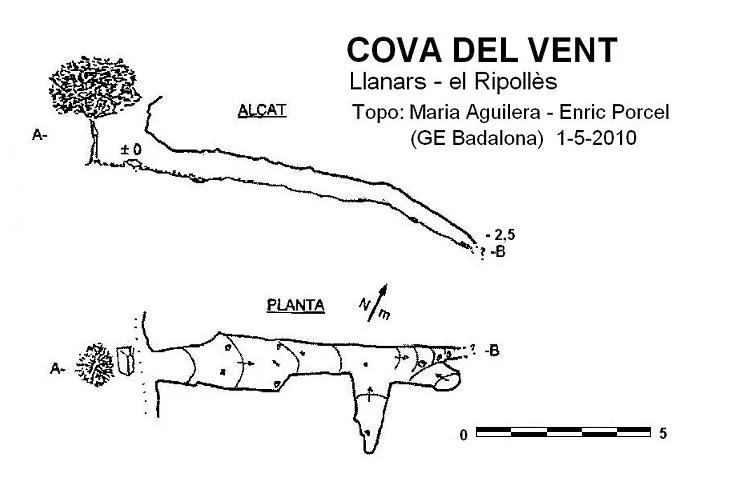


Source: Espeleoindex (espeleoindex.com), modified. CC BY-NC 4.0, https://creativecommons.org/licenses/by-nc/4.0/