
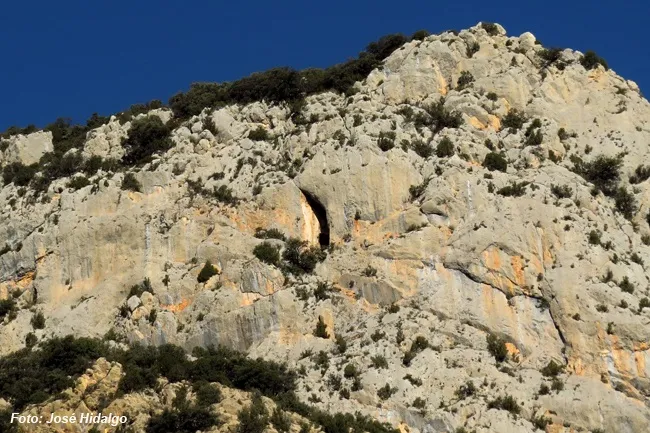
Espluga de les Caixes de Fenollet
Interessant cova penjada, d'interès històric, a Montanissell
EspeleoWorld
Espluga de les Caixes de Fenollet
Interessant cova penjada, d'interès històric, a Montanissell
Coll de Nargó · Alt Urgell
Length: 70 m · Depth: 16 m
Updated record
https://espeleoworld.com/en/c/espluga-de-les-caixes-de-fenollet
Information can change. Always verify coordinates, access, weather, and cave conditions before setting out.
Interesting cova penjada (hanging cave) of historical interest in Montanissell, with a large overhang, galleries and a deposit of wooden boxes.
Topographic
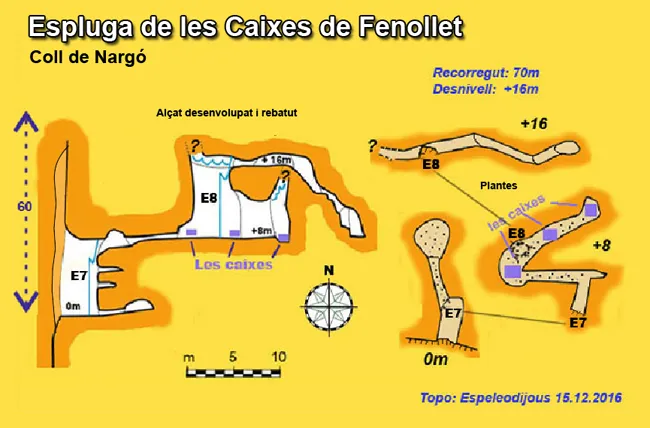

Espeleoindex · CC BY-NC 4.0, https://creativecommons.org/licenses/by-nc/4.0/ · Image © its author.
Photos

Espeleoindex · CC BY-NC 4.0, https://creativecommons.org/licenses/by-nc/4.0/ · Image © its author.
Description
Morphology
Following an S-N fracture, a large overhang more than 15 metres high is visible from afar at mid-wall.
After this majestic portal, a vestibule area 2 metres wide by 7 high continues in the same direction as a gallery 8 metres long, into which we penetrate crouched until its almost circular end, closed by sediments.
From above the climb, a conduit starts that narrows the section until forcing us to advance on "all fours" for 12 metres; here the direction has made a notable turn and advances with a certain parallelism to the direction of the cliff. We pass a narrow step and enter a wide conduit where we can stand up, which ends 12 metres further on: it is the Galeria de les Caixes.
From its ceiling in a W direction a ledge develops that continues the chimney, narrow enough that continuing would require major digging out. In an E direction, a sinuous descending conduit about 20 metres long drops from +16 m to +8 m, where it is convenient to descend with a rope; it ends where a sedimentary plug blocks the gallery at a level coinciding with the extension of the Galeria de les Caixes.
Galeria de les Caixes After crawling through the access conduit, the gallery where the boxes are deposited is 12 metres long, a first section consisting of a small chamber with a maximum width of 3 metres and its jointed continuation to a small final bend. For a good part it has chimneys that, by a largely aerial climb of 8 metres, lead to the upper floor.
As we see in other cavities of this mountain range, it is a residual cavity and its current mouth is entirely accidental, the result of the evolution of the slope.
Speleothems
On the front wall, calcified sedimentary infills are evident, presenting short penetrable platforms.
The upper gallery is the one with the greatest concretion, but at various points we observe obstructions, sedimentary infills, breakages, superposition of lithogenic stages, re-excavation, etc., which characterise it as a fragment of a cavity with a long evolution.
Progression
We descend the wall about 60 metres, with some small ledges and five re-belays to a ledge which, after a rising traverse, leads us to the current mouth of the cavity.
We return to the vestibule and must climb back up (5 + 2m), initially artificial, on our visit on fixed rope, to the ceiling where the continuation gallery opens.
We can continue again with a climb of 8 metres; surprisingly we find a trunk lying across near the head.
Other details
There are scattered remains of wood and three boxes made of several pieces of wood with pegs, which allow them to be fitted together without nails; their perimeter approximately 60x60cm, without bottom or lid, with depths varying between 40cm and nearly 100cm.
Certainly the presence of the boxes, apart from the perplexity it produces, raises the classic questions: what, who, how and when. What are they doing there? Who brought them? How did they manage to place them at this point? And when did they do it?
The greatest difficulty in trying to give some initial answers is that their location in a cova penjada (hanging cave) on a large vertical wall, where one must descend 60 metres and then climb back up another 7 metres without modern techniques, defies all intuition.
Dipòsit de les caixes We have already seen how improbable it is that the boxes were introduced through the current access. However skilled the people who inhabited these places in the past may have been, we do not see how they could find a system to access it unless the exterior configuration was sufficiently different from the current one and they reached it via some ledge or platform at mid-wall, either through the mouth we know or through some other one now blocked.
One detail that may suggest that the entry was made from the upper floor is the existence of the trunk lying across near the head of the second climb, which could have served to facilitate the descent of people or materials.
Everything indicates that we are dealing with a fairly ancient deposit, which coincides with the total ignorance about its existence in any of the nearby farmhouses, where we have been able to speak with people of advanced age, who had no news of it, nor had their parents or grandparents told them anything.
The mystery to be unravelled of who, why and when the boxes were introduced remains awaiting specialists in historical remains to study them.
History
The "first" exploration was on 19.09.2016 by Jordi Francés and Marcel Lavaquiol; from the first moment, aware of the importance of their discovery, they considered it appropriate to share the exploration, and it was through the mediation of Benjamí Grañena that a group from Espeleodijous made the visit on 15.12.2016.
User Comments (0)
No comments yet.
Be the first to share your experience!
Registered Explorations (0)
No explorations registered yet.
Register your visit to this cave!
Bibliography
- Totes les dades, topografia i fotografies han estat extretes del blog: espeleobloc.blogspot. Apunts dels dies 18 i 19 d'abril de 2017
Nearby caves
Espluga de Fenollet
0.1 km · NE
Coll de Nargó (Alt Urgell)
1 topo.7 photos
Espluga del Moro
0.3 km · W
Coll de Nargó (Alt Urgell)
1 topo.3 photos
Forats de les Costes de la Guineu
0.4 km · W
Coll de Nargó (Alt Urgell)
1 topo.3 photos
Cova del Corretgedor
1.4 km · E
Cabó (Alt Urgell)
1 topo.6 photos
Source: Espeleoindex (espeleoindex.com), modified. CC BY-NC 4.0, https://creativecommons.org/licenses/by-nc/4.0/