
EspeleoWorld
Cueva del Valle
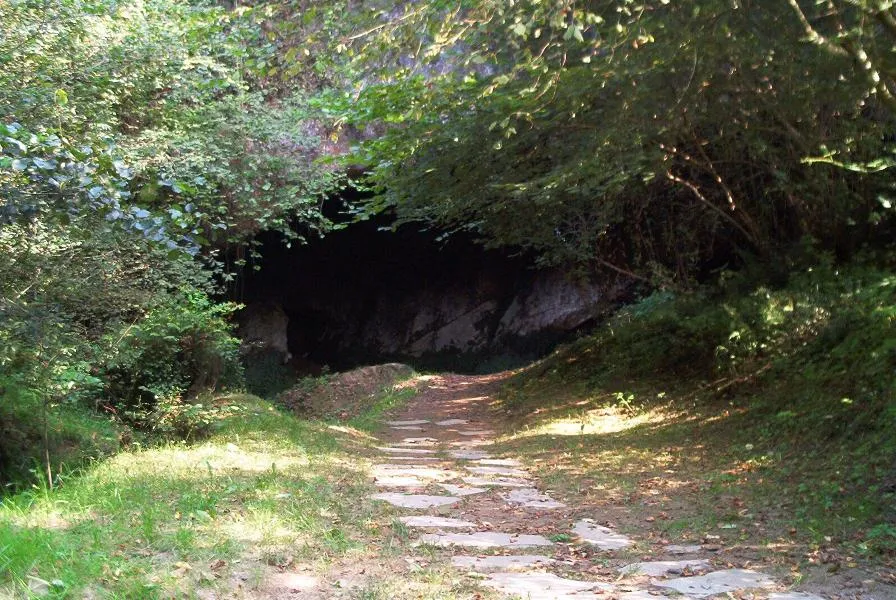
Lower entrance of the Red del Silencio, in Rasines (Cantabria): the río Silencio rises from it, and the system is among the largest in Spain, with about 60 km explored.
Rasines
Length: 60223 m · Depth: 477 m
Updated record
https://espeleoworld.com/en/c/cueva-del-valle-rasines
Information can change. Always verify coordinates, access, weather, and cave conditions before setting out.
Lower entrance of the Red del Silencio, in Rasines (Cantabria): the río Silencio rises from it, and the system is among the largest in Spain, with about 60 km explored.
Photos
© No machine-readable author provided. Notebook~commonswiki assumed (based on copyright claims). · CC BY 2.5, https://creativecommons.org/licenses/by/2.5/ · Wikimedia Commons · https://commons.wikimedia.org/wiki/File:Cueva_del_Valle.JPG
Description
Morphology
According to descriptions of the through-trips, the network combines three quite different environments. Above there is a succession of pits and small meanders, heavily charged with water. Lower down one reaches a collector of large dimensions, with wide galleries on several levels, fossil zones and boulder sections. The last sector towards the lower mouth alternates sandy chambers, low bedding planes that must be crawled through, large collapses and a stretch with water up to the chest.
Our record notes 477 m of vertical extent; a description of the complete through-trip from the upper entrance to this mouth speaks of about 498 m, so both figures are of the same order.
Hydrology
It is the spring of the río Silencio; its waters go to the Ruahermosa and from there to the Asón. The flow rate conditions the whole system: after prolonged rain several passages of the network flood, and in high water the lower entrance can be covered by more than two metres of water. That is why accounts of the through-trips insist on watching the weather and on knowing the passages that close easily.
Progression
Club chronicles describe the network as a long and demanding route, with equipped sections and points where it is advisable to know the alternative exit via the middle entrance. A British group that attempted it before 2003 reported that two of its members became disoriented and had to wait for rescue, which shows that it is not a cavity for improvising. This entry offers neither itineraries nor technical progression data: anyone wishing to visit it should seek current information and experienced company.
Other details
The total length depends on the source and the date. A 2003 review by a British club speaks of about 60 km; a list of large cavities on the Spanish Wikipedia gives 63 km, and the English and French Wikipedias cite more than 64 km. Another description of the through-trip notes 47 km without a date. Our record (60,223 m) falls in the 60 to 64 km group. This figure corresponds to the entire network and not only to the stretch near this mouth. The last known entrance, the Torca de Seguía, was connected after a dig during a period of low water and increased the total development.
History
Padre Lorenzo Sierra found the site in 1905, and the last excavations cited are from 1996 to 1998. It is an important archaeological site. The material includes harpoons, scrapers, burins and bone instruments, from the Azilian and Upper Magdalenian cultures. No cave paintings have been found.
Two batons are preserved from the assemblage. One, without decoration, is in the museum of prehistory of Cantabria. The other, perforated and decorated, has been lost; a replica is kept in the Museo Arqueológico Nacional.
Bio
The sources consulted provide no data on the cave fauna.
User Comments (0)
No comments yet.
Be the first to share your experience!
Registered Explorations (0)
No explorations registered yet.
Register your visit to this cave!
Nearby caves

Contains information from Grottocenter (Wikicaves), grottocenter.org, made available under the Open Database License (ODbL 1.0, https://opendatacommons.org/licenses/odbl/1-0/), modified. · https://grottocenter.org/ui/entrances/24938 · data as of 2026 · Text written by Espeleoworld from public sources. Please ask us before reusing it. · Text by Wikipedia (es) (Cueva del Valle), Wikipedia (en) (Cave del Valle (Cantabria)), Wikipedia (fr) (Grotte del Valle), Wikipedia (es) (Cueva (lista de grandes cavidades de España)), Wessex Cave Club (Red del Silencio (translation of a Spanish through-trip description)), Beardy (Red del Silencio, May 2003 trip report), Wikimedia Commons (Category: Cueva del Valle), José Luis Membrado Julián (Grandes Cavidades Españolas 2024) · adapted by Espeleoworld (normalized, translated); the adaptation is licensed Our own text, written from public sources. Please ask us before reusing it. · The derived data is available on request under the ODbL: [email protected]