
EspeleoWorld
Cueva de Arenaza
The cueva de Arenaza, in Galdames (Bizkaia), is the main entrance of the Atxuriaga System and also an archaeological site with rock art, protected as a cultural heritage asset since 1984.
Galdames
Length: 56000 m · Depth: 546 m
Updated record
https://espeleoworld.com/en/c/cueva-de-arenaza-galdames
Information can change. Always verify coordinates, access, weather, and cave conditions before setting out.
The cueva de Arenaza, in Galdames (Bizkaia), is the main entrance of the Atxuriaga System and also an archaeological site with rock art, protected as a cultural heritage asset since 1984.
Photos

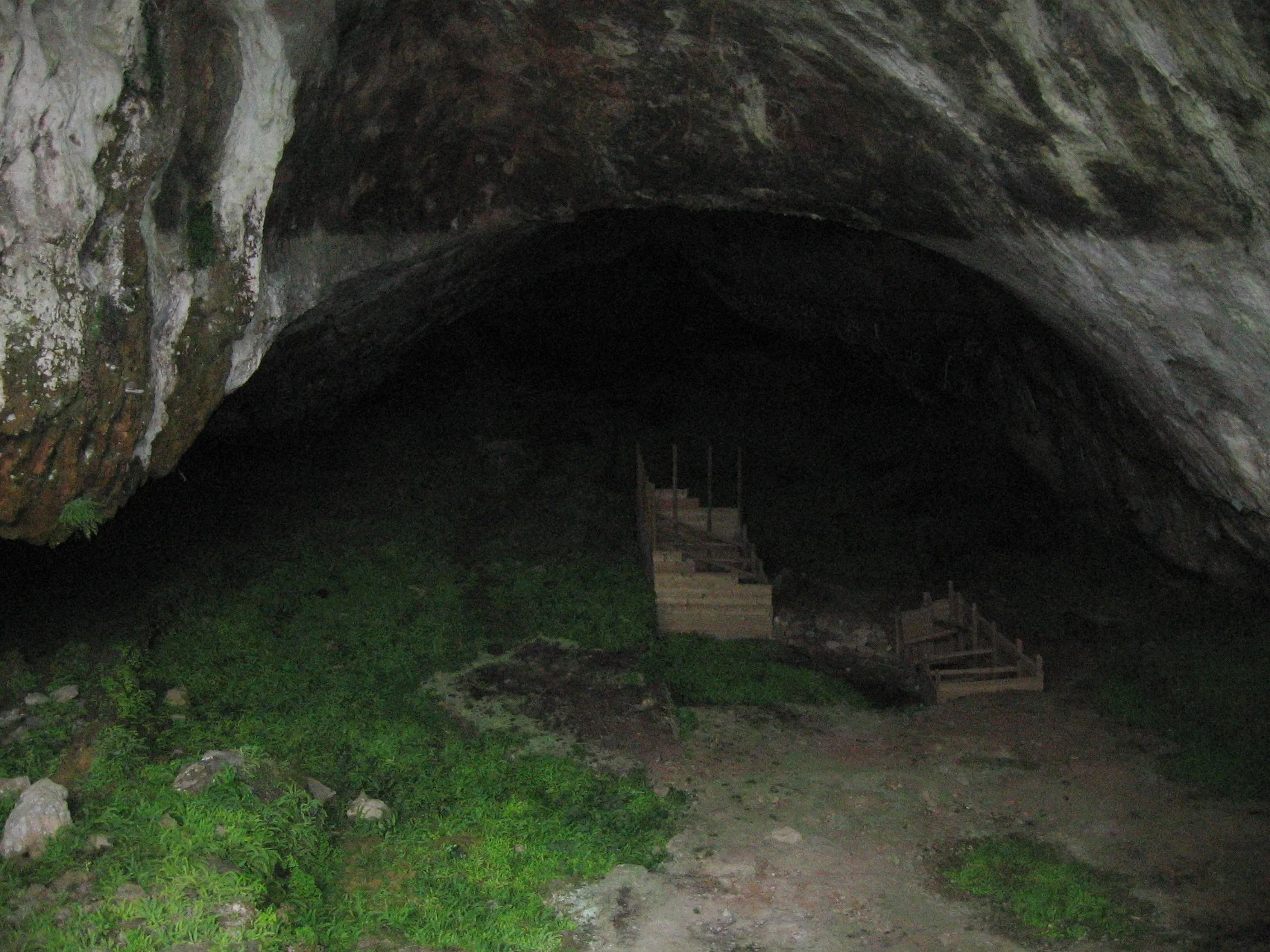
© Ebaki · CC-BY-SA-4.0 4.0 · Ebaki, CC BY-SA 4.0, via Wikimedia Commons · https://commons.wikimedia.org/wiki/File:014_Cueva_de_Arenaza_(2).jpg
Description
Morphology
The cave is mostly horizontal and is organized into several levels of medium- and large-sized galleries. The main gallery is about 20 m wide and 4 m high. The conduits described in the Galdames karst reach 100 m wide and 40 m high. In the Arañaga sector, the larger galleries lie between the 300 and 400 m elevations, reach 100 m in height and have large block chaos.
The natural part closest to the mouth is traversed over about 500 m. After that begins a zone heavily altered by mining. The entrance is high, arch-shaped, and leads to a spacious vestibule.
About 100 m from the entrance there is a hanging gallery with remains between 4000 and 7000 years BP.
Speleothems
In Galdames, stalactites, stalagmites, flowstone and gours are cited. There are also eccentric and aragonite forms.
Hydrology
The Bortal and Arañaga rivers converge at the height of Arenaza. The water emerges through the Aguas Frías spring, near San Pedro de Galdames. Before the quarry, the flow of this spring varied between 50 l/s and 3 m³/s. The underground rivers receive water from several closed high basins: Hoyo de la Buena, Hoyo Arnabal, Río Ciego, Rosario and La Jose.
Quarry activity has damaged the drainage network. The Galdames II quarry destroyed galleries, and in 2004 part of the flow already emerged inside the quarry itself. In 1992 the sector that connected the Bortal blowhole with Arenaza disappeared, and the river changed its course.
The channels located in 2017, among them part of the Arañaga river, indicate that part of the system's water flows toward the south.
Progression
The system's figures have grown in stages. In 2002 the name Atxuriaga System was given to the whole, with more than 27 km of development and 486 m of vertical extent. In 2004 more than 28 km of natural galleries and the same vertical extent were cited. In March 2017, 50,607 m and 546 m were counted, and it was the first cavity in Bizkaia to pass both 50 km and 500 m at the same time. Another source, without a date, indicates more than 59 km.
Three groups, GEV, Beti Goruntz and GAES, opened the study of the cavity; from GEV comes a first survey of about 1.5 km. The main galleries and the Bortal and Arañaga blowholes were mapped in 1992, during some UEV sessions. Since its founding at the end of 1993, the Sociedad Espeleológica Burnia has carried the weight of exploration.
Between 1994 and 1995 the SEB climbed in the Arenaza chamber and thus linked Bortal and Arenaza. In 1997 the Artekona-La Fragua traverse was completed, and in 1998 the passage between Arenaza and La Fragua was cleared.
The increase in vertical extent to 546 m is due to the most recent explorations. At the end of 2015 a short climb gave access to the República Liliputiense sector, with more than 6.5 km of new survey. In 2016 the cavities 1Mt25, 1Mt26 and 1Mt31 were connected in high zones.
These explorations have a permit from the Heritage service of the Diputación Foral de Bizkaia in the name of the archaeologist Diego Garate.
Other details
The system integrates Arenaza I, Bortal, Artekona, Fragua and Buena. It has four natural entrances: Arenaza I, La Glaja, Rosario 5 and Artekona. The quarry destroyed La Glaja. There are also artificial accesses: the Matilde II, Augusta, Impensada, Fragua and Buena mines, as well as Arenaza III and Cantera Vieja. The blowholes are cavities found by the miners. Those of Bortal, Arañaga and Graneran are reached through the Impensada, Fragua and Buena mines.
Known since 1962, the site was excavated from 1972 to 1993. At the base of the sequence there are Azilian and Mesolithic occupations; above them, the strata with pottery span from the Neolithic to historical times.
The rock art was discovered in 1973. Today 27 graphic units are recorded: 20 red paintings, 1 black and 5 engravings. Among the red ones there are 12 hinds and 1 stag. The cave has been a cultural heritage asset since 1984.
History
The Sociedad Espeleológica Burnia was constituted in December 1993, with Galdames as its main area of work. It has been the group that has explored the cave the most.
User Comments (0)
No comments yet.
Be the first to share your experience!
Registered Explorations (0)
No explorations registered yet.
Register your visit to this cave!
Nearby caves
Contains information from Grottocenter (Wikicaves), grottocenter.org, made available under the Open Database License (ODbL 1.0, https://opendatacommons.org/licenses/odbl/1-0/), modified. · https://grottocenter.org/ui/entrances/20312 · data as of 2026 · Text written by Espeleoworld from public sources. Please ask us before reusing it. · Text by UEV-EEE (Euskal Espeleologoen Elkargoa) (El Complejo Atxuriaga (Galdames) supera los 50 km), Universidad de Cantabria, Pregraphity (Arenaza I (Galdames, Bizkaia)), Sociedad Espeleológica Burnia (Memoria 2004 (incluye El Complejo Atxuriaga, artículo de Karaitza 12)), Nekatur (Arenaza Cave), Wikipedia (es) (Galdames), Wikimedia Commons (Category:Arenaza cave), Wikidata (Arenaza cave (Q12253903)), Sociedad Espeleológica Burnia (Historia) · adapted by Espeleoworld (normalized, translated); the adaptation is licensed Our own text, written from public sources. Please ask us before reusing it. · The derived data is available on request under the ODbL: [email protected]