
Cova Urbana de Tarragona
Important cavity in the very heart of the city of Tarragona, with galleries of Roman origin and large chambers, discovered by chance in 1996 during the construction of a parking garage at carrer del Gasòmetre, no. 32.
EspeleoWorld
Cova Urbana de Tarragona
Important cavity in the very heart of the city of Tarragona, with galleries of Roman origin and large chambers, discovered by chance in 1996 during the construction of a parking garage at carrer del Gasòmetre, no. 32.
Tarragona · Tarragonès
Length: 2441 m · Depth: 58 m
Updated record
https://espeleoworld.com/en/c/cova-urbana-de-tarragona
Information can change. Always verify coordinates, access, weather, and cave conditions before setting out.
Important cavity in the very heart of the city of Tarragona, with galleries of Roman origin and large chambers, discovered by chance in 1996 during the construction of a parking garage at carrer del Gasòmetre, no. 32.
Topographic
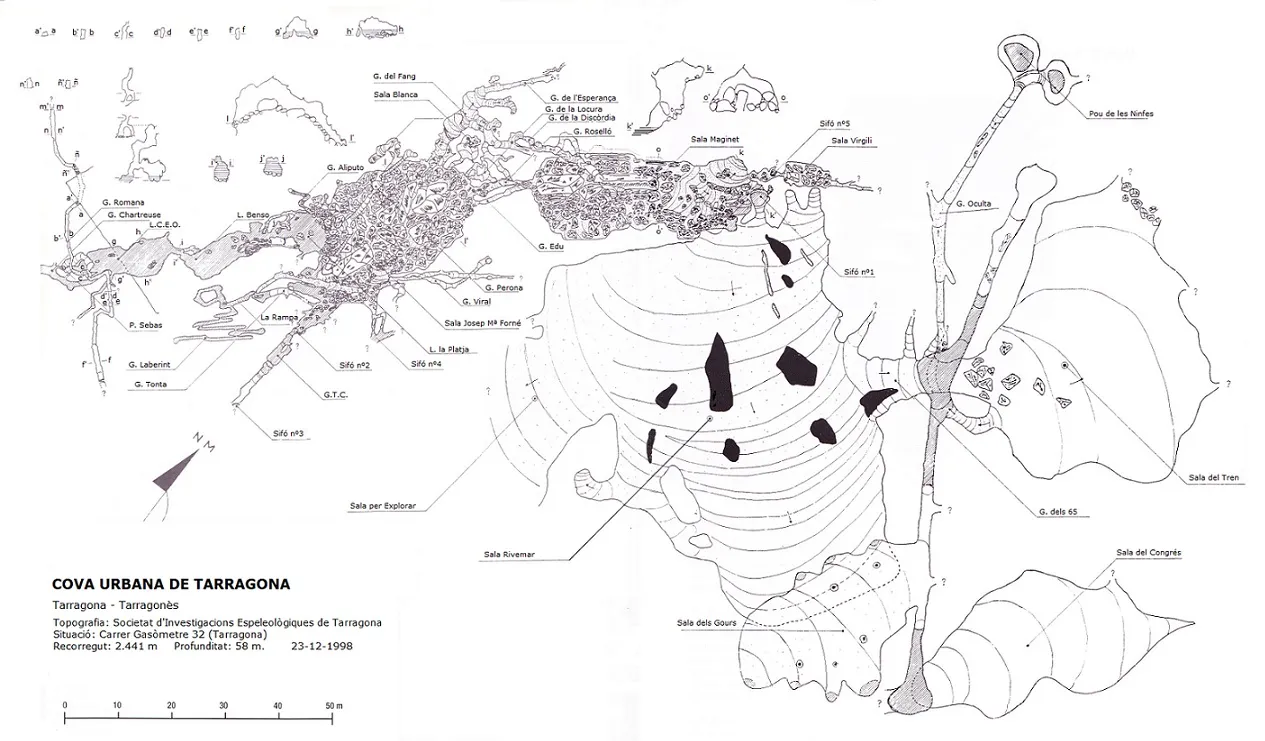
Espeleoindex · CC BY-NC 4.0, https://creativecommons.org/licenses/by-nc/4.0/ · Image © its author.
Photos
Espeleoindex · CC BY-NC 4.0, https://creativecommons.org/licenses/by-nc/4.0/ · Image © its author.
Description
Morphology
Access to the cavity is via an artificial shaft installed with iron rungs that allows one to reach the gallery excavated by the Romans. Of narrow and winding route but presenting no difficulty, it allows access through a small shaft to a room of reduced dimensions and a drop of another shaft, of 7 metres, at the base of which and through a passage of about 90 cm one reaches the Llac CEO which ends in a sumped point. Once this is passed, one enters the Sala BENSO, also of large dimensions like the previous one and which at its end presents a new sumped passage that, after passing it, one penetrates into a new lake that is no more than a beach of a gigantic room of 900 square metres, known as the Sala dels Blocs (later renamed Sala Josep Mª Forné, as a tribute to the builder who collaborated so much in the discovery and facilitated the explorations of the cave). From this chaotic and large room emerge a host of galleries: Galeria del Fang; Galeria de l'Esperança; Galeria Viral; Galeria Perona; ...
At the end of the Sala Josep Mª Forné one can access another large and chaotic room, the Sala Maginet, and at its end one of more modest dimensions, the Sala Virgili.
At the Sala Maginet, and through a lake of about 3 metres in diameter, one penetrates into the Sala Rivemar, already totally flooded. Crossing a tube of 5 metres begins a descent of about 45º until reaching 29 metres of depth. This room has a length of 85 metres and a width of 55 metres, the height oscillating between 0.75 and 4 metres.
To the right of the Sala Rivemar begins the Galeria dels 65, at about 17 metres of depth and which has a route of 30 metres. At its end and among the blocks, there is a passage that gives access to the Sala del Tren, also of considerable dimensions and where the water seems to become less turbid at the passage of the cave divers. Through the ceiling of the Galeria dels 65 and via a vertical access from – 17 to 0, one arrives through a round tube in spiral form at the Galeria de la Il·lusió, of about 50 metres of route and about 20 metres of height. From it some dry galleries branch off.
At the Galeria de la Il·lusió also begins the Galeria 3, totally submerged and with dimensions of 70 by 60 metres. Also from the Galeria de la Il·lusió one accesses the Sala dels Gours, of about 30 metres long by 10 wide and also the Galeria Oculta, with access hidden among blocks.
Hydrology
The Llac CEO ends in a sumped point. Once this is passed, one enters the Sala BENSO, which at its end presents a new sumped passage that, after passing it, one penetrates into a new lake that is no more than a beach of a gigantic room of 900 square metres.
At the Sala Maginet, and through a lake of about 3 metres in diameter, one penetrates into the Sala Rivemar, already totally flooded. At the Sala del Tren the water seems to become less turbid at the passage of the cave divers. The Galeria 3 is totally submerged.
History
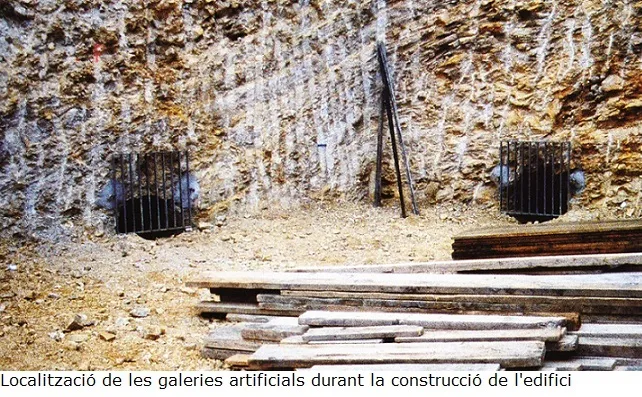
In the year 1849, in the book “Tarragona monumental” by Juan Francisco Albiñana and Andrés de Bofarull, some galleries of Roman origin are described and in which various shafts are found that end in a lake. For years the speculations of the existence of a subterranean Tarragona were being confirmed, but it was not until almost 150 years later that these galleries reappeared. By chance, on 16 November 1996, the Constructora BENSO, SA was making an excavation on the plot at carrer del Gasòmetre no. 32 for the construction of a parking garage and they came upon a shaft. After an exhaustive sweep of the plot and of the shaft, the builders descend to a depth of 12 metres and in one of the corners, two small openings appear that give access to the Roman galleries and that were recognised by members of BENSO and archaeologists, until finding a shaft of natural appearance, not excavated like the preceding galleries.
The builder gets in contact with members of the Centre Excursionista d'Olivella and on 22 November 1996 the explorations begin and they reach the first lake. Five days later they manage to pass the first sumped passage, accessing the Sala BENSO and that of the Blocs. During the following weeks exploration of new galleries continues until the Sala Maginet. Given the magnitude of the discovery, on 15 December 1996 it is decided to give the news to the press. Around these dates three members of the Societat d'Investigacions Espeleològiques de Tarragona (SIET) join the team, where, some time later, the members of the CE Olivella would be integrated, carrying out the following explorations and control of the cavity under these initials.
User Comments (0)
No comments yet.
Be the first to share your experience!
Registered Explorations (0)
No explorations registered yet.
Register your visit to this cave!
Bibliography
- Cabezas, A. (1999).- “Cova urbana de Tarragona. Espeleología bajo cemento y asfalto”. Subterránea (12): 16-23. Fed. Española Espeleología. Barcelona.
- Ferrer, Victor (2011).-La Cova Urbana de Tarragona - Catalunya. 60 pp. + video. Edició de l'autor.
- SIET (2001).- La Cova Urbana de Tarragona. Arola Editors: 107 pp. Tarragona.
- Fotografies extretes i cedides per Marcos Carbó (CE Dinàmics, Sant Carles de la Ràpita) del seu àlbum de Google.
Nearby caves


Source: Espeleoindex (espeleoindex.com), modified. CC BY-NC 4.0, https://creativecommons.org/licenses/by-nc/4.0/