
Cova dels Mongons
Petita cova semi-artificial i d'interès històric a Tarragona
EspeleoWorld
Cova dels Mongons
Petita cova semi-artificial i d'interès històric a Tarragona
Tarragona · Tarragonès
Length: 20 m
Updated record
https://espeleoworld.com/en/c/cova-dels-mongons
Information can change. Always verify coordinates, access, weather, and cave conditions before setting out.
Small semi-artificial cave of historical interest in Tarragona, formed by two cavities joined by an artificial gallery.
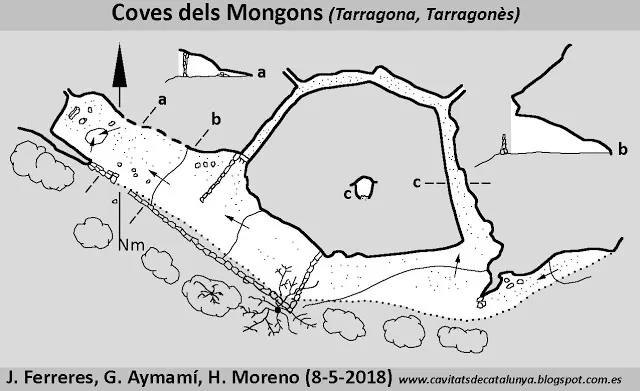
Topographic
Espeleoindex · CC BY-NC 4.0, https://creativecommons.org/licenses/by-nc/4.0/ · Image © its author.
Photos
Espeleoindex · CC BY-NC 4.0, https://creativecommons.org/licenses/by-nc/4.0/ · Image © its author.
Description
Morphology
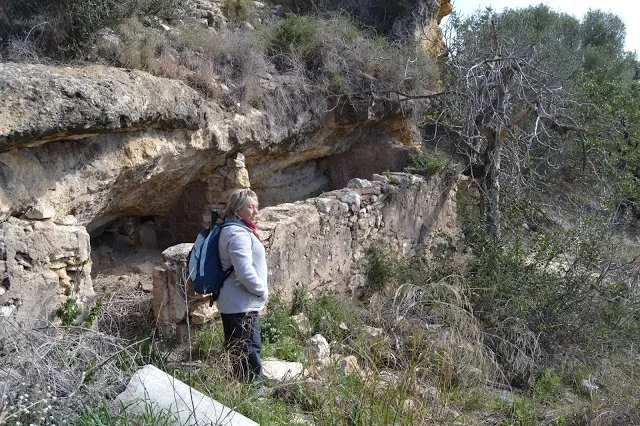
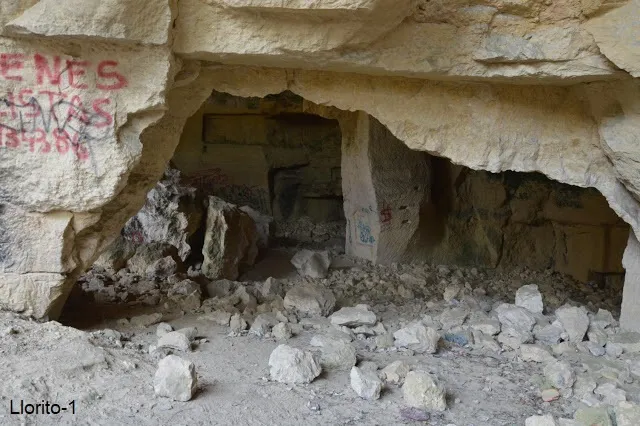
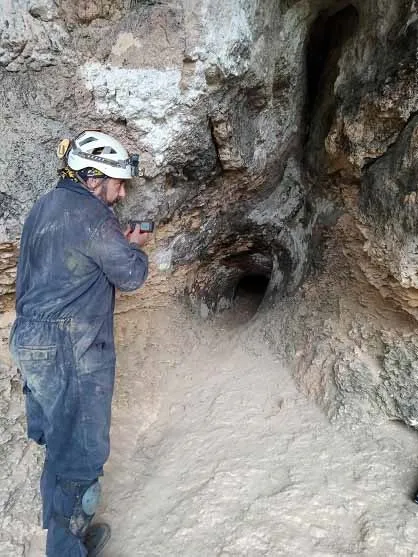
These are two cavities, located one beside the other, which together measure about 10 metres of frontage by about 2 metres of depth. At the front and on the side they are closed by stone walls and, as a curious note, they are also joined inside by an artificial gallery about 16 metres long, less than one metre high and about 80 cm wide.
History
Known since time immemorial. We are in front of an abandoned village, which began to be depopulated in the mid-16th century, of which very few vestiges remain; one of them is the church of Sant Julià, which had the functions of a parish church. It is mentioned as early as the 15th century, although it is believed, because of its structure, that its construction may date back to the end of the 13th century. At present it presents a rather desolate appearance, with the interior all broken and burnt; for a time it had been used as a dwelling. We also find, on the plateau of a nearby small hill, some walls of what had been a fortress of rectangular plan, which from the construction technique is dated to around the year 1000. In this deserted village, already mentioned in a donation deed of the year 1149, these caves should be highlighted, which together with other dwellings made up the village, although they were later used to keep small livestock.
User Comments (0)
No comments yet.
Be the first to share your experience!
Registered Explorations (0)
No explorations registered yet.
Register your visit to this cave!
Bibliography
- Catalunya Romànica, vol XXI. Enciclopèdia Catalana. Barcelona. 1995
- Totes les dades, topografia i fotografies han estat extretes del blog: cavitatsdecatalunya.blogspot (de Jordi de Valles). Apunt del 2-7-2018. Dades: Genar Aymamí (EC Barcelonès)
Nearby caves


Source: Espeleoindex (espeleoindex.com), modified. CC BY-NC 4.0, https://creativecommons.org/licenses/by-nc/4.0/