
Cova dels Gorgs del Borró
Temporary spring 50 m long in Sales de Llierca (Garrotxa), with a vertical entrance almost 3 m high, a low passage with a pool at 28 m and a final sump; documented speleologically in November 2024.
EspeleoWorld
Cova dels Gorgs del Borró
Temporary spring 50 m long in Sales de Llierca (Garrotxa), with a vertical entrance almost 3 m high, a low passage with a pool at 28 m and a final sump; documented speleologically in November 2024.
Sales de Llierca · Garrotxa
Length: 50 m
Updated record
https://espeleoworld.com/en/c/cova-del-fang
Information can change. Always verify coordinates, access, weather, and cave conditions before setting out.
Temporary spring 50 m long in Sales de Llierca (Garrotxa), with a vertical entrance almost 3 m high, a low passage with a pool at 28 m and a final sump; documented speleologically in November 2024.
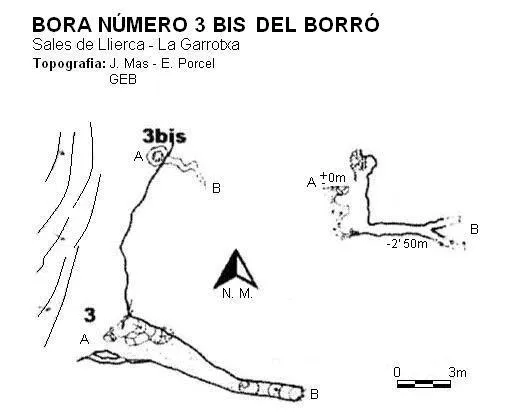
Topographic

Espeleoindex · CC BY-NC 4.0, https://creativecommons.org/licenses/by-nc/4.0/ · Image © its author.
Photos
Espeleoindex · CC BY-NC 4.0, https://creativecommons.org/licenses/by-nc/4.0/ · Image © its author.
Description
Morphology
The entrance, vertical and almost 3 m high, gives way to a comfortable gallery, slightly sinuous and with a clear morphology of an underground watercourse, including pebbles on the floor. At 28 m of passage the ceiling suddenly lowers and we find a low passage that coincides with a pool of water over which we must pass almost crawling. A slightly wider gallery follows, though no higher, with a little mud and sediment. Suddenly it turns to the right and we find the sump, a pool of transparent water, not very wide but deep, where the continuation of the cavity can be glimpsed beneath the water.
The cave has a second entrance, 'boca sud', located a few metres from the main one.
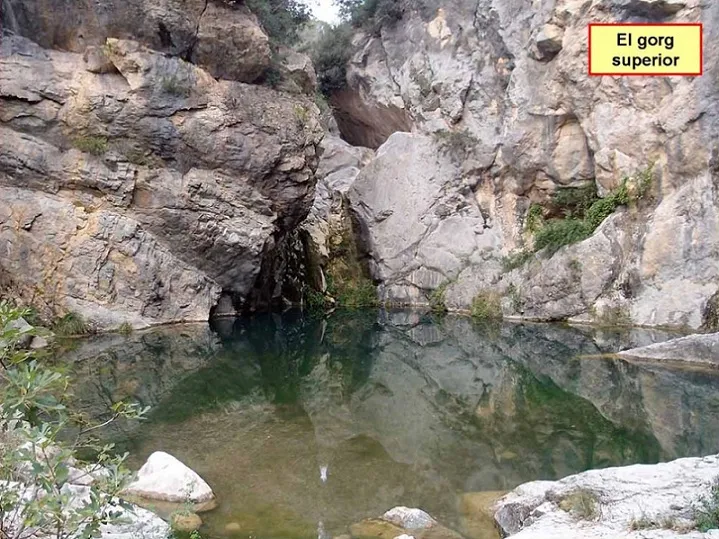
The cave is an important temporary spring. The entrance opens at the base of a thick limestone bar that dips about 30 degrees to the south and that is also responsible for the origin of the rock cirque and the waterfall of the fourth plunge pool. Undoubtedly, the cave drains the underground waters that circulate through the limestone bar coming from the eastern slope of the Borró.
Hydrology
The cave is an important temporary spring. Although we have no data on the frequency with which the cavity acts as a spring, the presence of a fairly extensive stretch of moss-covered stones starting from the entrance allows us to deduce that the flow that springs forth can become significant and that, very probably, it does so after rains of some importance. In these cases, the sump overflows and the water circulates freely through the cavity until it springs outside. We do not know whether the level of the sump can drop or even disappear in times of drought.
On our visit the pool had a maximum depth of about 40 cm (it had rained on previous days).
Progression
At 28 m of passage the ceiling suddenly lowers and we find a low passage that coincides with a pool of water over which we must pass almost crawling. Suddenly it turns to the right and we find the sump, a pool of transparent water, not very wide but deep, where the continuation of the cavity can be glimpsed beneath the water.
History
The cave is very little known, even to the local people. Only some woodcutter or hunter knows it and little more. News of its existence reached the ears of Albert Sancho, a Barcelona man who has lived in Olot for many years, a great connoisseur and lover of the mountains of Alta Garrotxa.
Having some data on the situation of the cave, in July 2024 he went to locate it together with his friend Manel. They found it and explored it until reaching the low passage where the pool is, which in those summer days was without water but with a lot of mud.
That being so, Albert Sancho got in touch with us in October, dates when we were finishing a speleological research campaign in the mountains located between Olot and Banyoles. Without knowing us previously, we met in Olot on 2 November 2024. Together with his friend Albert Sala, from Sant Joan les Fonts, all four of us went to the cave and carried out the study.
Our surprise was to see that at the entrance of the cave the initials 'GIEG' were marked in paint together with the date 'febrer-96'. The GIEG is the group of speleologists of the Agrupació Excursionista de Granollers. Everything seems to indicate that we were not the first speleologists to enter the cave, but, be that as it may and for whatever reason, the speleologists who had preceded us never made the find known and the cavity continued speleologically unpublished until November 2024, not appearing in any catalogue, publication or review in the speleological field.
User Comments (0)
No comments yet.
Be the first to share your experience!
Registered Explorations (0)
No explorations registered yet.
Register your visit to this cave!
Bibliography
Totes les dades, topografia i fotografies han estat extretes del web: geb.cat (del Grup d'Espeleologia de Badalona). Apunt de l'11-11-2024. Dades: Ferran Cardona (ECM Barcelonès), Josep Cuenca (GE Badalona), Albert Sancho (Olot) i Albert Sala (Sant Joan les Fonts)
Nearby caves


Source: Espeleoindex (espeleoindex.com), modified. CC BY-NC 4.0, https://creativecommons.org/licenses/by-nc/4.0/