
Cova de Santa Magdalena
Cave in the Serra de Godall (Ulldecona) with a 56 m route and archaeological interest, featuring an anthropomorphic halteriform engraving.
EspeleoWorld
Cova de Santa Magdalena
Cave in the Serra de Godall (Ulldecona) with a 56 m route and archaeological interest, featuring an anthropomorphic halteriform engraving.
Ulldecona · Montsià
Length: 56 m · Depth: 8 m
Updated record
https://espeleoworld.com/en/c/cova-de-santa-magdalena
Information can change. Always verify coordinates, access, weather, and cave conditions before setting out.
Cave in the Serra de Godall (Ulldecona) with a 56 m route and archaeological interest, featuring an anthropomorphic halteriform engraving.
Topographic
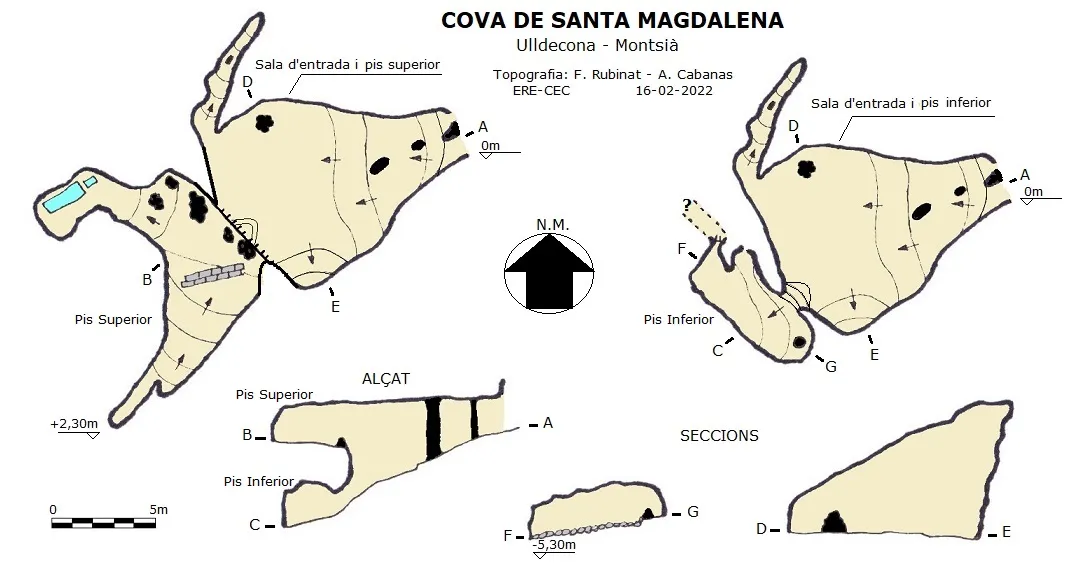
Espeleoindex · CC BY-NC 4.0, https://creativecommons.org/licenses/by-nc/4.0/ · Image © its author.
Photos
Espeleoindex · CC BY-NC 4.0, https://creativecommons.org/licenses/by-nc/4.0/ · Image © its author.
Description
Morphology
Once past the entrance mouth one enters a chamber of good dimensions. From the right side of the hall a small passage of short length emerges, while on the left side we find some stone steps that go up to the upper part of the stalagmitic flow. The height difference of the cavity is 7.6 metres (-5.3/+2.3), and the route is currently 56 metres.
Speleothems
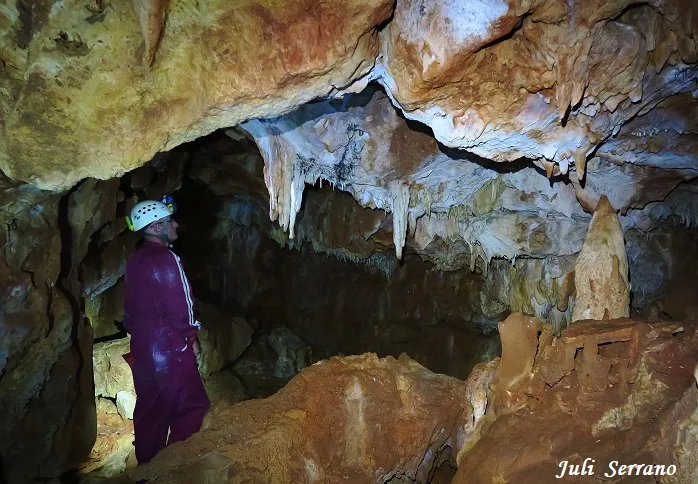
The walls of the entrance chamber are covered by different lithogenic forms, especially parietal flows. On the lower floor there are some formations.
Progression
In the lowest part on the right we find a narrow passage that gives access to a gallery that we have not been able to explore for lack of suitable equipment, and we do not know whether it has much length.
Other details
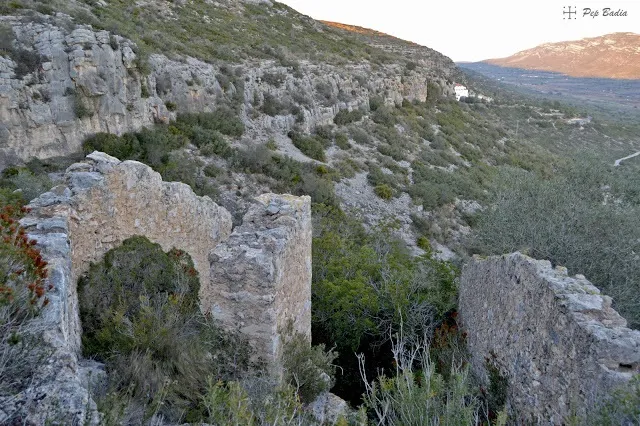
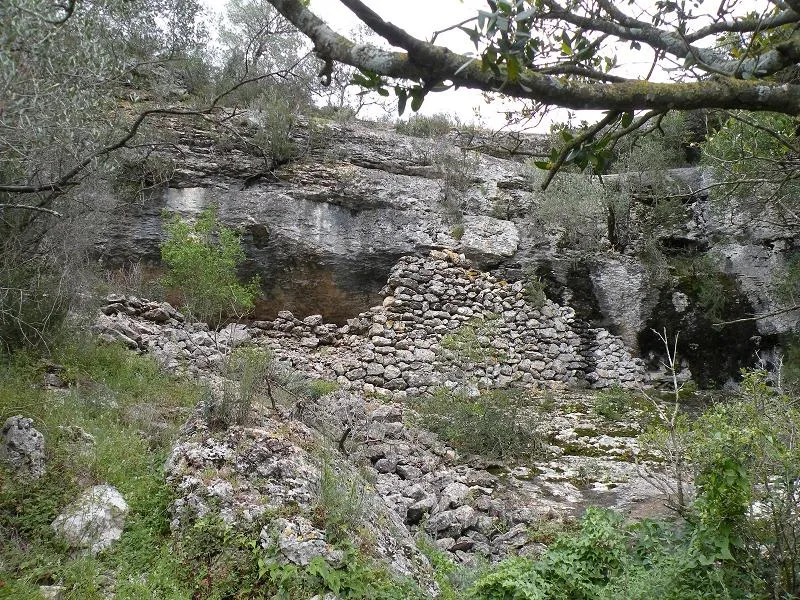
The most interesting feature of the cavity is the presence of an anthropomorphic halteriform engraving on one of the flows shortly after entering. This engraving (28 cm in height and 31 cm in length) is formed by two circles joined by a vertical axis; two horizontally engraved lines cross this axis and each end of these two lines has five more strokes. In this cave some fragments of hand-made pottery with a carinated profile were found, belonging to the Bronze Age. On the upper floor of the cave there are still remains of walls and some stone vats placed to collect water from the filtrations.
History
Known since time immemorial.
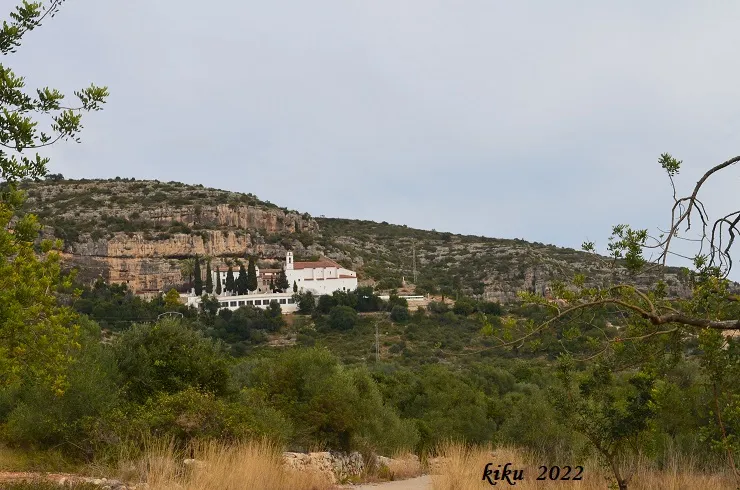
In 1699, the Valencian Romualdo Simón de Pallarès, knight of the order of the Hospitallers of Jerusalem and commander of Ulldecona and Amposta, decided to spend the last years of his life in the cave, ordering an ermita to be built on that spot, where the cavity was to serve as a chapel. Little eremitic life could he lead, since he died in 1704 and it seems that the works were never completed.
In 1965, at the start of the activities of the Grup Espeleològic d'Ulldecona, the Cova de Santa Magdalena was one of its objectives. They discovered the halteriform engraving and we do not know whether they came to survey the cave.
User Comments (0)
No comments yet.
Be the first to share your experience!
Registered Explorations (0)
No explorations registered yet.
Register your visit to this cave!
Bibliography
- Genera i Monells, Margarida.- “El gravat halteriforme”. Rails, 9-15 (en línia)1993,núm.1,p.9,https:raco.cat/index.php/Rails/article/view/26607
- Viñas, Ramon; Romeu, Joaquím; Romeu, Josep (1979).- “Un grabado de halteriforme antropomorfo en la cueva de Santa Magdalena (Ulldecona – Tarragona)”. Caesaraugusta (49-50): 213-222. Institución Fernando el Católico. Zaragoza.
- Altres dades, coordenades i fotografies extretes del blog: senderes.blogspot (de Pep Badia, la Ràpita). Inclou ruta de wikiloc
- Dades, topografia i fotos facilitades per Arcadia Cabanas i Francesc Rubinat (ERE del CEC) actualitzat el febrer de 2022.
Nearby caves


Source: Espeleoindex (espeleoindex.com), modified. CC BY-NC 4.0, https://creativecommons.org/licenses/by-nc/4.0/