
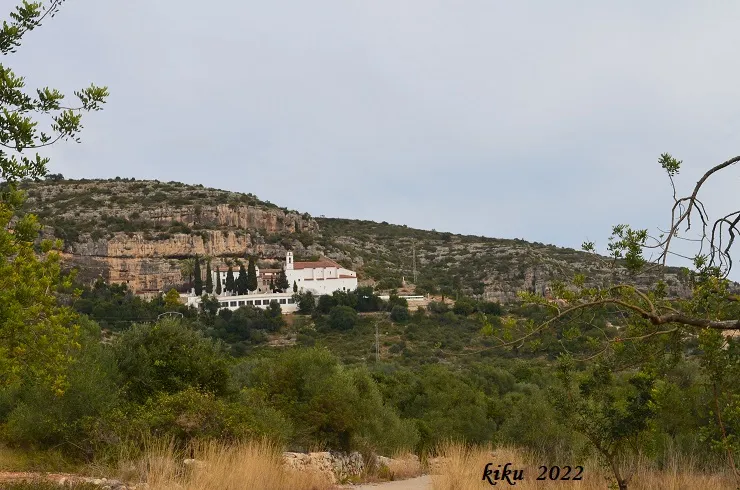
Abrics d'Ermites de la Pietat
A group of shelters of archaeological interest in Ulldecona (Montsià), with rock paintings of the Levantine style.
EspeleoWorld
Abrics d'Ermites de la Pietat
A group of shelters of archaeological interest in Ulldecona (Montsià), with rock paintings of the Levantine style.
Ulldecona · Montsià
Length: 10 m
Updated record
https://espeleoworld.com/en/c/abrics-d-ermites-de-la-pietat
Information can change. Always verify coordinates, access, weather, and cave conditions before setting out.
A group of shelters of archaeological interest in Ulldecona (Montsià), with rock paintings of the Levantine style.
Topographic
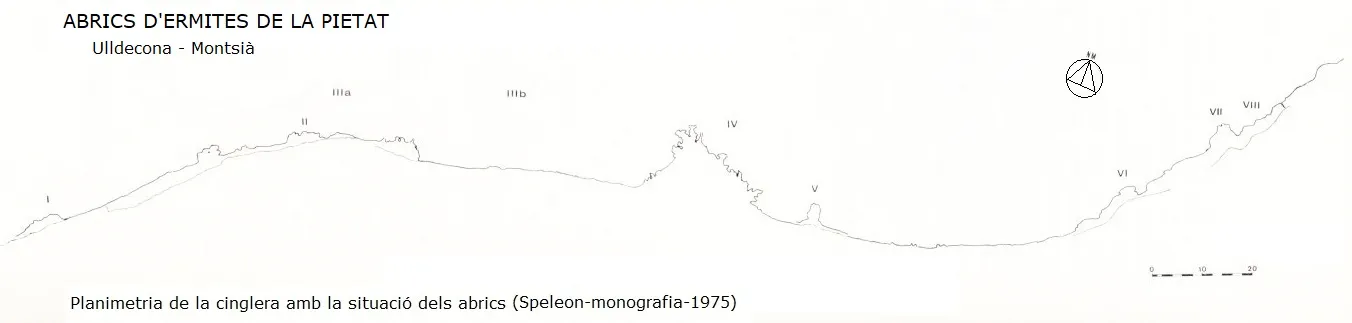
Espeleoindex · CC BY-NC 4.0, https://creativecommons.org/licenses/by-nc/4.0/ · Image © its author.
Photos
Espeleoindex · CC BY-NC 4.0, https://creativecommons.org/licenses/by-nc/4.0/ · Image © its author.
Description
Morphology
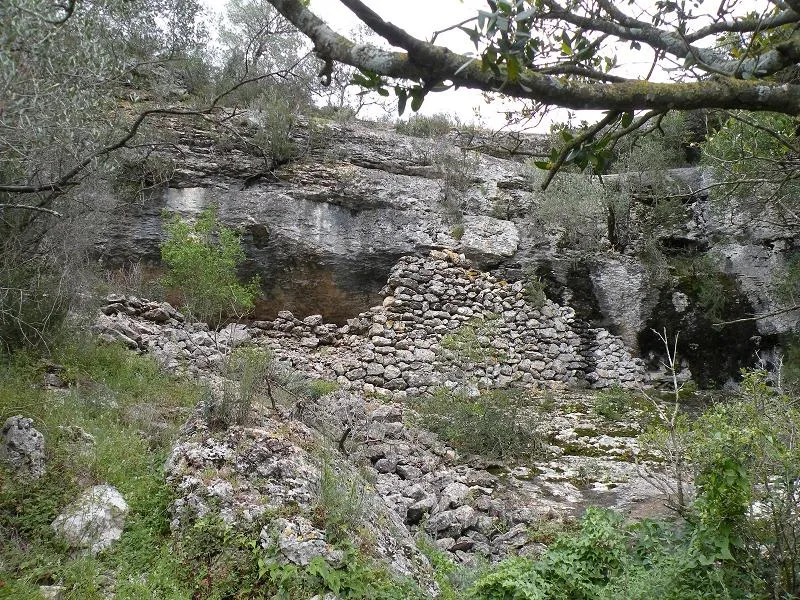
The group of painted shelters opens beneath a bedding plane along some 500 metres, in a stratum of softer fossiliferous limestone materials, which has created a line of concavities of erosive origin in which the climate, the runoff waters and the underground waters have played one of the main roles.
Abric I: at present it is reached through a metal platform with stairs. The cavity opens 4/5 metres from the base of the cliff and measures 7 metres in length, between 1.40 and 2 metres in depth and between 1 and 1.50 metres in height. The wall is almost non-existent and is formed by a whole series of stepped unevennesses, inclined towards the interior, with alveolar-type cavities.
Abric II: the cavity opens 4 metres from the base of the cliff, and its dimensions are 7 metres in length, between 1.50 and 2 metres in depth and between 1 and 1.50 metres in height. The irregularity and scant surface of the wall suggests the choice of the ceiling for the making of the frieze. The paintings occupy the central and inner part of it, with a length of 2.67 metres and a height of between 1 and 1.40 metres from the floor.
Abric III: subdivided as IIIa and IIIb. They have a length of some 11 metres, they have little height and the rock is highly altered, particularly the inclined ceiling which is moreover covered by a vegetal layer and micro calcareous formations.
Abric IV or COVA FOSCA: unlike the rest of the shelters that open in an upper stratum, this one opens at the base of the cliff and its dimensions are 20 metres in width at the mouth, 10 metres maximum depth and 8 metres maximum height.
Abric V: the cavity, located 7 metres above the base of the cliff, is 2.50 metres maximum width at the mouth, 3 metres in depth and 1.50 metres average height, and is accessible by means of a ladder.
Abric VI: this shelter is oriented facing the Santuari, its length is 10 metres and its average height one metre.
Abric VII: some 20 metres from Abric VI are located the last two shelters (VII and VIII), separated by some 2 metres. This first one is some 6 metres in length by 1 metre average height.
Abric VIII: it is the closest to the Santuari, it is a wall covered by an overhang of the upper stratum some 8 metres in length.
Speleothems
Abric II has a highly deteriorated ceiling due to the lithogenic configuration of the rock and the support is disintegrated and covered by micro calcareous formations and organic matter that affect all the paintings.
Abric V has a floor formed by a layer of shiny concretion, polished in some points, and the ceiling is covered by a black layer of concretion and organic matter that eclipses two thirds of the surface, affecting the figures.
Abric VI has its ceiling totally darkened by smoke and organic matter; in the NE sector of the ceiling, almost on the exterior, two stylised human figures of a dark red colour can be glimpsed beneath the micro formations.
Hydrology
The climate, the runoff waters and the underground waters have played one of the main roles in the creation of the line of concavities of erosive origin.
Progression
At present Abric I is reached through a metal platform with stairs. Abric V is accessible by means of a ladder.
Other details
Abric I: the paintings occupied practically the whole profile of the cavity, from the base to the ceiling, but at present only a small part of the frieze is preserved. The main theme of this one is hunting scenes, centred on a group of deer and some goats made at different times, as demonstrated by the different styles and superimpositions. In total 170 figures have been documented, corresponding to human figures (archers, indeterminate ones, female figures), deer, bows and arrows, quadrupeds, bucks, goats, bovids, possible canids, etc. The colour of the pictographs ranges from dark chestnut-red to dark reddish-chestnut and blackened. Flat wash and simple stroke predominate, although there are also figures with punctiform technique and silhouetted. As for the style, the naturalistic is combined with the semi-schematic.
Abric II: the pictorial ensemble represents small groups of hunters. In total 25 figures have been documented corresponding to archers, arrows, indeterminate animals and remains of pigment, of semi-schematic-naturalistic style. The colour of the pictographs ranges from dark reddish-chestnut to dark chestnut and combines the technique of simple stroke and flat wash.
Abric IV or COVA FOSCA: in total there are 47 documented figures, they are grouped in two facing panels, each at one end of the mouth (north zone, right wall and south zone, left wall). In both panels an ochre pasty substance is observed, on the support or the paintings, which totally covered the frieze of the north zone and partially that of the south zone. The detachment of this ochre layer at some points of the north zone has allowed the partial viewing of the figures. In the group of the south zone, the layer reaches the right limit covering some paintings, of which some fragment is observed. Most of the Ermites shelters present a similar theme and style, which belongs to the post-Palaeolithic naturalistic-stylised ensemble or "Levantine" style.
Abric V: the floor demonstrates the use of this place by people and animals. The walls show advanced erosion. The figures are only visible at the points least affected by the organisms and where the rock shows its clearest tone. For the most part, the paintings visible today occupy the outermost part of the ceiling, although there are also remains at the back and on the degraded inner walls, some 50 cm from the floor, revealing that the paintings occupied a large part of the cavity. 66 figures have been documented that make up different scenes. One of the main scenes is formed by a group of horses going from left to right in a descending direction towards the interior of the cavity. With this scene various figures of archers and some goat are linked. Other compositions, at present half lost, are made up of indeterminate animals and goats related to archers. In other zones remains of other particular scenes are observed, basically made up of human figures.
Abric VI: on the walls some stains of paint without a determined shape are observed.
Abric VII: like all of them, the ceiling is altered but in it some paintings are preserved, among which stands out an archer of dark red colour of naturalistic style. He wears a headdress, possibly of feathers, and is in a position to shoot the bow. To the left of the Abric various remains are located where a possible goat can be distinguished.
Abric VIII: the best preserved figures are those located at the highest place. An archer on the lookout holds the bow and the arrows with his left hand. He wears feathers on his legs and a bag with pendants on his back. On his head he must have worn a headdress or cap, but in this place the paint has not been preserved. Below this figure, on the right, there is a short-horned goat, and further to the right there is another one in a very poor state of conservation. 1 metre from the ground to the left of this group the rear part of a possible deer is observed. Further below, at 1 metre, another goat is seen that heads another group where small figures predominate (archers and a possible fox with its tail raised). 1 metre from the ground, below the deer of the upper group, a stylised archer with thick legs and a triangular head is seen, in a poor state of conservation.
History
These cavities were always known and Abric IV or Cova Fonda as it was known, used to keep the flocks.
Dr. Esteve Gálvez apparently had already observed these paintings of the Cova Fonda in the year 1950 during the archaeological explorations he had carried out in the region.
The first paintings were discovered by Joan Ruiz, of the children's group of the Centre Cultural Recreatiu d'Ulldecona, during an excursion through the Serra de la Pietat on 31 March 1975 (this find would correspond to Abric V); he later commented it to J. M. Querol and Joaquim Virgili of the Grup Espeleològic del CCRU, who went to the indicated place to verify it. After a month, on 27 April Josep and Joaquim Romeu of the same speleological group began the prospections, locating that same day two new cavities with paintings. These, interested in the study of these paintings, sought the collaboration of other groups, forming a team made up of Ramon Viñas, Miquel Domènec, Joaquim Romeu, Josep Romeu, Ramon Ten, Mª Lluïsa Mora, Maria Canals, Consuelo Martin and Domingo Campillo, with the collaboration also of Joan Ruiz, J.M. Querol and Joaquim Virgili.
In the year 2005 the Centre d'Interpretació d'Art Rupestre Abrics de l'Ermita (Ulldecona, Montsià) was created by the Museu d'Arqueologia de Catalunya, located at the same Ermita de la Pietat, right beside the shelters.
User Comments (0)
No comments yet.
Be the first to share your experience!
Registered Explorations (0)
No explorations registered yet.
Register your visit to this cave!
Bibliography
- Grup Espeleològic d'Ulldecona del CCR; Equip de Recerques Espeleològiques del CEC; Espeleo-Club de Sabadell del UES (1975).-L'Art Prehistòric d'Ulldecona pp:1-51. Centre Excursionista de Catalunya. Barcelona.
- Viñas, Ramon; Domènec, Miquel; Romeu, Joaquim; Romeu, Josep; Ten, Ramón; Mora, Mª Lluïsa; Canals, Maria; Martin, Consuelo; Campillo, Domingo. (1975).-”El conjunto rupestre de la Serra de la Pietat. Ulldecona-Tarragona”. Speleon (monografia I):115-151. Centre Excursionista de Catalunya. Barcelona.
- Invarque.cultura.gencat.cat
- L'accés és restringit i les visites són guiades, per a més informació:
http://www.rutadelartrupestre.cat/Centres-d-interpretacio/Centre-d-Interpretacio-d-Art-Rupestre-Els-Abrics-de-l-Ermita/Els-Abrics-de-l-Ermita-Informacio-practica
Nearby caves
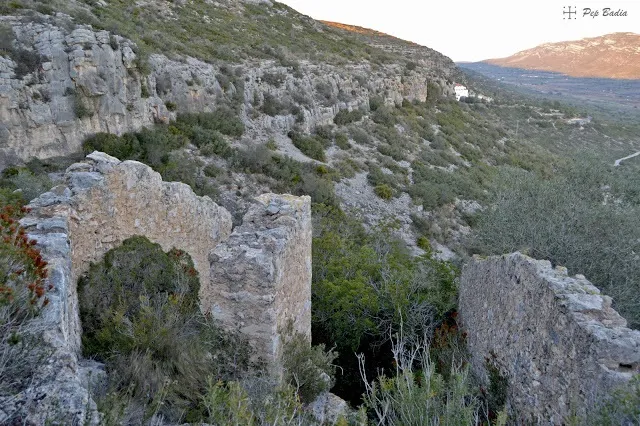
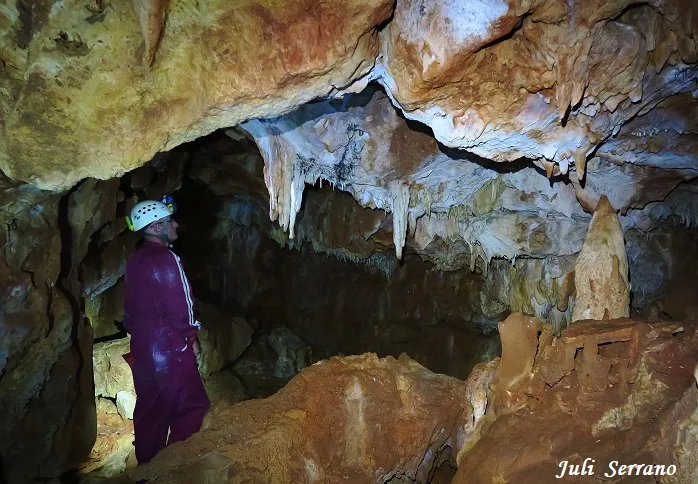


Source: Espeleoindex (espeleoindex.com), modified. CC BY-NC 4.0, https://creativecommons.org/licenses/by-nc/4.0/