
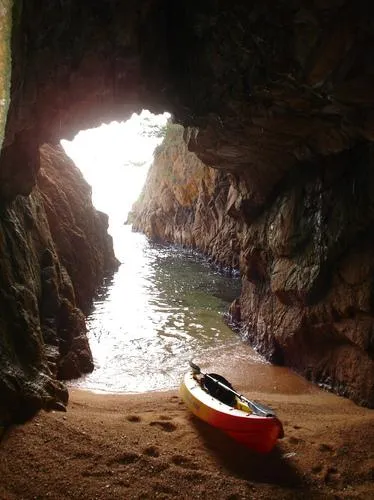
Cova de les Rates Penades
A 41 m-long sea cave in Sant Feliu de Guíxols (Baix Empordà), known for its bat colony. Includes surveys, history and biology.
EspeleoWorld
Cova de les Rates Penades
A 41 m-long sea cave in Sant Feliu de Guíxols (Baix Empordà), known for its bat colony. Includes surveys, history and biology.
Sant Feliu de Guíxols · Baix Empordà
Length: 41 m · Depth: 3 m
Updated record
https://espeleoworld.com/en/c/cova-de-les-rates-penades
Information can change. Always verify coordinates, access, weather, and cave conditions before setting out.
A 41 m-long sea cave in Sant Feliu de Guíxols (Baix Empordà), known for its bat colony. Includes surveys, history and biology.
Topographic
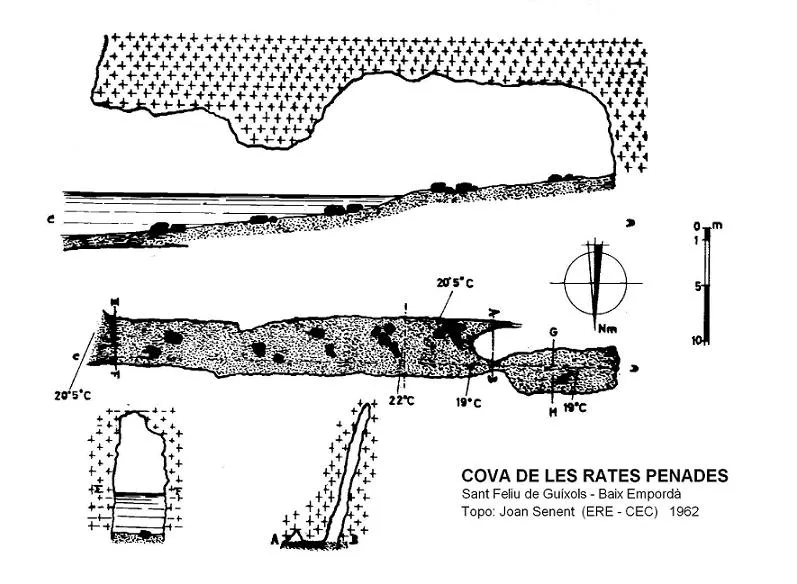

Espeleoindex · CC BY-NC 4.0, https://creativecommons.org/licenses/by-nc/4.0/ · Image © its author.
Photos

Espeleoindex · CC BY-NC 4.0, https://creativecommons.org/licenses/by-nc/4.0/ · Image © its author.
Description
Morphology
The entrance porch is of medium size, 6 metres high by about 4 wide. The gallery continues in a slightly ascending sand ramp about 25 metres long. At its end, a narrow fissure, often buried by the sand, allows one to penetrate into a chamber 9 metres long, 3 wide and about 8 metres high.
The two surveys, made over a span of 36 years, should be compared to observe the differences in the sea water level due to the sedimentation of sand at the entrance of the main gallery, something Senent (1963) had already observed over the course of five years.
Senent (1963) also observes that the cavity originates from the action of the sea on the granite mass itself, taking advantage of a diaclase with direction E20N located in a zone of crushed granite and, unlike other coastal cavities that have also been originated by the action of the sea, but on intrusive dykes, generally of lamprophyres.
Hydrology
At present the sea water penetrates a few metres and in this stretch it is only one metre deep.
History
Known to fishermen since time immemorial. The first written mention corresponds to Faura, who mentions it in 1923 in the memoir of the sheet of the Servei Geològic de Catalunya corresponding to Sant Feliu de Guíxols. Although at the beginning of the 20th century some postcards of the cavity had already been published.
The first specific details about the cavity are not published until 1963.
Collado and Sandoval (1999) say that the most appropriate name would be Cova de les Rates Pinyades (ratapinyades would be the most correct), which is what appeared on the old postcards and what the people of the area say. We have really seen it written in every possible way.
Bio
The name of the cavity already indicates explicitly enough that inside it there is an important colony (perhaps now not so much) of bats.
Senent (1963) indicates that at times it could exceed 500 individuals, especially of Miniopterus schreibersi, characterised by its long-distance migrations. The cavity could represent a midway point of the journey between the cavities near Barcelona (Avenc del Daví, etc.) and the caves of S France.
He also says that on one occasion he was able to see a specimen of Myotis myotis.
User Comments (0)
No comments yet.
Be the first to share your experience!
Registered Explorations (0)
No explorations registered yet.
Register your visit to this cave!
Bibliography
- Collado, Mª A.; Sandoval, J. (1999).- “Catàleg de cavitats de Sant Feliu de Guíxols”. Excursionisme (274): 35-48. Unió Excursionista de Catalunya. Barcelona.
- Senent, J. (1963).- “La 'Cova de les Rates Penades' en la Costa Brava” Montaña (88): 487-491. Centre Excursionista de Catalunya. Barcelona.
- Coordenades i fotografia extretes de Panoramio (Google Earth) autor: Yersi.
Nearby caves
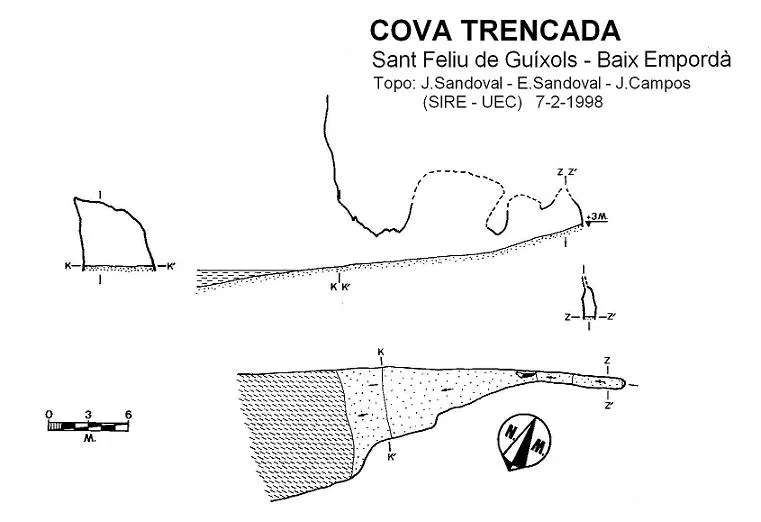
Cova Trencada
0.0 km · S
Sant Feliu de Guíxols (Baix Empordà)
1 topo.
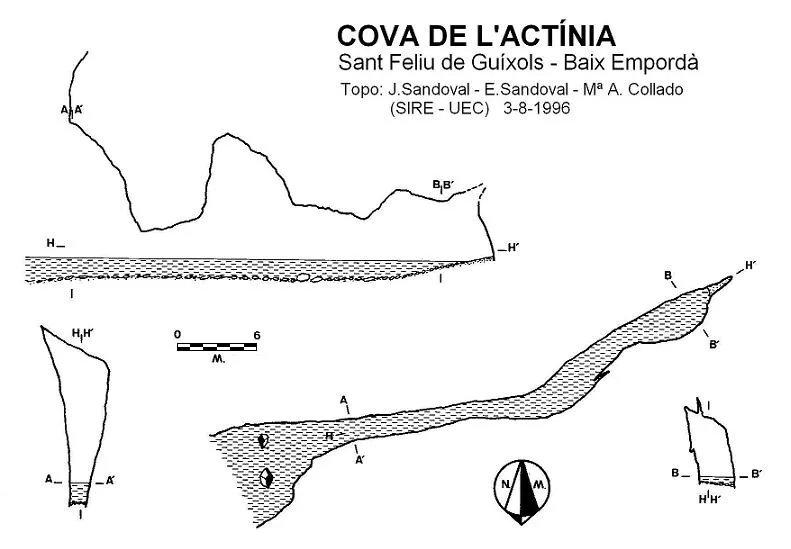
Cova de l'Actínia
0.0 km · N
Sant Feliu de Guíxols (Baix Empordà)
1 topo.
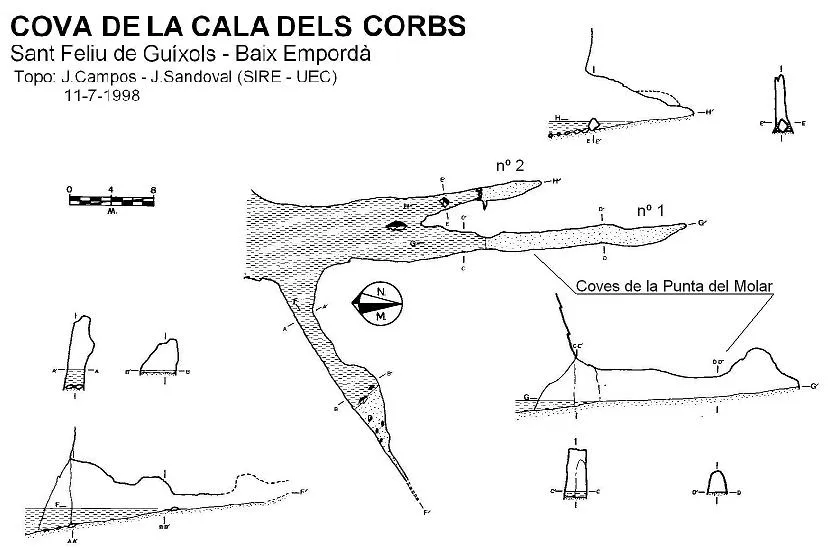
Cova de la Cala dels Corbs
0.1 km · S
Sant Feliu de Guíxols (Baix Empordà)
1 topo.
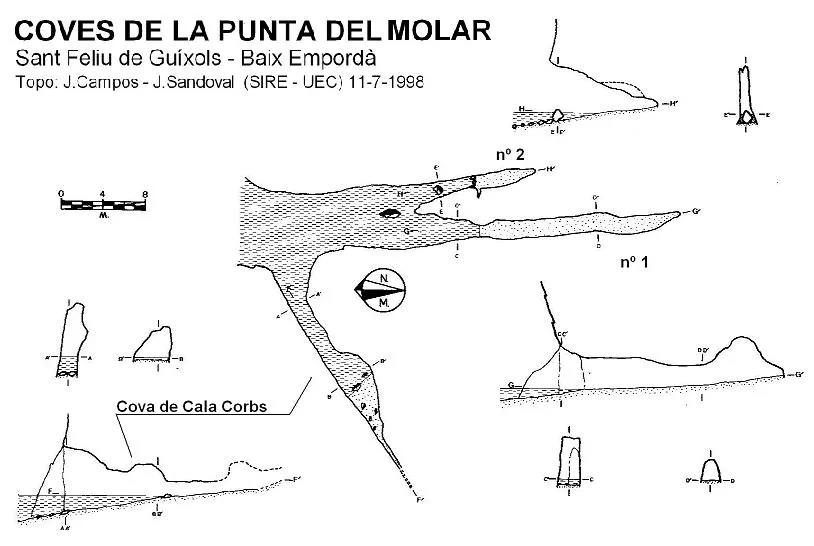
Coves de la Punta del Molar
0.1 km · S
Sant Feliu de Guíxols (Baix Empordà)
2 topo.
Source: Espeleoindex (espeleoindex.com), modified. CC BY-NC 4.0, https://creativecommons.org/licenses/by-nc/4.0/