
Cort Fosca de Matarrodona
A 125 m long cave in the Serra de l'Obac, on the hill of Pujol de Matarrodona, known since time immemorial and used as a shelter.
EspeleoWorld
Cort Fosca de Matarrodona
A 125 m long cave in the Serra de l'Obac, on the hill of Pujol de Matarrodona, known since time immemorial and used as a shelter.
Mura · Bages
Length: 125 m · Depth: 6 m
Updated record
https://espeleoworld.com/en/c/cort-fosca-de-matarrodona
Information can change. Always verify coordinates, access, weather, and cave conditions before setting out.
A 125 m long cave in the Serra de l'Obac, on the hill of Pujol de Matarrodona, known since time immemorial and used as a shelter.
Topographic
Espeleoindex · CC BY-NC 4.0, https://creativecommons.org/licenses/by-nc/4.0/ · Image © its author.
Photos
Espeleoindex · CC BY-NC 4.0, https://creativecommons.org/licenses/by-nc/4.0/ · Image © its author.
Description
Morphology
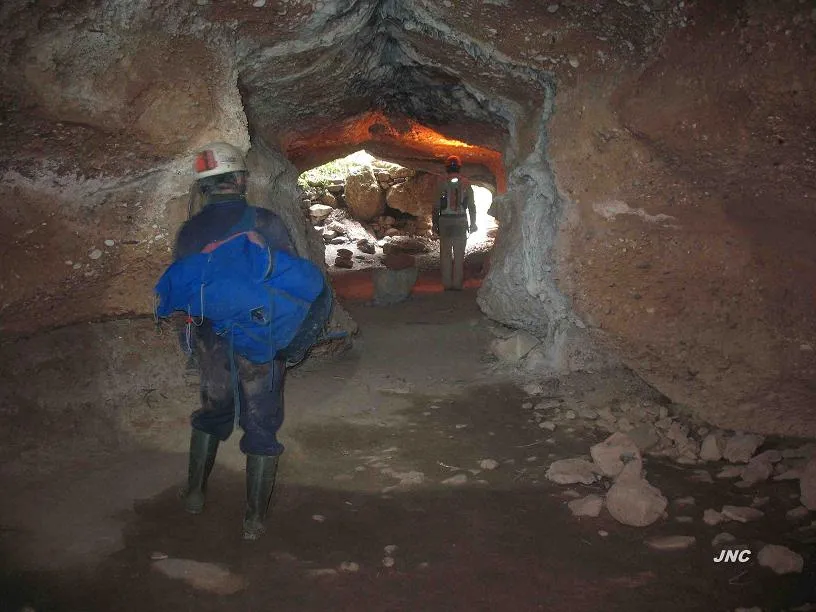
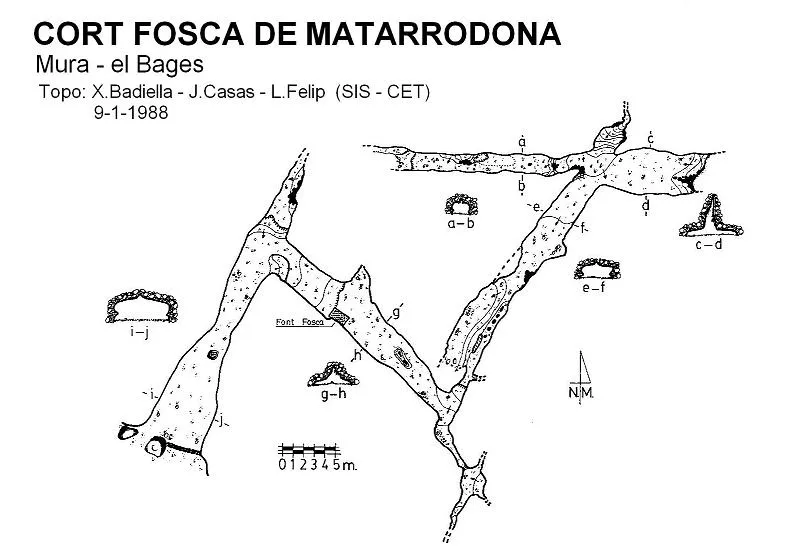
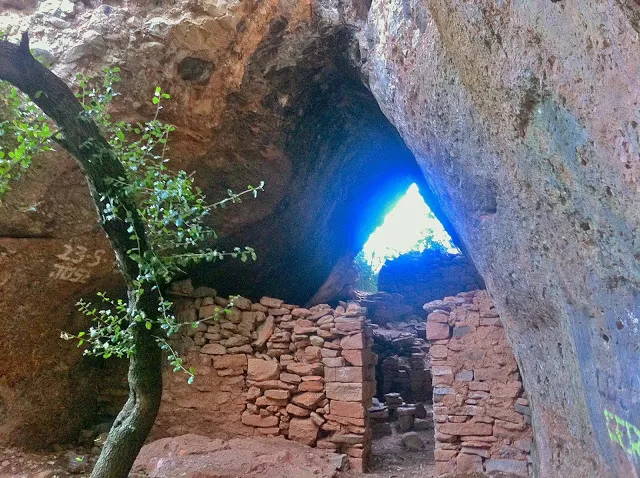
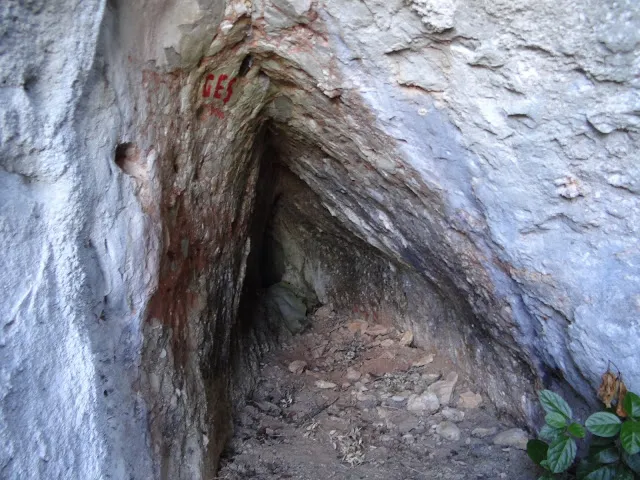
The entrance is divided in two by an artificial wall built as a shelter, making use of a couple of blocks that interrupt the uniformity of the entrance gallery. Past the porch of the mouth, we can continue along a gallery about 20 metres long. The initial width is 3.5 metres which halfway along narrows to 1 metre and then widens again further on. The height is more regular, as it is almost always 2 metres. On the ceiling one can observe the very well marked generating joint, even at the intersection of the second gallery that we find on the right. Although the entrance passage continues a few metres more, these are few and one must crawl, as there we find a stalagmitic crust resting on a mound of sediments.
Following the gallery that appears on the right, we can advance the first metres under the same conditions as the entrance gallery until reaching the Font Fosca, an artificial basin that makes use of some still somewhat active stalactite drips. From here, a small ascending step must be overcome. The gallery is about 15 metres long, the floor is covered with stalagmitic crust that in some points forms some protruding group of stalagmites; the width is a couple of metres, while the height is conditioned by the section of the gallery in the shape of an inverted “T”: wide at the floor, high in the middle but forming a narrow passage, while the rest is low-ceilinged. We find a small passage on the left that we leave for the moment, while we continue crawling the few metres that remain of the second gallery, which ends with two small impassable holes. Taking the passage on the left that we left behind, the first narrow step must be overcome to find ourselves in a wide gallery, but low on one side and a little high on the other, half divided by a group of stalagmitic formations. Once the first metres of gallery are passed, it takes on more comfortable dimensions, one can straighten up although we cannot stand fully upright. The gallery continues about 10 metres until it crosses a fourth passage.
At the confluence of these galleries we can stand upright. To the right a short passage continues that ends up becoming low, obstructed by an accumulation of stalagmitic formations. While to the left one can advance along a heavily concretioned gallery; a column divides the passage into two caving squeezes; once these are passed, a beautiful stalagmitic column, curiously contouring, traces the course of a tree root. The gallery along which we advance crouched leads us to the final gallery of the cave, where we observe two crusts of stalagmitic formations. One is the floor along which we advance, which in some points hollows out and forms some lower small gallery; the other crust we find towards the end of the gallery, after leaving behind a large mass of limestone formations that make the passage a little difficult. This rests on sediments, causing the cave to end within a few metres of difficult progress.
Speleothems
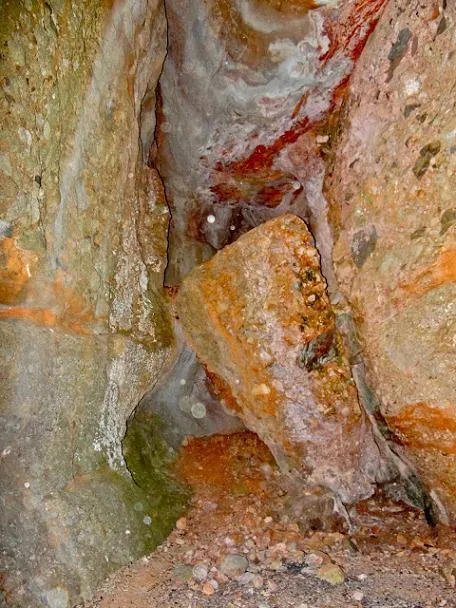
On the ceiling one can observe the very well marked generating joint. There we find a stalagmitic crust resting on a mound of sediments. The Font Fosca is an artificial basin that makes use of some still somewhat active stalactite drips. The floor is covered with stalagmitic crust that in some points forms some protruding group of stalagmites. A column divides the passage into two caving squeezes; once these are passed, a beautiful stalagmitic column, curiously contouring, traces the course of a tree root. In the final gallery we observe two crusts of stalagmitic formations: one is the floor along which we advance, which in some points hollows out and forms some lower small gallery; the other crust we find towards the end of the gallery, after leaving behind a large mass of limestone formations that make the passage a little difficult, and it rests on sediments.
Progression
Past the porch of the mouth, we can continue along a gallery about 20 metres long. Although the entrance passage continues a few metres more, these are few and one must crawl. Following the gallery that appears on the right, we can advance the first metres under the same conditions as the entrance gallery until reaching the Font Fosca. From here, a small ascending step must be overcome. We find a small passage on the left that we leave for the moment, while we continue crawling the few metres that remain of the second gallery, which ends with two small impassable holes. Taking the passage on the left that we left behind, the first narrow step must be overcome. The gallery continues about 10 metres until it crosses a fourth passage. At the confluence of these galleries we can stand upright. To the right a short passage continues that ends up becoming low, obstructed by an accumulation of stalagmitic formations. While to the left one can advance along a heavily concretioned gallery; a column divides the passage into two caving squeezes. The gallery along which we advance crouched leads us to the final gallery of the cave.
Other details
Well-known cave 125 m long in the Serra de l'Obac.
History
Known since time immemorial and used as a shelter. Despite being well known by hikers and cavers, it is not until 1978 that the first survey is carried out by members of the Grup Espeleològic de la Penya Excursionista Guimerà de Barcelona, but this remained unpublished until the present, when it was provided to us by the colleague Alex Martin Alcalde. We take the opportunity to review the record as of 2-9-2016, including the survey carried out in 1980 by Sabadell members of the Espeleo Club de Gràcia, who published the first known record of the cavity in 1981. Between 1987 and 1988 members of the SIS del Centre Excursionista de Terrassa carry out a complete work of all the cavities of the Pujol de Matarrodona.
User Comments (0)
No comments yet.
Be the first to share your experience!
Registered Explorations (0)
No explorations registered yet.
Register your visit to this cave!
Bibliography
- Badiella, X.; Casas, J.; Felip, L.; (1988).- “Les cavitats del Pujol de Matarrodona” SIS (11): 96-108 /Arxiu del Centre Excursionista de Terrassa (53): 212- 224. CE Terrassa.
- Valles, J. de et al. (1981).- “Recull de cavitats catalanes” Exploracions (5): 91- 102. EC de Gràcia. Barcelona.
- Coordenades i fotografies “JNC” facilitades per Jordi Navarro (Centre Excursionista de Castellar del Vallès).
- Topografia inèdita facilitada per Alex Martin Alcalde.
Nearby caves


Source: Espeleoindex (espeleoindex.com), modified. CC BY-NC 4.0, https://creativecommons.org/licenses/by-nc/4.0/