
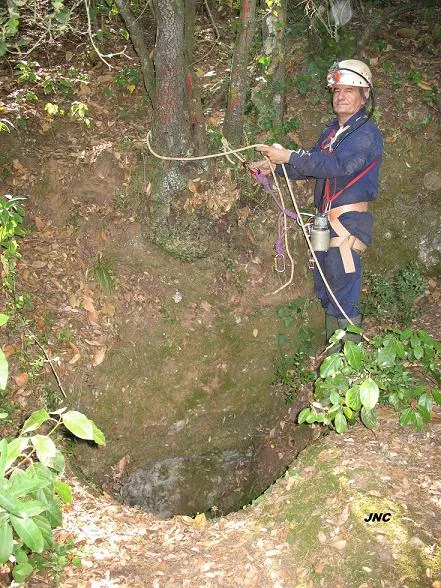
Avenc de la Canal de Mura
Avenc de 36 metres de fondària a la Serra l'Obac
EspeleoWorld
Avenc de la Canal de Mura
Avenc de 36 metres de fondària a la Serra l'Obac
Vacarisses · Vallès Occidental
Length: 100 m · Depth: 36 m
Updated record
https://espeleoworld.com/en/c/avenc-de-la-canal-de-mura
Information can change. Always verify coordinates, access, weather, and cave conditions before setting out.
A 36-metre-deep pit in the Serra l'Obac, with an entrance of 1 x o,5 metres, shafts, chimneys and galleries. Mentioned in 1935, explored in 1961 and 1980. Cave fauna.
Topographic
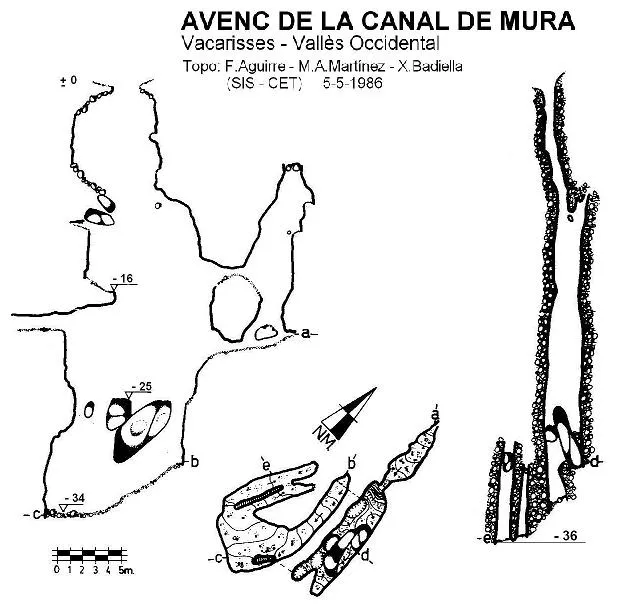

Espeleoindex · CC BY-NC 4.0, https://creativecommons.org/licenses/by-nc/4.0/ · Image © its author.
Photos

Espeleoindex · CC BY-NC 4.0, https://creativecommons.org/licenses/by-nc/4.0/ · Image © its author.
Description
Morphology
The entrance of 1 x o,5 metres allows us to pass into a shaft that is narrow at first, but elongated, which at 10 metres widens notably and 6 metres later reaches a step formed by a large wedged block. We can descend 8 metres more, where the shaft lengthens a little more, maintaining, however, its width of 2.5 metres. We arrive above a pile of large blocks of clastic origin in a N direction and, climbing back up with difficulty, a small hole is reached, after passing which we arrive at a chimney 12 metres high up which one must climb very delicately.
A few metres away we find a second hole on the S side, which communicates again with the shaft of the pit. This chimney ends in an uncomfortable step, where the joint that formed it becomes very narrow. Returning to the pile of large blocks at the foot of the shaft, one can descend among them without difficulty by the NW end, quickly following a ramp that leads us to a chamber measuring 6 x 4 metres. The irregular ceiling reaches 6 metres in height in some places. In the lower part of the chamber, the NW end, two galleries appear. The one more on the E side is quite narrow and can be followed for about 6 metres. The ceiling becomes narrower, not exceeding 5 metres. The second begins with an annoying low passage that, once passed, leads us to a gallery of 7 metres, wider than the previous one; the ceiling is higher: it reaches 8 metres in height. In the walls of the gallery several quite large blocks are wedged. The N end of this gallery is where the cavity reaches its maximum depth (-36 m). Near this point, at floor level, we will find a hole, on the E side, through which one accesses the first gallery mentioned.
History
In the Guia monogràfica de Sant Llorenç del Munt, published by the Centre Excursionista de Terrassa in 1935, the cavity is mentioned and they only say that it is about 50 metres deep. This datum is repeated by Llopis Lladó (1944) and Termes in his catalogue (1951), but we have no record of whether anyone had made a first exploration of the pit, or when.
The oldest exploration of which we have news is the one carried out by members of the GES del CMB on 5 November 1961, and the first survey of the cavity that we know of is made.
Although it is not a very frequented cavity, during some course outings, members of the SIS del CET observed some holes in the wall of the entrance shaft, almost at its base, and on 15 June 1980 they decided to resolve the doubt and, climbing, they discovered and explored a small side passage that ended in a fairly high chimney.
Bio
Arachnida / Araneae / Linyphiidae
- Porrhomma pygmaeum (Blackwall, 1834)
Crustacea / Isopoda / Stenasellidae
- Stenasellus virei (Dolfus, 1898)
Diplopoda / Polydesmida / Polydesmidae
- Polydesmus sp.
Insecta / Coleoptera / Carabidae
- Laemostenus (Prystonichus) terricola (Herbst, 1783)
- Trechus (Trechus) obtusus (Erichson, 1837)
Insecta / Coleoptera / Leiodidae
- Troglocharinus kiesenwetteri santllorensi (Zariquiey, 1924)
Insecta / Diptera / Limonidae
- Limonia nubeculosa (Meigen, 1804)
Insecta / Orthoptera / Gryllidae
- Nemobius sylvestris (Bosc, 1792)
Insecta / Trichoptera / Limnephilidae
- Mesophylax aspersus (Rambur, 1842)
(Source of the data: Dept. Artròpodes del Museu de Ciències Naturals de Barcelona)
User Comments (0)
No comments yet.
Be the first to share your experience!
Registered Explorations (0)
No explorations registered yet.
Register your visit to this cave!
Bibliography
- Andrés, O. (1964).- “Karstificación en conglomerados. Su estudio en el macizo de Sant Llorenç del Munt – Serra de l'Obac (Barcelona)” Geo y Bio Karst (2): 9-16. J.Mª Armengou, editor. Barcelona.
- Badiella, X. i Mansell, C. (1986).- “Noves troballes a cavitats de Sant Llorenç del Munt i Serra de l'Obac” Arxiu del Centre Excursionista de Terrassa (44): 1068-1074 / SIS (10): 42-48. CE de Terrassa.
· Coordenades i fotografies “JNC” facilitades per Jordi Navarro (Centre Excursionista de Castellar del Vallès)
Nearby caves
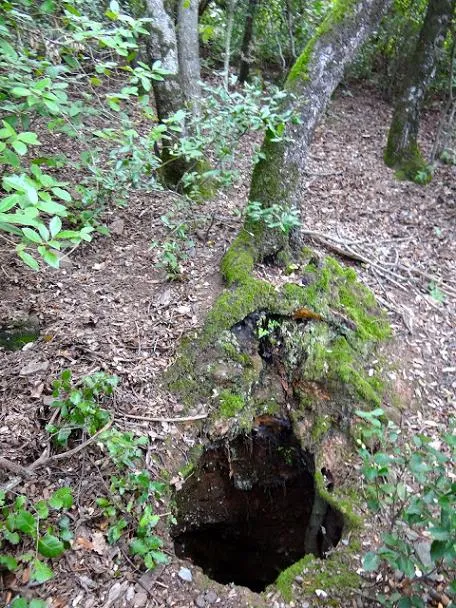
Avenc del Queixal del Porc
0.1 km · N
Vacarisses (Vallès Occidental)
1 topo.1 photos
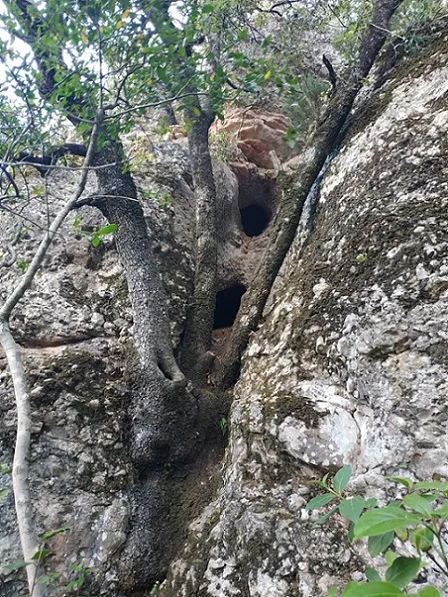
Cova de les Mercès
0.2 km · S
Vacarisses (Vallès Occidental)
1 photos
Cova de la Canal del Solitari
0.4 km · W
Vacarisses (Vallès Occidental)
1 topo.1 photos
Avenc de Castellsapera
0.6 km · NE
Terrassa (Vallès Occidental)
2 topo.13 photos
Source: Espeleoindex (espeleoindex.com), modified. CC BY-NC 4.0, https://creativecommons.org/licenses/by-nc/4.0/