
Avenc de Castellsapera
Important i conegut avenc de 84 m. de fondària a la Serra de l'Obac
EspeleoWorld
Avenc de Castellsapera
Important i conegut avenc de 84 m. de fondària a la Serra de l'Obac
Terrassa · Vallès Occidental
Length: 128 m · Depth: 84 m
Updated record
https://espeleoworld.com/en/c/avenc-de-castellsapera
Information can change. Always verify coordinates, access, weather, and cave conditions before setting out.
A pit 84 m deep in the Serra de l'Obac, with an entrance 7 by 2 metres, a 45-metre entrance shaft and a large final chamber. Access restricted from 1 November to 31 May to protect the bat colony.
Topographic
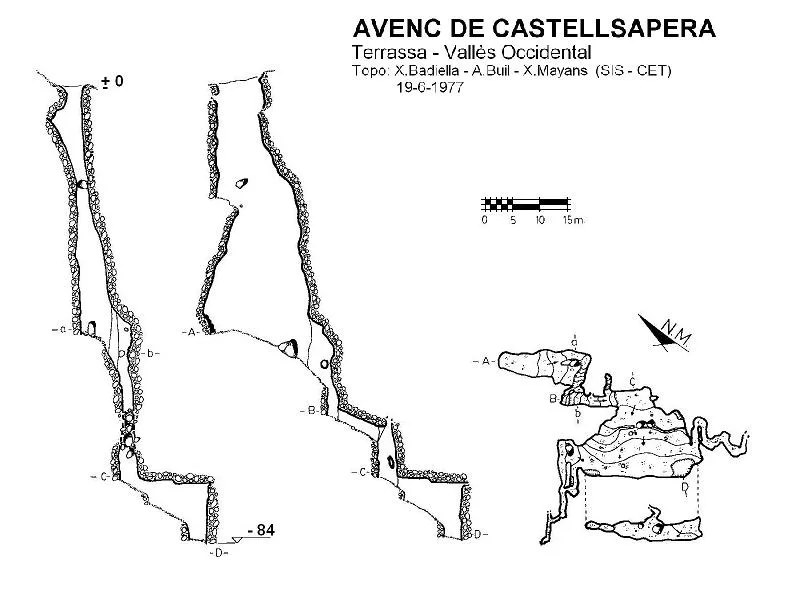
Espeleoindex · CC BY-NC 4.0, https://creativecommons.org/licenses/by-nc/4.0/ · Image © its author.
Photos
Espeleoindex · CC BY-NC 4.0, https://creativecommons.org/licenses/by-nc/4.0/ · Image © its author.
Description
Morphology
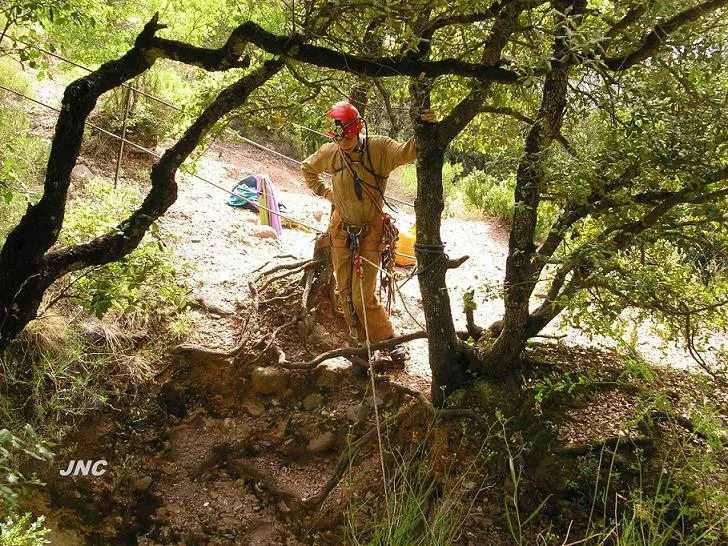
The entrance measures 7 by 2 metres and is surrounded in one corner by abundant vegetation, such as ivy and holm oaks, on one of which it was customary to tie the rope to carry out the descent. The entrance shaft is about 45 metres deep in a direct vertical, although at 18 metres there is a large stone wedged between the walls, which makes a second anchor necessary to continue the descent. A little below this block there is a small ledge with room for two people. The next 27 vertical metres are almost entirely airy until reaching the bottom of a spacious chamber 15 metres long and between 2 and 5 metres wide. At the SE end, where we find a large rock jutting out in a pointed shape, a fairly steep corridor descends at a right angle towards a step. At the foot of this, another sloping passage brings us towards a second step higher than the previous one. With a portal 6 metres wide and 3 high, one of the largest underground wings of the massif is presented to us, 20 metres long and 12 metres wide. The floor is steeply sloping towards the opposite end from which we enter, finding a slight step right at the beginning of our entry. At both lower ends of the chamber there are respective steps that communicate through a lower corridor; the point where the maximum depth of the cavity is reached (level – 84). On the SE side of the chamber there is a fairly cramped gallery between mud and stones that, after a couple of turns, ends filled with sediments. At the opposite end and next to the step that leads to the lower gallery, we find the entrance to two rooms, the first through a large block leads us to a small room; the second is formed by an elongated passage at the end of which, through a narrow passage, it continues for about 10 metres making a couple of angles that are sometimes difficult to overcome.
Progression
The descent was carried out by tying the rope to a holm oak. The entrance shaft makes a second anchor necessary at 18 metres to continue the descent. Formerly, the small ledge located below the block was used to make a second installation of the elektron ladder (currently few people use this ledge). The step in the corridor can be avoided by passing through a crawlway that starts on our right. The second step, higher than the previous one, can also be avoided on its left side by making a couple of little jumps between a pile of large untidy blocks, thus reaching the final chamber.
History
The first complete exploration took place on 12 October 1913, led by Marià Faura i Sans and with the participation of Sagués, Pineda, Cuyàs, Folch and Amat, members of the Centre Excursionista de Catalunya, Centre Excursionista del Vallès (Sabadell) and Centre Excursionista de Terrassa.
Recently we have learned (Aragonès, E., 2010) that a few months before this exploration, specifically on 15 August of the same 1913, elements of the Círculo Tradicionalista de Terrassa made an exploration attempt that ended in a scare, having to bring out one of them, trapped due to the insufficiency of the material they had.
Very possibly, the second exploration took place on 16 January 1921 by members of the Centre Excursionista de Terrassa.
From the 1950s it became one of the most visited cavities of the Serra de l'Obac. Inside it there have been two unfortunate fatal accidents, the first of them that of an excursionist who, while running through the wood, fell down the entrance shaft.
Bio
For the protection of the important colony of bats that hibernates inside, the management of the Parc Natural recommends refraining from visiting it during the period between 1 November and 31 May. In a small room some bats usually hibernate.
User Comments (0)
No comments yet.
Be the first to share your experience!
Registered Explorations (0)
No explorations registered yet.
Register your visit to this cave!
Bibliography
- Andrés, O. (1960).- “Sobre ciertas particularidades de la carstificación en el macizo de conglomerados eocenos de Sant Llorenç del Munt (Provincia de Barcelona)” Speleon (XI): 27-46. Universidad de Oviedo.
- Andrés, O. (1964).- “Karstificación en conglomerados. Su estudio en el macizo de St. Llorenç del Munt – Serra de l'Obac (Barcelona)”. Geo y Bio Karst (2): 9-16. Ed. J. Mª Armengou. Barcelona.
- Aragonès, E. (2010).- Marià Faura i Sans espeleòleg (1883-1941). 106 pp. Federació Catalana d'Espeleologia. Barcelona.
- Badiella, X. (1999).- “L'Avenc de Castellsapera”. Arxiu del Centre Excursionista de Terrassa (100-101): 23-24. Terrassa
· Fotografies “JNC” facilitades per Jordi Navarro (centre Excursionista de Castellar del Vallès)
Nearby caves
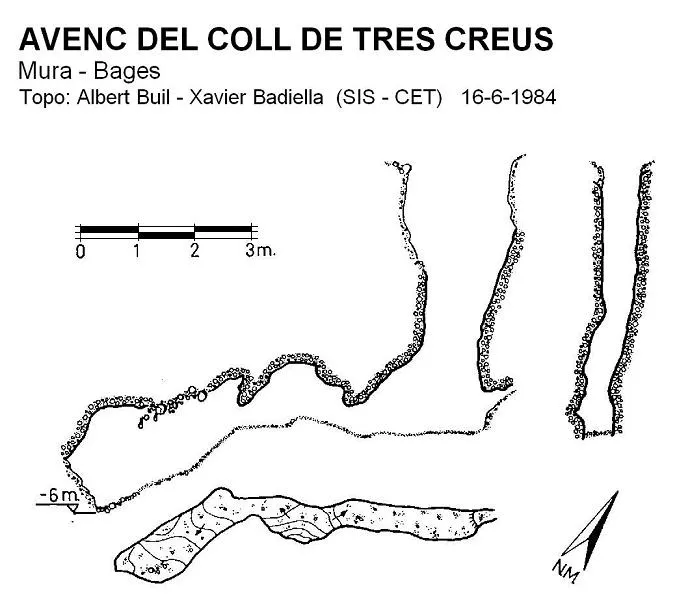
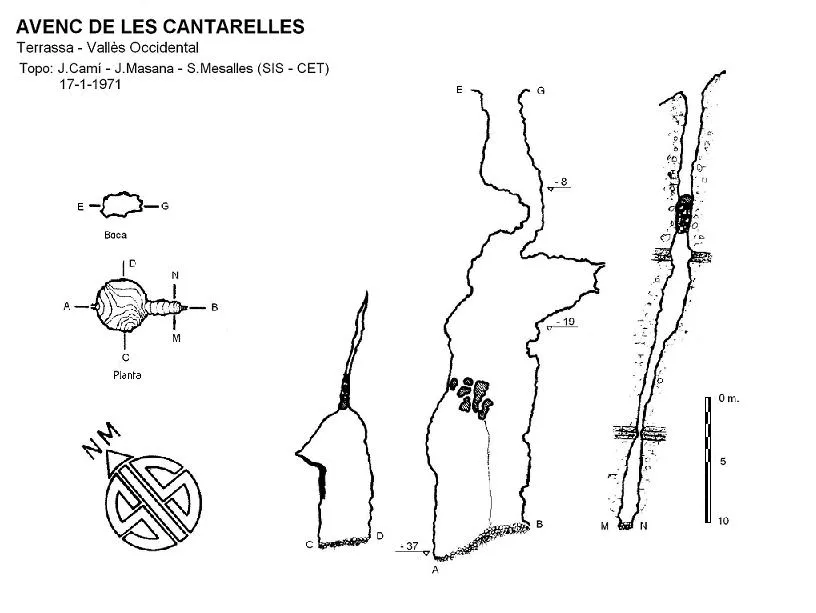


Source: Espeleoindex (espeleoindex.com), modified. CC BY-NC 4.0, https://creativecommons.org/licenses/by-nc/4.0/