
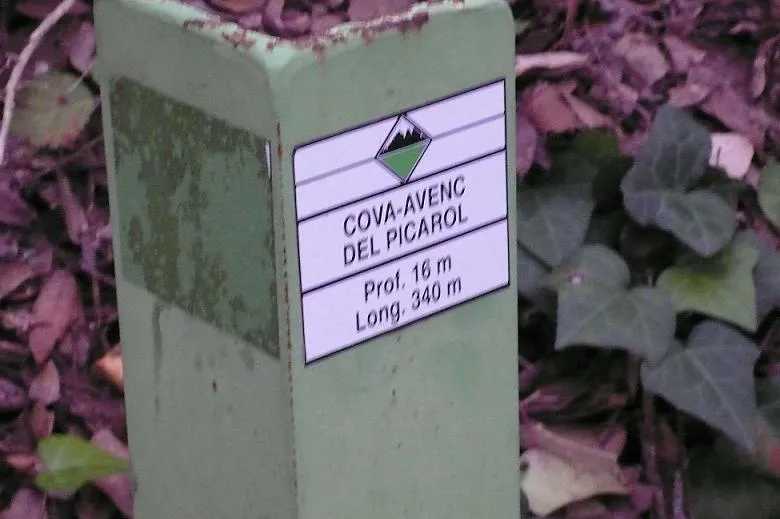
Cova-avenc del Picarol
A 340 m long cave-pit in the Serra de l'Obac, with a 7.5 m entrance pit and a system of galleries on three levels.
EspeleoWorld
Cova-avenc del Picarol
A 340 m long cave-pit in the Serra de l'Obac, with a 7.5 m entrance pit and a system of galleries on three levels.
Mura · Bages
Length: 340 m · Depth: 16 m
Updated record
https://espeleoworld.com/en/c/cova-avenc-del-picarol
Information can change. Always verify coordinates, access, weather, and cave conditions before setting out.
A 340 m long cave-pit in the Serra de l'Obac, with a 7.5 m entrance pit and a system of galleries on three levels.
Topographic
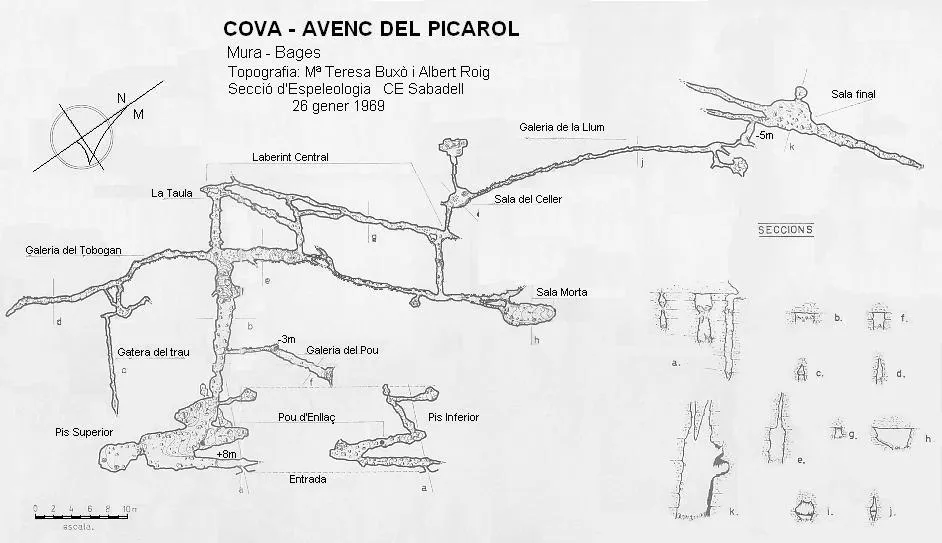
Espeleoindex · CC BY-NC 4.0, https://creativecommons.org/licenses/by-nc/4.0/ · Image © its author.
Photos
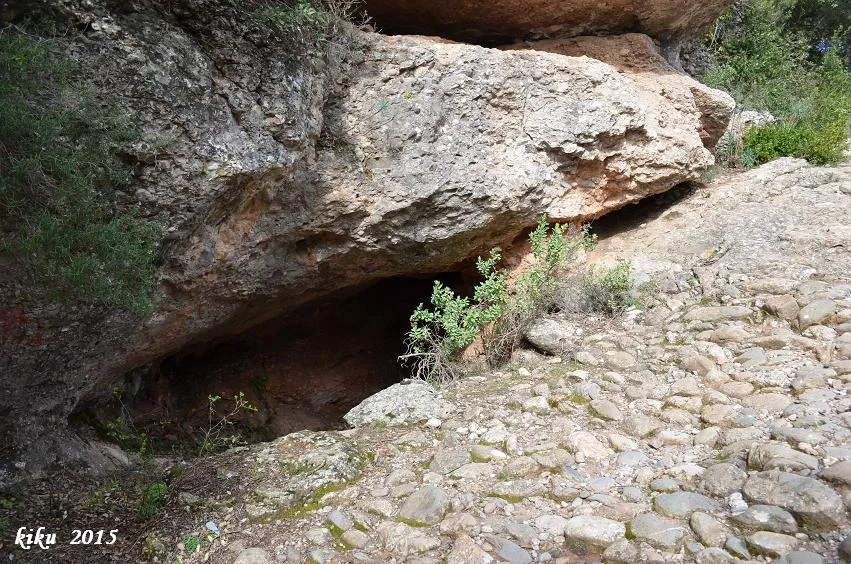
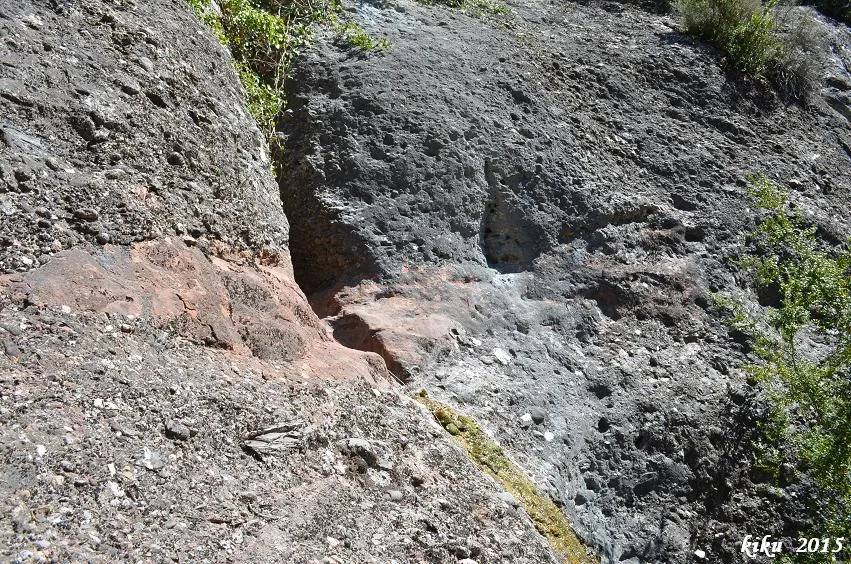
Espeleoindex · CC BY-NC 4.0, https://creativecommons.org/licenses/by-nc/4.0/ · Image © its author.
Description
Morphology
The entrance, of small dimensions (0.40 x 0.50 m), gives way to a small 7.5 metre pit that leads to the lower gallery of the cavity. On taking the first turn, we find ourselves in a gallery that ends after a few metres at a step that gives way on one side to a crawl and on the other to a room with a steep slope. Towards the middle of the aforementioned gallery we can see in the ceiling a window that will take us to what we shall call the second level; thus, after climbing the 5 metres separating the window from the floor by opposition, we reach a room in which we can see in front a flat-out passage that gives way to a small room with a very low ceiling; on the left, a gallery that leads to the entrance pit and on the right, a crawl through which the cavity continues. This crawl, which is rather a flat-out passage about 35 centimetres high, opens after a few metres into a low but wider gallery, where on the right we find another crawl, narrow and of little length. Towards the front and after a step one reaches the third level of the cavity, situated at a lower level than the aforementioned one. On entering, we already find a gallery that crosses the one we are following, giving on one side to another that ends choked by sediments and on the other to one that joins the one we are following. After taking a turn to the right, it leads to a crossing of galleries, where we find on one side the aforementioned gallery; in front, a crawl that ends right there and on the left another crawl through which the cavity continues. This crawl will lead us, after passing numerous side passages, to the final pit of the cavity. It should be noted that at the end of this gallery one can observe up to three levels of galleries. Of those we find, only two stand out, emerging on the right-hand side, one leading to a series of galleries of little importance and to a small room with a sloping floor, and the other to a small room with a low ceiling covered in blocks. The room into which the final pit leads is of large dimensions if compared with the dimensions of the rest of the cavity.
Hydrology
It seems to have a direct relationship with the Avenc de Castellsapera as regards the role played by megajoints and interjoints in the processes linked to infiltration and how horizontal circulation levels become established from more carbonate-rich levels, but in this case it remains confined by the sandstone or lutite levels that infiltrating waters can only cross through the megajoints affecting them, at the same time as the upper levels.
History
It is said that this cavity was known as an unimportant pit about 8 metres deep, but that following the floods of the year 1962, the water washed away the sediments obstructing the bottom of the entrance pit. It is also said that its name comes from when its first explorers descended the entrance pit and found the skeleton of a polecat that still had a bell around its neck.
But the discovery of the cavity, as we know it now, is due to members of the Speleology Section of the Centre Excursionista de Sabadell (SECES) around the year 1967 or 68.
User Comments (0)
No comments yet.
Be the first to share your experience!
Registered Explorations (0)
No explorations registered yet.
Register your visit to this cave!
Bibliography
- Amenós, A. (1978).- “Cova del Picarol”. Espeleòleg (26-27): 443-449. ERE del Centre Excursionista de Catalunya. Barcelona.
- Freixes, A.; Monterde, M.; Cervelló, JM. (1983).- El paleocarst i el carst actual de les serres de Sant Llorenç del Munt i de l'Obac (El carst experimental de Rellinars). 57 pp. Espeleo Club de la Unió Excursionista de Sabadell
- Fotografies facilitades per Antoni Ferro (SIE – CEA)
Nearby caves


Source: Espeleoindex (espeleoindex.com), modified. CC BY-NC 4.0, https://creativecommons.org/licenses/by-nc/4.0/