
Avenc de l'Arion
Avenc d'uns 58 m. de fondària a Ulldecona (el Montsià)
EspeleoWorld
Avenc de l'Arion
Avenc d'uns 58 m. de fondària a Ulldecona (el Montsià)
Ulldecona · Montsià
Length: 70 m · Depth: 58 m
Updated record
https://espeleoworld.com/en/c/avenc-de-l-arion
Information can change. Always verify coordinates, access, weather, and cave conditions before setting out.
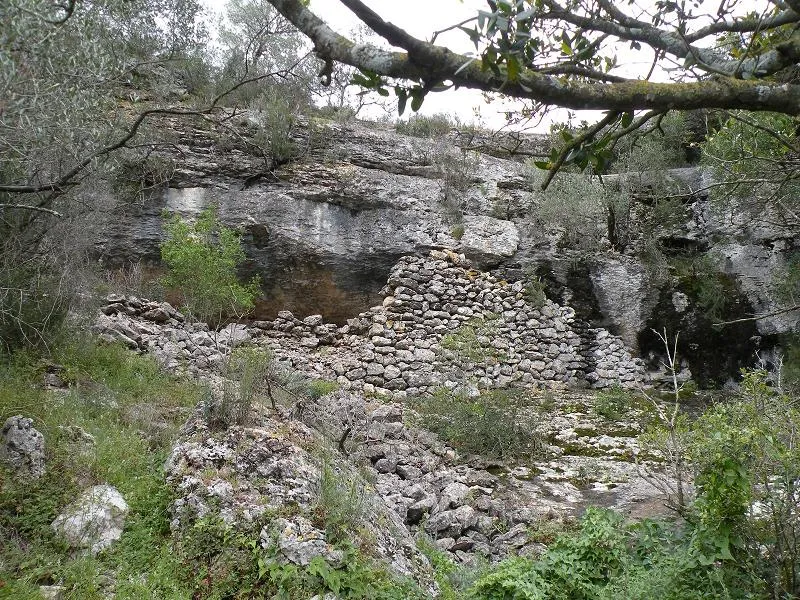
A pit about 58 m deep in Ulldecona (el Montsià), in the SW of the Serra de Godall, explored in 1934 and relocated in 2015 by the EC Tortosa.
Topographic
Espeleoindex · CC BY-NC 4.0, https://creativecommons.org/licenses/by-nc/4.0/ · Image © its author.
Photos
Espeleoindex · CC BY-NC 4.0, https://creativecommons.org/licenses/by-nc/4.0/ · Image © its author.
Description
Morphology
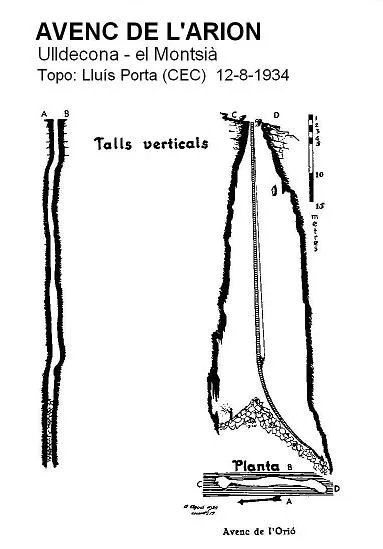
It consists of a single shaft, of not too wide dimensions, about 48 metres deep. Here, a large cone of debris forms a pronounced ramp, which reaches the point of maximum depth (elevation – 58). (data taken from the 1934 exploration).
The exploration in March and April 2015 by members of the EC Tortosa and in the absence of a new survey, largely corroborates this description.
Progression
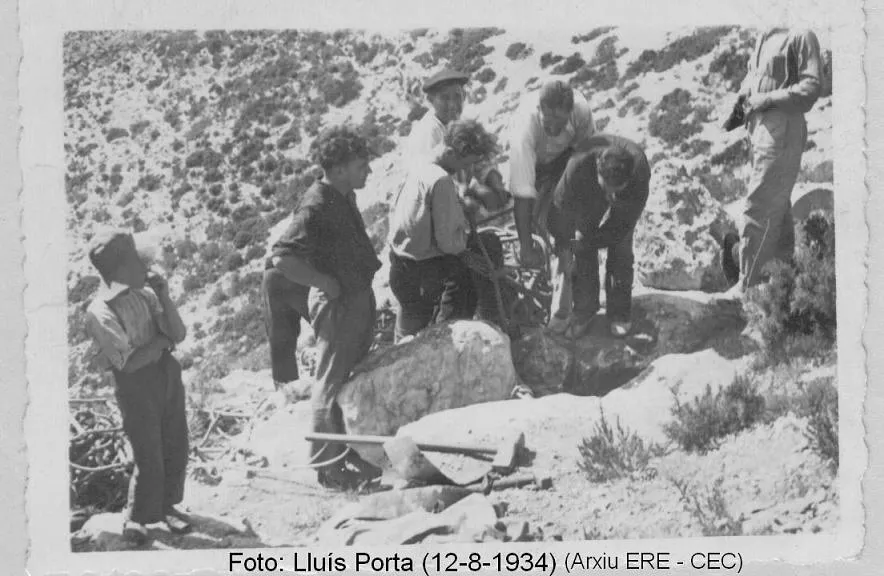
The first exploration of the pit took place on 12 August 1934 and was carried out by a group of CEC members led by Lluís Porta i Massana; among the explorers we know that his brother Joan and the biospeleologist Francesc Español i Coll were also there.
We do not have much news of explorations, although we think it may be the same pit explored by the GES of the CMB in November 1958, which they named Avenc d'Ulldecona, they attributed 54 metres of depth to it and they believed they were the first explorers. In 1982 it was also visited by members of the G.E. d'Ulldecona (they called it Avenc dels Arions).
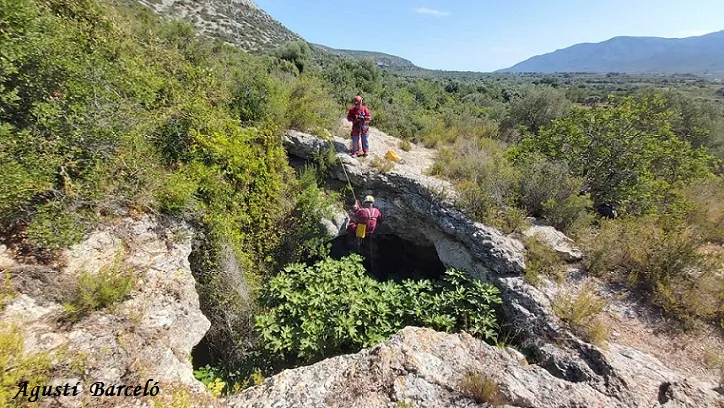
Relocated by the EC Tortosa in March 2015, who proceeded to an exploration, after having to carry out a partial clearing of the entrance.
Other details
It should be added that the colleagues from Tortosa detected a fairly important concentration of guilla (what is now called hypoxia) and a strong smell of ammonia from the bats' excrement.
One can take advantage of the excursion and at the finca de l'Arion one can observe a few specimens of the oldest olive trees of the Iberian Peninsula (possibly, they say, from the Ibero-Roman period).
Toponymy: Lluís Porta names the cavity as Avenc de l'Orió (noting that the origin of this name is a corruption of Hilarion). According to official toponymy the correct designation would be Arion, which seems to have the same origin that Porta explains.
History
The first exploration of the pit took place on 12 August 1934 and was carried out by a group of CEC members led by Lluís Porta i Massana; among the explorers we know that his brother Joan and the biospeleologist Francesc Español i Coll were also there.
We do not have much news of explorations, although we think it may be the same pit explored by the GES of the CMB in November 1958, which they named Avenc d'Ulldecona, they attributed 54 metres of depth to it and they believed they were the first explorers. In 1982 it was also visited by members of the G.E. d'Ulldecona (they called it Avenc dels Arions).
Relocated by the EC Tortosa in March 2015, who proceeded to an exploration, after having to carry out a partial clearing of the entrance.
Bio
It should be added that the colleagues from Tortosa detected a fairly important concentration of guilla (what is now called hypoxia) and a strong smell of ammonia from the bats' excrement.
User Comments (0)
No comments yet.
Be the first to share your experience!
Registered Explorations (0)
No explorations registered yet.
Register your visit to this cave!
Bibliography
- Porta, Lluís (1935).- “Recerques espeleològiques per la comarca de Tortosa”. Butlletí del Centre Excursionista de Catalunya (478): 111-114. CEC. Barcelona.
- Fotografia inèdita de Lluís Porta, extreta de l'arxiu de l'ERE del CEC.
- Actualització de dades i fotografies actuals extretes del blog de l'Espeleo Club Tortosa (març i abril 2015).
Nearby caves



Source: Espeleoindex (espeleoindex.com), modified. CC BY-NC 4.0, https://creativecommons.org/licenses/by-nc/4.0/