
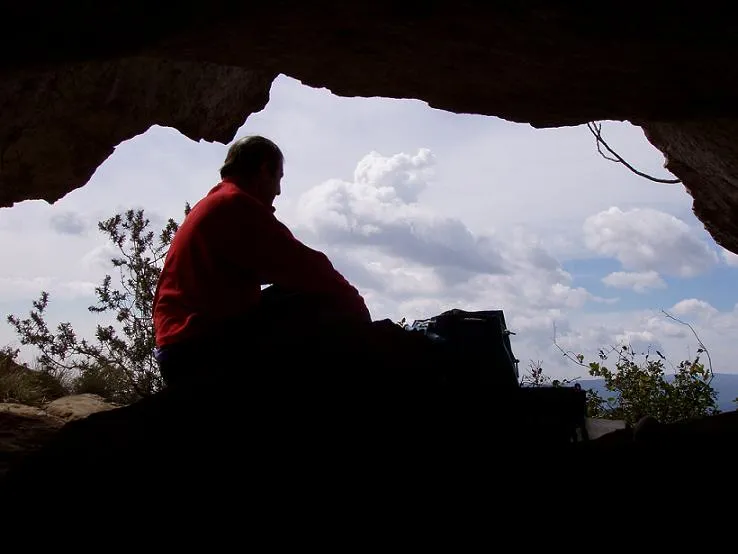
Cova del Moro
Small cave with 40 m of passage in the serra de Miramar, between the Conca de Barberà and the Alt Camp, with its entrance hanging on the cingle del Tossal Gros (867 m).
EspeleoWorld
Cova del Moro
Small cave with 40 m of passage in the serra de Miramar, between the Conca de Barberà and the Alt Camp, with its entrance hanging on the cingle del Tossal Gros (867 m).
Figuerola del Camp · Alt Camp
Sviluppo: 40 m · Profondità: 5 m
Scheda aggiornata
https://espeleoworld.com/it/c/cova-del-moro-figuerola-del-camp
Le informazioni possono cambiare. Verifica sempre coordinate, accesso, meteo e condizioni della cavità prima di partire.
Small cave with 40 m of passage in the serra de Miramar, between the Conca de Barberà and the Alt Camp, with its entrance hanging on the cingle del Tossal Gros (867 m).
Topografia
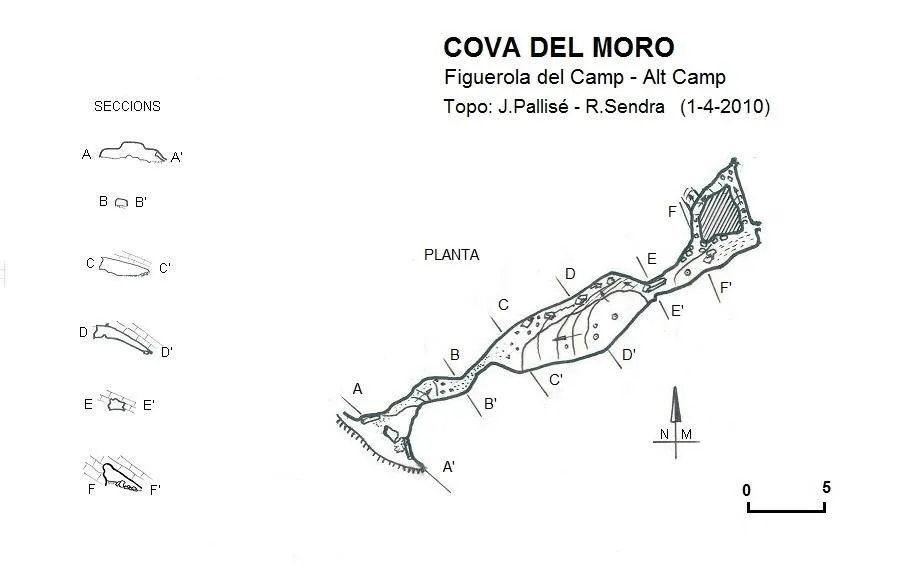
Espeleoindex · CC BY-NC 4.0, https://creativecommons.org/licenses/by-nc/4.0/ · Immagine © del suo autore.
Foto
Espeleoindex · CC BY-NC 4.0, https://creativecommons.org/licenses/by-nc/4.0/ · Immagine © del suo autore.
Descrizione
Morfologia
After descending to the balcony hanging on the cinglera, we find an entrance 5x1.5 metres that descends gently forming an “S” with a slight right-left turn, while it becomes a narrow gatera with an earthy floor. Once past it, we enter the most spacious little chamber of the cavity, in the form of an elongated trapezoid 10x2.5 metres, although we will only be able to stand upright at the beginning of it, because a large part of the chamber is occupied by fragments of blocks that are nothing other than strata fallen from the ceiling, having subsequently been covered by a stalagmitic concretion. The whole cavity presents a slightly inclined section due to the fact that it develops entirely within a plane of stratification following the slope of the mountain, since the limestone rock presents that inclination at that point.
At the opposite end of the first little chamber, in the upper part, there is another gatera that leads us to a second little chamber, of more reduced dimensions, obliging us to remain half lying down. At its end a small descending corridor in the form of a V emerges that leads us to the end of the chamber and of the cavity, although it should be noted that on the final wall there is a small cylindrical conduit, impenetrable, that seems to widen later, but that cannot be passed without first carrying out a desobstrucció.
Concrezioni
Only a slight concretion covering some block can be noted.
Idrologia
Despite the old accounts, there is no riu Jordà inside it.
Progressione
To reach the entrance it is necessary to descend a couple of metres down the estimball to a kind of balcony hanging on the cingle of less than half a metre, with a drop of almost 10 metres remaining below.
Altri dettagli
Thus, despite the old accounts, there is no vertical crack, no large spacious chamber; although nevertheless, both because of the situation of the entrance and from the morphological point of view, a visit to the cavity is quite interesting.
Storia
Known since time immemorial and with an important baggage of legends of Moors and of the presence of the riu Jordà inside it. Madoz, Puig y Larraz, Font i Sagué, Faura i Sans already record it in their old catalogues, although they only give oral references. It is not until 2 June 1899 that a group of excursionists, among whom was J. Conangla (at that time delegate of the CEC in Montblanc) and who, led by a guide, visit the cavity (possibly they did not go much beyond the entrance) and of which the same Conangla makes a romantic description, typical of the period, that has nothing to do with reality. Joan Ferraté includes it in his Espeleologia de les comarques tarragonines (1918), making a summary of the data given by Conangla. We have no further news until the visits made from the middle of the 1960's by the then young members of the GIEM – CE Montblanc. In 1969 they made a croquis and in April 2010 they made the topographic survey.
Commenti degli utenti (0)
Nessun commento ancora.
Sii il primo a condividere la tua esperienza!
Esplorazioni registrate (0)
Nessuna esplorazione registrata.
Registra la tua visita a questa grotta!
Bibliografia
- Borràs,J; Miñarro, JM; Talavera, F (1984).- Catàleg Espeleològic de Catalunya.(vol 2): 246 pp. Ed. Poliglota. Barcelona.
- Conangla, J. (1901).- “Una excursió al Castell del Moro, Coll de Prenafeta y Còva de Jordà”. Butlletí del Centre Excursionista de Catalunya (82): 286-293. Barcelona.
- Ferraté, Joan (1918).- Espeleologia de les comarques tarragonines. pp 95-96. Reus.
- Actualització de dades, topografia, coordenades i fotografies facilitades per Joan Pallisé (Montblanc)
Grotte vicine


Fonte: Espeleoindex (espeleoindex.com), modificato. CC BY-NC 4.0, https://creativecommons.org/licenses/by-nc/4.0/