
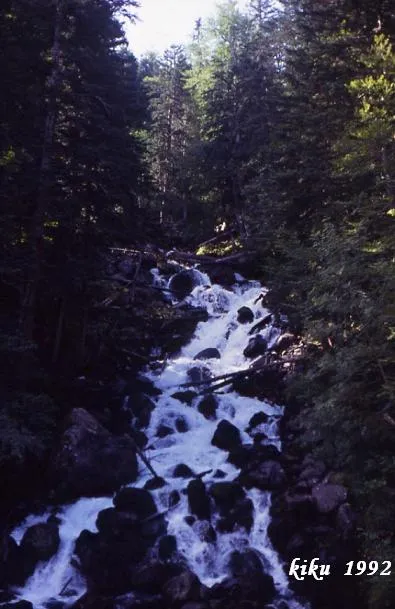
Uelhs Deth Joeu
La surgència més important de les fonts de la Garona (Vall d'Aran)
EspeleoWorld
Uelhs Deth Joeu
La surgència més important de les fonts de la Garona (Vall d'Aran)
Vielha e Mijaran · Val d'Aran
Updated record
https://espeleoworld.com/en/c/uelhs-deth-joeu
Information can change. Always verify coordinates, access, weather, and cave conditions before setting out.
The most important spring of the sources of the Garona, in the Vall d'Aran, not penetrable, fed in large part by the waters of the Forau d'Aigualluts.
Photos
Espeleoindex · CC BY-NC 4.0, https://creativecommons.org/licenses/by-nc/4.0/ · Image © its author.
Description
Morphology
Important non-penetrable karstic spring that constitutes one of the main sources of the Garona.
Hydrology
A large part of the waters that emerge come from the Forau d'Aigualluts, in the Mediterranean basin of the riu Éssera. For more details see the history section of this same record.
History
Font i Sagué in his Catàlech (1897) cites the Embut del Jueu, saying that it is a pit where the riu Jueu plunges and that after a subterranean course of one kilometre, it reappears at the Gola del Jueu (Uelhs deth Joeu). He also mentions the Trou del Toro and already makes it quite clear that the waters of the Maladeta slope go, through Aigualluts (he calls it: Aigualais), to the Uelhs deth Joueu.
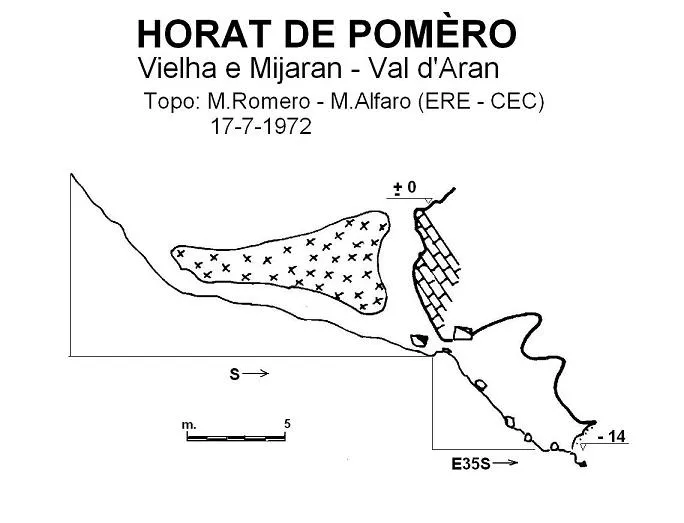
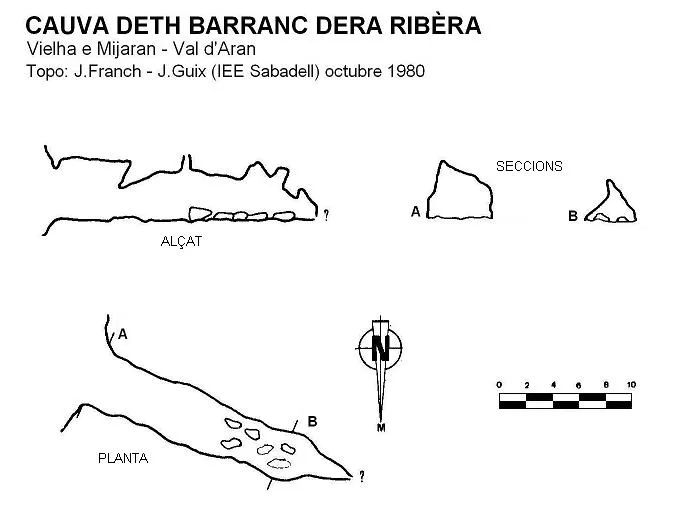
Font draws all this information from a work by the engineer Josep Reig i Palau, entitled: El Valle de Aran, published in Barcelona in the year 1895. We have been able to consult this work in the library of the CEC and we can observe some curiosities: The so-called Embut del Jueu he says is an abyss through which the waters of the ravine coming from the lake of Pomèro flow, which makes a subterranean course of one kilometre to come out again to the exterior toward the Gola del Jueu. The book is accompanied by a very detailed colour map of the Vall d'Aran, but which we think in some stretches he made “by ear”, since he places the estany de Pomèro where the estany des Pois really is and, having consulted current cartography, we find no collapse, therefore we suspect that he is referring to the neighbouring estany de Coth deht Horo, from which the barranc dera Ribera comes out and where the great depression of eth Horo des Barrancs is found (see record).
When he speaks of the Gola del Jueu (Uelhs deth Joeu) he gives a description entirely in keeping with reality and which was not accepted until Norbert Casteret, thirty-six years later, demonstrated by colouring the relation of the Forau d'Aigualluts with the Uelhs deth Joueu.
Reig says textually: “ Las aguas procedentes del macizo de Aneto, dan lugar á un hecho anómalo, pues en vez de ir á engrosar los rios Ribagorzana y Esera que van á desaguar á otros más importantes de nuestra Península, conforme lo exigen las formas del terreno, penetran en los senos de la tierra en el sitio denominado Trou de Toro (Aragón), cruzan subterráneamente la cordillera que sirve de límite entre el Valle de Aran y la provincia de Huesca, y aparecen en la Gola del Jueu, después de un recorrido subterráneo de unos 4 kilómetros, con un pérdida de nivel de 600 metros. No ofrece duda en la localidad semejante hecho por cuanto se ha observado que cuando se desencadenan tempestades en la Maladeta, crece el rio Jueu aunque se experimente una pertinaz sequia en las vertientes del Valle de Aran y que las arenas, piedras y restos que arrastran las aguas, coinciden perfectament con las del Torrente dels Aygualais, que se precipita en Trou de Toro”.
User Comments (0)
No comments yet.
Be the first to share your experience!
Registered Explorations (0)
No explorations registered yet.
Register your visit to this cave!
Bibliography
- Cardona, F. (1990).- Grans cavitats de Catalunya. Vol 1: La Serralada Pirinenca. 198 pp. Espeleo Club de Gràcia. Barcelona.
- Freixes, A. (1986).- “El karst en Catalunya: aspectos geomorfológicos e hidrogeològicos”. Com. 9è. Congrés Internacional d'Espeleologia (vol.3): 63-66. Federació Catalna d'Espeleologia. Barcelona.
Nearby caves

Source: Espeleoindex (espeleoindex.com), modified. CC BY-NC 4.0, https://creativecommons.org/licenses/by-nc/4.0/