
EspeleoWorld
Torca de la Cornisa
La Torca de la Cornisa, in Posada de Valdeón (León), forms with the Torca Magali a system in the central massif of the Picos de Europa with 1,507 m of vertical extent and about 6.4 km of development.
Posada de Valdeón
Length: 6445 m · Depth: 1507 m
Updated record
https://espeleoworld.com/en/c/torca-de-la-cornisa-posada-de-valdeon
Information can change. Always verify coordinates, access, weather, and cave conditions before setting out.
La Torca de la Cornisa, in Posada de Valdeón (León), forms with the Torca Magali a system in the central massif of the Picos de Europa with 1,507 m of vertical extent and about 6.4 km of development.
Photos

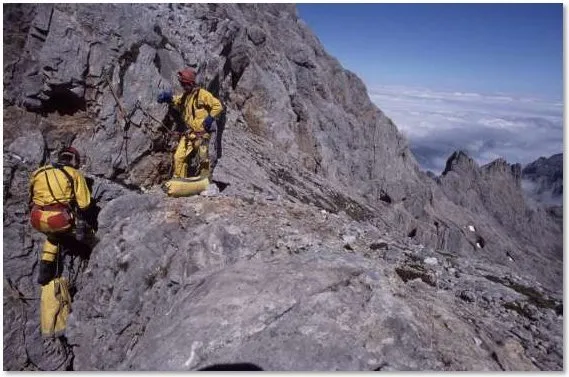
© Spekul · none-stated · Spekul vzw (Leuven) · https://spekul.be/exploration/picos-de-europa/sima-de-la-cornisa-picture-gallery/
Description
Morphology
The 2007 exploration ended at -1,507 m, in a large collector that ends in a sump. In the lower part there are three branches, and each one descends below -1,000 m.
The large shafts have steps of about 90, 145, 95 and 130 m. The cave also includes meanders and galleries with many formations. The exploring clubs produced plan and profile surveys.
Speleothems
There are crystalline crusts with a cauliflower-like appearance. They appear in some galleries located between the shafts and the meanders, alongside many other formations.
Hydrology
The rock is mountain limestone in two thrust sheets, separated by a thin band of griotte limestone, and the interior temperature is about 2 °C. The bottom, reached in 2007, has a large river that ends in a sump. The probable destination is the Cares valley, in the Caín area, and Los Molinos has been proposed as a spring. An important fault that crosses the Hoyo Grande marks the direction.
Progression
The expeditions are carried out in summer and last several weeks, with teams of 6 to 12 people. Bivouacs are set up at -500, -700, -900 and -1,500 m. The material is transported on foot through the mountain. The usual entrance is the Cornisa, not the Torca Magali.
Other details
The catalogue of large cavities of the Federación Española de Espeleología (2024) records for the system a vertical extent of -1,507 m (December 2007) and a development of 6,435 m (September 2007). A 2009 poster by the Belgian explorers speaks of about 6.5 km. Other sources cite -1,508 m or -1,509 m for the deepest point. An IGME guide, with data from April 2009, places it among the deepest pits in the world.
History
- 2001: a Belgian-Spanish team finds the Pozo Clandestino.
- 2002: -700 m.
- 2004: -1140 m.
- 2007: terminal sump at -1507 m.
Earlier, French speleologists discovered the Cornisa and explored it until 2001, when they stopped near -400 m.
The Torca Magali was marked by the Grupo Espeleológico Matallana on 30 August 1999. In September 2004 it was connected with the Cornisa at about -500 m, and from that connection comes the name of the system.
Participating were the Unión de Espeleólogos de Valencia, the Royal Caving Club de Belgique, Spekul (Lovaina) and the Grupo Espeleológico Matallana (León).
User Comments (0)
No comments yet.
Be the first to share your experience!
Registered Explorations (0)
No explorations registered yet.
Register your visit to this cave!
Nearby caves
Contains information from Grottocenter (Wikicaves), grottocenter.org, made available under the Open Database License (ODbL 1.0, https://opendatacommons.org/licenses/odbl/1-0/), modified. · https://grottocenter.org/ui/entrances/25033 · data as of 2026 · Text written by Espeleoworld from public sources. Please ask us before reusing it. · Text by José Luis Membrado Julián (Grandes Cavidades Españolas 2024), Jan Masschelein, David De Roest, David Lagrou, Wim Janse, Vincent Coessens (Sistema Sima de la Cornisa – Torca Magali, Picos de Europa (-1507 m)), Spekul (Picos de Europa), Catastro espeleológico de Castilla y León (Sima de la Cornisa-Torca Magalí (HG.43-L.280), ficha de cavidad), Levante-EMV (via ADENE) (Espeleólogos valencianos llegan a un desnivel -1.503), Diario de León (La novena sima más profunda está en León), IGME (P. N. de Los Picos de Europa, 2ª ed., p. 67 (Geomorfología)), Spekul (Sima de la Cornisa picture gallery) · adapted by Espeleoworld (normalized, translated); the adaptation is licensed Our own text, written from public sources. Please ask us before reusing it. · The derived data is available on request under the ODbL: [email protected]