
EspeleoWorld
Sistema Partacua (Sima PE-6)
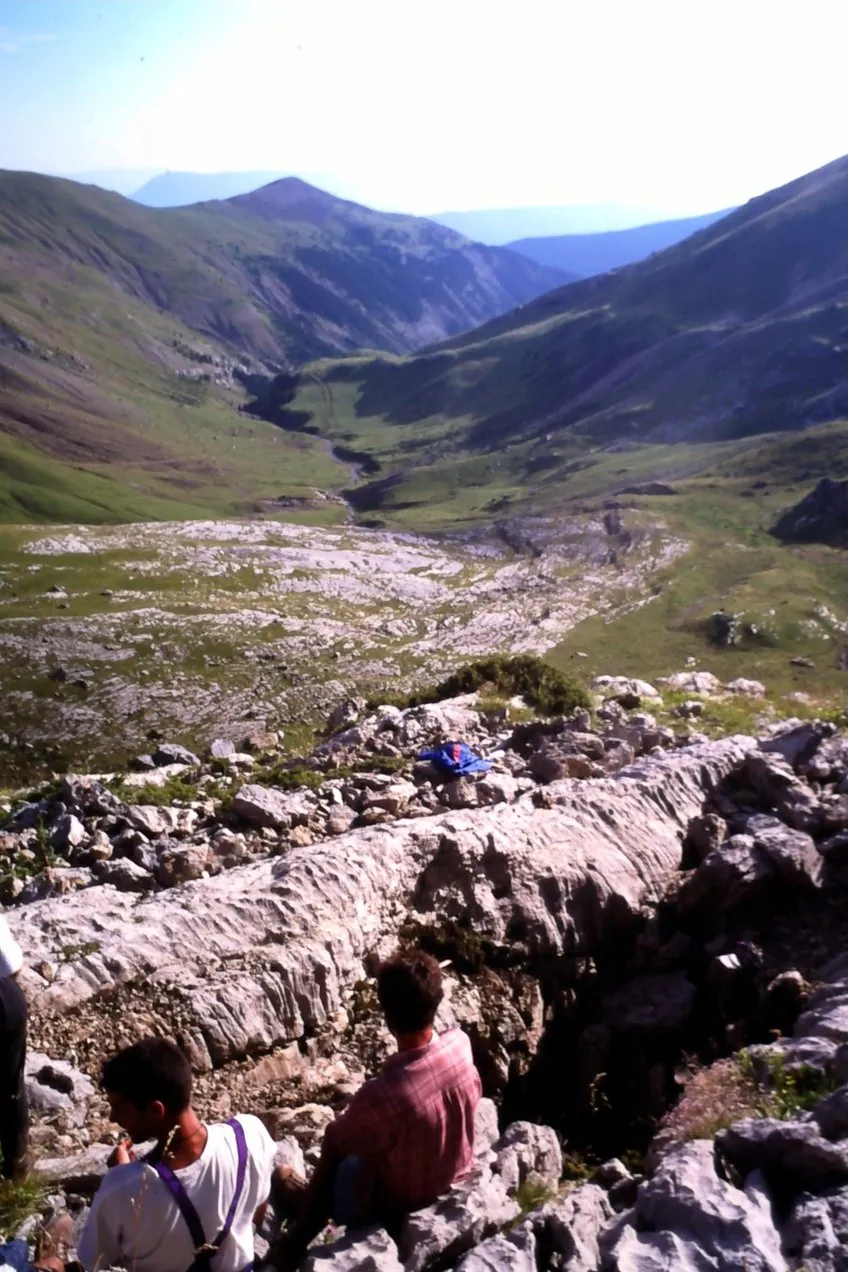
The Partacua System, with its PE-6 entrance, is in the Partacua mountain range (Huesca, Aragón). In September 2016 it had 17,427 m of surveyed passage and a vertical extent of -825 m.
Sabiñánigo
Length: 17427 m · Depth: 825 m
Updated record
https://espeleoworld.com/en/c/sistema-partacua-sima-pe-6-sabinanigo
Information can change. Always verify coordinates, access, weather, and cave conditions before setting out.
The Partacua System, with its PE-6 entrance, is in the Partacua mountain range (Huesca, Aragón). In September 2016 it had 17,427 m of surveyed passage and a vertical extent of -825 m.
Photos

© Societat Espeleològica de València, Club Deportivo Aire Lliure, Grup Il·licità de Muntanyisme · none-stated · SEV, Aire Lliure y GIM (partacua.wordpress.com) · https://partacua.wordpress.com/galeria-de-fotos/
Description
Morphology
The largest dimensions occur at two points. Sala Partácula measures 113 x 50 x 40 m and is the largest chamber. Vía Pastiche has a cross-section of 20 x 15 m and descends 535 m toward the Fadrí river.
Between -292 m and -825 m there is an intermediate network of 8428 m of surveyed passage. Closer to the surface, Galería TransAmazónica measures about 3406 m and reaches -431 m with a north-south orientation. It coincides with a fault visible in the limestone pavement. The fossil galleries have a cross-section of about 10 x 10 m, with block floors and high ceilings.
La Otra Dimensión is the deep part. It consists of dry galleries, in phreatic tubes about 5 m in diameter, at 9-10 °C. To reach it you must pass through Meandro Bukoko and Río Sintopo. These are narrow, wet passages with mud, and they require at least five hours of crawling.
The survey is at a scale of 1:500 and has 1668 survey points.
Speleothems
Between Ojo del Kraken and Sifón del Barro there are filiform formations, along a stretch 989 m long with a vertical extent of -286 m. In Sifón del Barro, where they were discovered in 1999, they measure about 30 cm long and 1 mm in diameter.
Hydrology
The Fadrí river carries about 20 l/s at low water and disappears into a flooded pit 12 x 8 m. The pit was sounded to more than 20 m and is at -825 m. A first collector, a river with a sump toward -814 m, was reached at -804 m in 2006.
The spring presumed to be associated is that of Las Traconeras de Biescas, at 1060 m altitude, although it is not confirmed. In 1998 it was thought that the network draining toward them had been entered. The 2014 prospections in the Acumuer and Betés valleys did not locate a spring with enough flow to link it with the cave.
Progression
In 2012 the deepest point, the sump at -825 m, was considered closed, since it could only be passed by diving. In 2014 the total removal of equipment began. In 2016 the cave was left clean, with fixed ropes only on some climbs. Over the campaigns as a whole, more than 3500 m of rope and 700 carabiners and anchors were used, which were removed as far as possible. More than one hundred cavers from various groups took part.
Other details
The floor of Sala del Oso lies 95 m below a channel in the limestone pavement, and where the animal entered has not been located.
At 100-120 m from PE-6 is Cueva de las Tormentas (PE-8), with a cold air current. In 2016 no connection with the system had been made. The cave Z-12 (Zeta-Peta), found in 2008, was closed in 2013 without continuation or connection.
History
The exploration lasted 20 years, from 1996 to 2016. The SEV's first campaign in the mountain range was in 1996. Before that date, the IEES of Sabadell, at Las Traconeras, and the SIE of Barcelona, at Las Cachivirizas, had already worked in the area.
In August 1997 the entrance was found by chance, in the limestone pavement. It was obstructed by stones and had a strong air current. About 25 m³ of stones were removed and 90 m were descended. In 1998 Sala del Oso was reached, which contains a complete bear skeleton; the environmental authorities were notified. That year there were 1500 m of surveyed passage and a vertical extent of -214 m. In 1999 there were 3163 m and -444 m.
In 2006 La Otra Dimensión was accessed above -700 m. In December 2007 the cave had 14,603 m and -814 m, and in 2008, 14,726 m and -814 m. That year it was the third in Aragón by length and the sixth by depth. In 2011 the Fadrí river and its flooded pit were reached, at -825 m. The exploration was declared finished in 2016.
The work was organized by the Societat Espeleològica de València, the Club Deportivo Básico Aire Lliure (since 1998) and the Grup Il·licità de Muntanyisme (since 2002). They had the support of federations and of the Ayuntamiento de Biescas.
User Comments (0)
No comments yet.
Be the first to share your experience!
Registered Explorations (0)
No explorations registered yet.
Register your visit to this cave!
Nearby caves
Source: Gobierno de Aragón – IGEAR / Observatorio de la Montaña de Aragón (OMA), Inventario de recursos turístico-deportivos: cuevas y cavidades (icearagon.aragon.es), modified. CC BY 4.0, https://creativecommons.org/licenses/by/4.0/ Gobierno de Aragón · Federación Aragonesa de Espeleología, Federación Aragonesa de Montaña · data as of 2024 · Text written by Espeleoworld from public sources. Please ask us before reusing it. · Text by Partacua (SEV, Aire Lliure, GIM) (LA PARTACUA PE-6), SEV, Aire Lliure, GIM (Historia de las exploraciones en la Partacua PE-6), Partacua (SEV, Aire Lliure, GIM) (La Partacua PE-6: Descripción General), David Maragliano Bellvis (Una nueva gran cavidad en el Pirineo: el sistema de Partacua (Subterránea 29)), Partacua (SEV, Aire Lliure, GIM) (Situación Geográfica), Partacua (SEV, Aire Lliure, GIM) (La Partacua PE-6: Topografías), Observatorio de la Montaña de Aragón (Inventario de cuevas y cavidades (tabla)), Partacua (SEV, Aire Lliure, GIM) (PARTACUA: Espeleología en la sierra de Partacua), Partacua (SEV, Aire Lliure, GIM) (Galería de fotos) · adapted by Espeleoworld (normalized, translated); the adaptation is licensed Our own text, written from public sources. Please ask us before reusing it.