
EspeleoWorld
Sima del Baste
La Sima del Baste (A-113) is a cave in Borau, in Huesca, that forms part of the Lecherines karst. Since 10 August 2020 it has been connected to the Sistema Lecherines, whose surveyed development reached 40.9 km in 2025.
Borau
Length: 13089 m · Depth: 759 m
Updated record
https://espeleoworld.com/en/c/sima-del-baste-borau
Information can change. Always verify coordinates, access, weather, and cave conditions before setting out.
La Sima del Baste (A-113) is a cave in Borau, in Huesca, that forms part of the Lecherines karst. Since 10 August 2020 it has been connected to the Sistema Lecherines, whose surveyed development reached 40.9 km in 2025.
Topographic

© Centro de Espeleología de Aragón · none-stated · Centro de Espeleología de Aragón (campaign page) · https://centroespeleoaragon.org/campana-de-exploracion-lecherines-2018/
Photos

© Centro de Espeleología de Aragón · none-stated · Centro de Espeleología de Aragón (campaign page) · https://centroespeleoaragon.org/campana-de-exploracion-lecherines-2018/
Description
Morphology
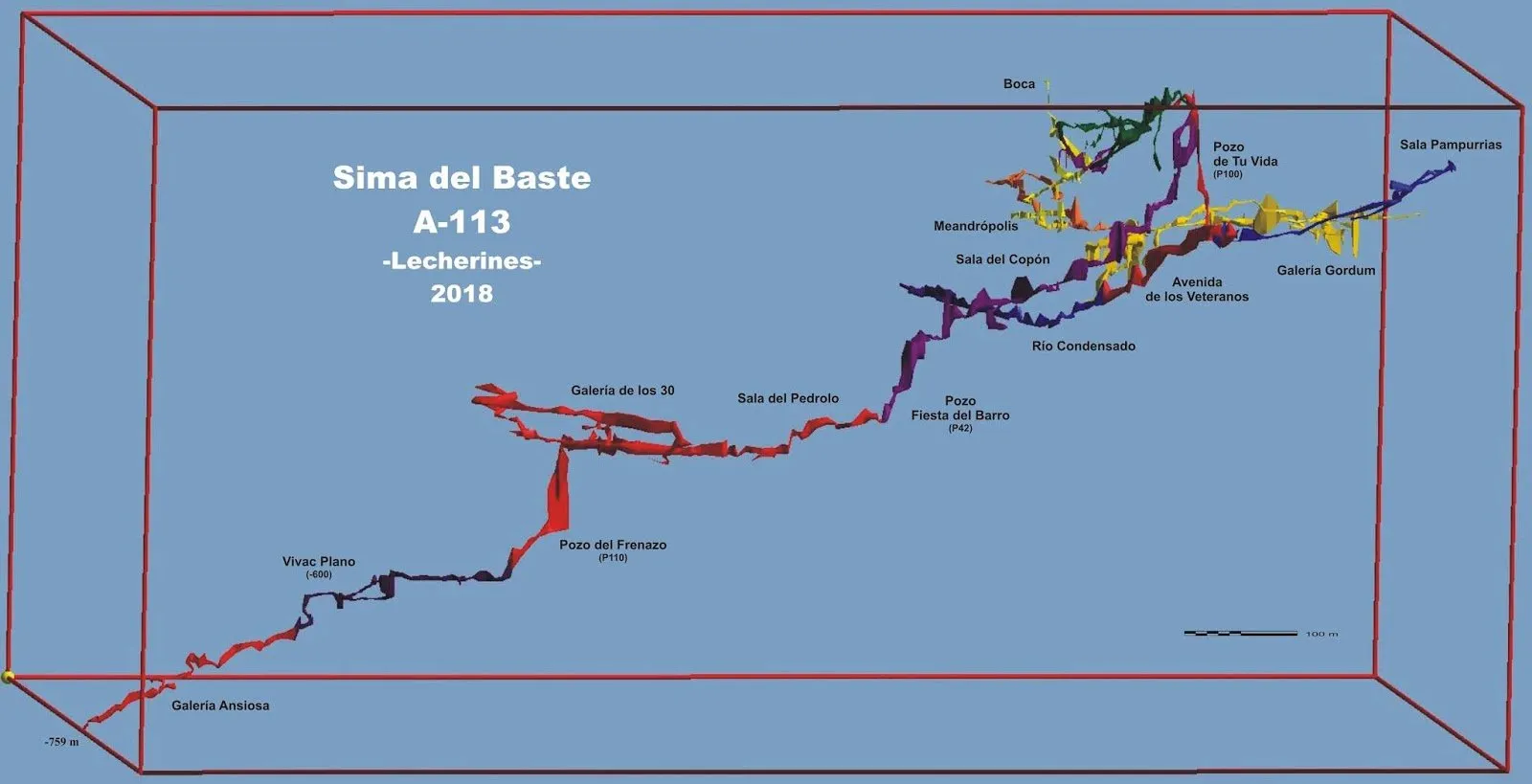
La Sima del Baste has a depth of -759 m, measured in 2018. There a sump closes the Galería Ansiosa. The cave combines a series of shafts with a network of fossil galleries.
The vertical series begins at the entrance, a fissure that the cavers had to widen and through which a lot of air comes out. Then follow the Pozo de Tu Vida, 100 m deep, the Pozo del Averno and, toward -600 m, the Pozo del Frenazo (P110).
The fossil parts are distributed at different levels. At -200 m is the Avenida de los Veteranos, a large conduit reached by several active collectors. At -400 m, the Galería de los 30 brings together wide galleries with intense air circulation, recognized in 2018. The Galería Ansiosa reached -660 m in 2017.
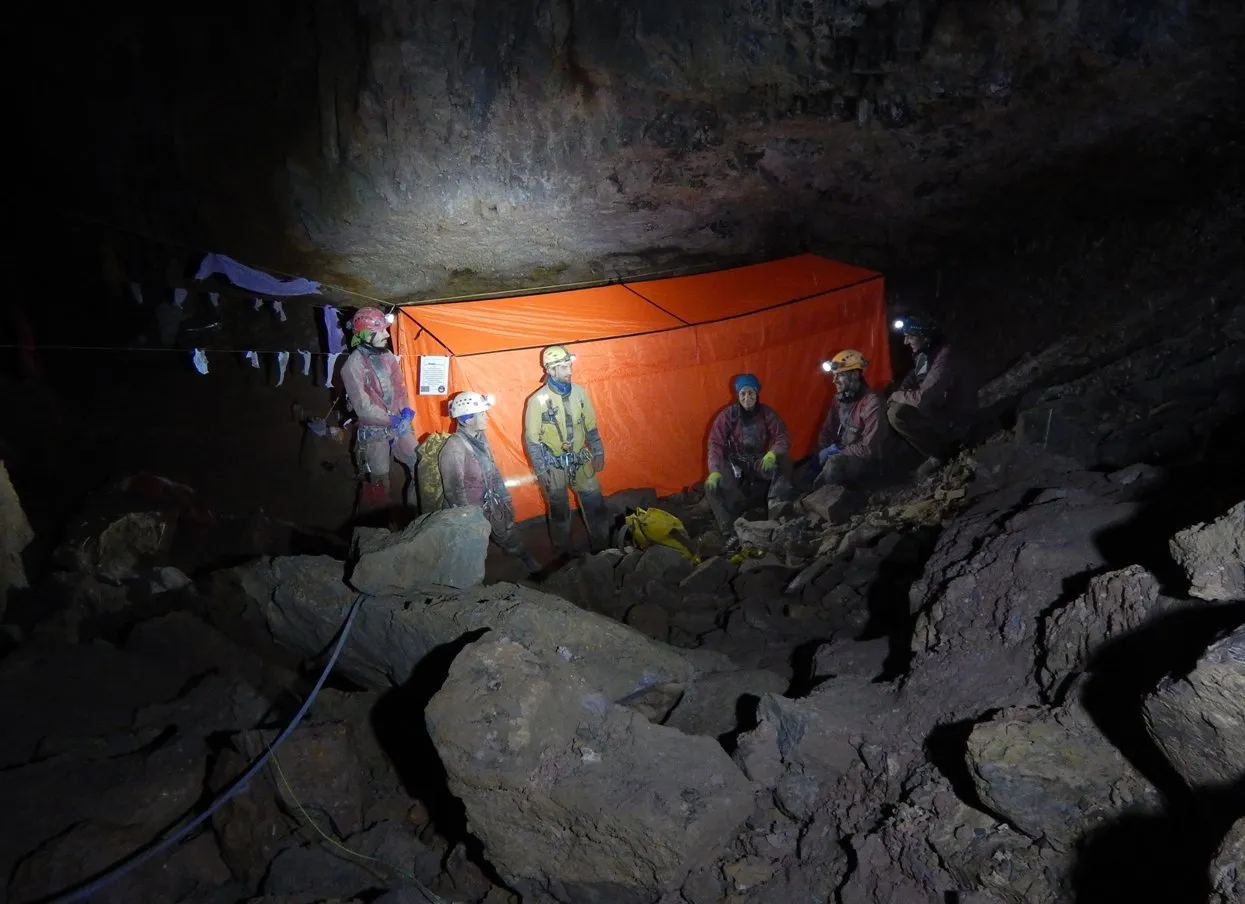
There are three equipped bivouacs: Copón, Plano (at -600 m) and Gordum.
Hydrology
The waters of the system emerge through springs of the río Aragón, next to Villanúa, at 953 m of altitude. A dye tracing carried out in 1994 in the underground river of the system gave a positive result at those springs.
In the Avenida de los Veteranos, at -200 m, several active collectors come together. In 2016 the team reached the main fault and an important active collector.
Progression
The bivouacs facilitate long explorations underground. There are three equipped zones: the Vivac Copón, the Vivac Plano, at -600 m, and the Vivac Gordum. A TEDRA communication was also tested, which works through the conductivity of the ground, and it was installed between the surface and the bivouacs.
Other details
In absorption zone A, la Sima del Baste is the most important cave. The Sistema Lecherines was known by the entrances C-12, C-13, B-13, B-18 and B-28, according to a 2013 list. Before the connection it measured 17,114 m of development and -1009 m of depth.
After the connection, the whole receives the name Sistema Lecherines-Baste. In 2020 it exceeded 33 km, with 33,040 m. In 2023 it passed 37 km surveyed and in 2025 it reached 40.9 km. The link occurred in the sector of the pit, toward -700 m of depth.
Near there is the A-111 cave, called Cueva de Lecherín Bajo. It has 5,030 m of development and 166 m of vertical extent. It is hoped to be able to connect it with galleries of the Baste.
History
The pit was discovered in 2015 by the Centro de Espeleología de Aragón. That year exploration reached -313 m, with 4,000 m of development. The data from the following years are these:
- 2016: 7,500 m of development and 630 m of depth.
- 2017: 10,320 m and -660 m. The Galería Ansiosa reached -660 m.
- 2018: 11,547 m and -759 m.
- 2019: 13,089 m, almost 2 km more than the previous year, with the depth stable at -759 m.
On 10 August 2020 the connection with the Sistema Lecherines was achieved. That system had been under investigation for more than 25 years. The Centro de Espeleología de Aragón has organized annual campaigns in the area since 1987.
In the campaigns 33 people from 5 groups participated in 2023. In 2025 the Centro Espeleología de Aragón, Ranidae Espeleoclub, the Sección Espeleología CAS (Aínsa), the Club de Espeleología Ocho, the Espeleo Club Zaragoza and the S.E. Centro Excursionista Moncayo collaborated. In 2019 the bulletin Aragón Subterráneo no. 2, of the Centro de Espeleología de Aragón, devoted a monograph to the Sistema de Lecherines.
User Comments (0)
No comments yet.
Be the first to share your experience!
Registered Explorations (0)
No explorations registered yet.
Register your visit to this cave!
Source: Gobierno de Aragón – IGEAR / Observatorio de la Montaña de Aragón (OMA), Inventario de recursos turístico-deportivos: cuevas y cavidades (icearagon.aragon.es), modified. CC BY 4.0, https://creativecommons.org/licenses/by/4.0/ Gobierno de Aragón · Federación Aragonesa de Espeleología, Federación Aragonesa de Montaña · data as of 2024 · Text written by Espeleoworld from public sources. Please ask us before reusing it. · Text by Centro de Espeleología de Aragón (LECHERINES (history of explorations, Centro de Espeleología de Aragón)), Centro de Espeleología de Aragón (Campaña de exploración Lecherines 2015), Centro de Espeleología de Aragón (Campaña de exploración Lecherines 2017), Centro de Espeleología de Aragón (Campaña de exploración Lecherines 2018), Centro de Espeleología de Aragón (Campaña de exploración Lecherines 2019), Centro de Espeleología de Aragón (Campaña de exploración Lecherines 2020), Centro de Espeleología de Aragón (Campaña de exploración Lecherines 2023), Centro de Espeleología de Aragón (Campaña de exploración Lecherines 2024), Centro de Espeleología de Aragón (Campaña de exploración Lecherines 2025), descendedor (blog) (Unidas la Sima del Baste con el Sistema Lecherines. Borau (Huesca)), Centro de Espeleología de Aragón (Zenodo) (Aragón Subterráneo. Boletín de exploraciones nº2. Monografía: Sistema de Lecherines) · adapted by Espeleoworld (normalized, translated); the adaptation is licensed Our own text, written from public sources. Please ask us before reusing it.