
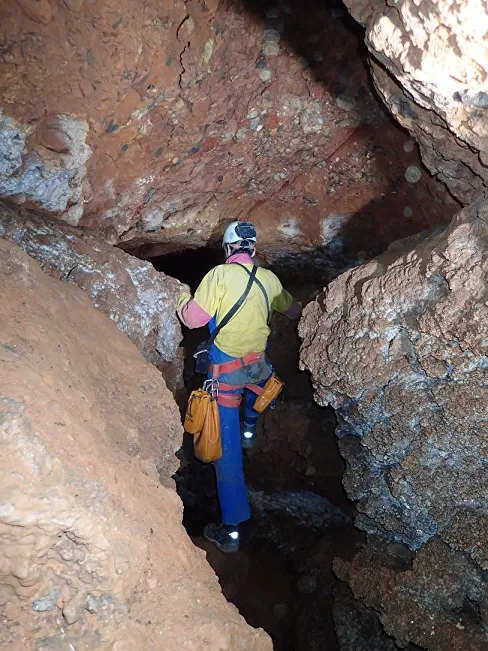
Graller de Castellet
A cavity with 116 m of vertical extent in the municipality of Tremp (Sapeira), explored since 1911. It includes the Pou Jeannel and the Pou de la Piqueta, with a small watercourse and a terminal meander.
EspeleoWorld
Graller de Castellet
A cavity with 116 m of vertical extent in the municipality of Tremp (Sapeira), explored since 1911. It includes the Pou Jeannel and the Pou de la Piqueta, with a small watercourse and a terminal meander.
Tremp · Pallars Jussà
Length: 500 m · Depth: 116 m
Updated record
https://espeleoworld.com/en/c/graller-de-castellet
Information can change. Always verify coordinates, access, weather, and cave conditions before setting out.
A cavity with 116 m of vertical extent in the municipality of Tremp (Sapeira), explored since 1911. It includes the Pou Jeannel and the Pou de la Piqueta, with a small watercourse and a terminal meander.
Topographic
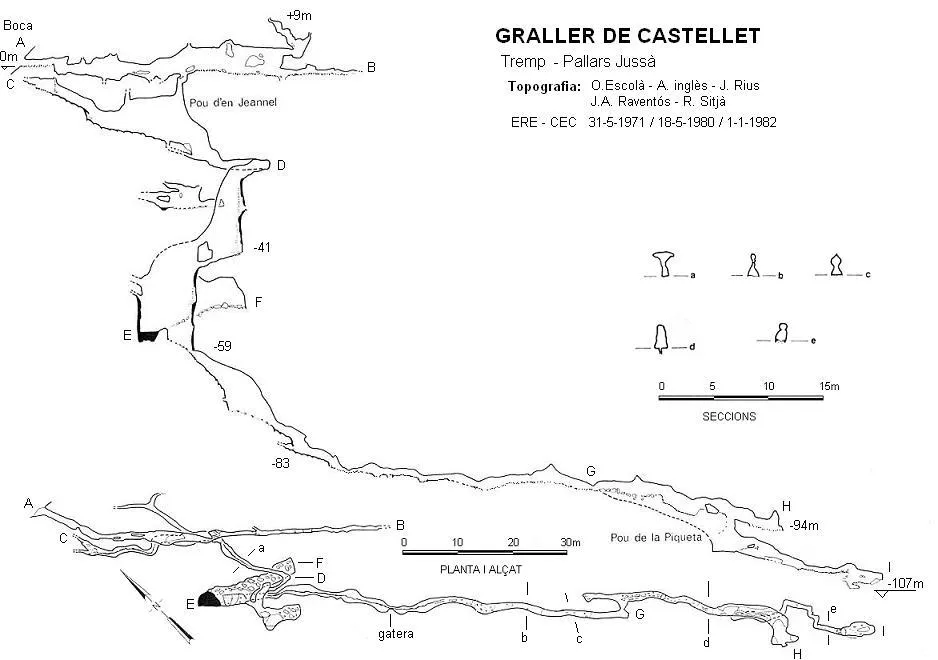
Espeleoindex · CC BY-NC 4.0, https://creativecommons.org/licenses/by-nc/4.0/ · Image © its author.
Photos
Espeleoindex · CC BY-NC 4.0, https://creativecommons.org/licenses/by-nc/4.0/ · Image © its author.
Description
Morphology
Small cave-shaped entrance where the first 10 m must be crawled. After a narrow passage we find a 2 m step and the gallery gains dimensions, ending in a narrow section; shortly before we find an ascending route that places us 9 m above the entrance. Halfway along the gallery a 2.5 m pit followed by another of 12 m places us in a wide gallery. Down the gallery we find a small step and the gallery continues; at one point it makes a sharp turn to the right to finally drop us into a 16.6 m pit (Pou Jeannel). At its base we find on the S side a closed chamber with a floor full of blocks, and on the N side we find a low passage which, once passed, places us in a 17.4 m pit that is quite wet; at its base, at -59 m, we find a chamber of 15 X 16 m with a pool of water 5 X 3 m and 2 deep. The cavity continues in a SE direction on a steep slope, finding a 6 metre pit and several steps, the largest 3 m, until reaching -83 metres where there is a crawl. On the other side of the crawl the gallery loses its slope. The gallery continues subhorizontal with medium dimensions until reaching a narrow fissure (Pou de la Piqueta) that descends 7 m; at its bottom the terminal meander begins, of difficult and painful progress. The total vertical extent is 116 m (+9/-107).
Speleothems
Going up the gallery we find some flowstone; once passed, there is a small chamber whose ceiling receives the water input.
Hydrology
Halfway along the gallery a 2.5 m pit followed by another of 12 m places us in a wide gallery where we normally find a small watercourse. At the base of the 17.4 m pit, at -59 m, we find a chamber of 15 X 16 m with a pool of water 5 X 3 m and 2 deep. On the other side of the crawl the little stream disappears through an impenetrable hole. In times of flooding the crawl cannot be passed as it becomes a sump.
Progression
The first 10 m must be crawled. After a narrow passage we find a 2 m step. An ascending route places us 9 m above the entrance. A 2.5 m pit followed by another of 12 m. A 16.6 m pit (Pou Jeannel). A low passage leads to a 17.4 m pit that is quite wet. The cavity continues in a SE direction on a steep slope with a 6 metre pit and several steps, the largest 3 m, until -83 metres where there is a crawl. The Pou de la Piqueta descends 7 m; at its bottom the terminal meander begins, of difficult and painful progress.
Other details
The total vertical extent is 116 m (+9/-107).
History
First explored on 17 June 1911 by R. Jeannel and E.G. Racovitza during one of their biospeleological research campaigns. They only make a partial exploration of the upper part, estimating an incomplete exploration of about 80 m. This cavity, at least the upper part or cave, has long been known to the inhabitants of the area and is quite often referred to in the popular legends collected by F. Gili and J. Amades. Members of the SIE of the CE Àliga rediscover the cavity and explore the whole upper gallery on 24 September 1966. On 12 and 13 December 1970 members of the ERE of the CE Catalunya visit the cavity and find the continuation, descending the first pit and stopping at the entrance of the next. They return on 23 and 24 January 1971, when they reach -84 metres in a crawl that they begin to dig open. On 29 to 31 May of the same year they carry out the total exploration of the cavity, finishing digging open the Pou de la Piqueta and passing with considerable effort the very narrow terminal passage that leads to the -107 m level. In July 1971 and April 1972 the people of the SIE return to the cavity and carry out a survey that will be published in 1974, although it fails to represent the final stretch. In May 1980 a team of the ERE-CEC decides to survey the accursed terminal meander again, which they achieve, and it is not until January 1982 that they consider the total survey finished, publishing it that same year.
Note on toponymy: When Jeannel and Racovitza visited the cavity in 1911 they named it lo Graller, on the indications of the local people, and they place it at la fayada de Castellet (sic). It should be noted that the entrance of the cavity does not meet any of the conditions to call it a classic graller. It is not a pit, nor a fissure and of course the gralles do not nest there. When in 1966 it is rediscovered by the SIE-CEA they mention it as Espluga de la Fageda and consider that this is the most appropriate name. When in 1970 it is visited by the ERE-CEC they recover the name given by Jeannel and Racovitza and, to differentiate it from other grallers in the area, they decide to add the name of the nearest village, Castellet. So both denominations are valid and each person may use whichever they prefer. It should be said, however, that recently, in September 2020, speaking with one of the very few inhabitants remaining in Castellet, he assured us that he has always known it (and he is more than 80 years old) as lo Graller and that he had never heard the other name.
Bio
Coleoptera
- Stygiophyes latebricola latebricola (Jeannel, 1911) (previously: Speonomus latebricola (Jeannel, 1911))
- Troglocharinus (Troglocharinus) quadricollis (Jeannel, 1911) (previously: Speophilus quadricollis (Jeannel, 1911))
User Comments (0)
No comments yet.
Be the first to share your experience!
Registered Explorations (0)
No explorations registered yet.
Register your visit to this cave!
Bibliography
- Jeannel, R. et Racovitza, E.G. (1912).-“Énummération des grottes visitées 1909-1911 4éme série”. Arch. Zool. Expér. Gén. (T. IX):637-638.
- Gili, Fulgenci. (1933).-“Recull de llegendes”. Graons (Vol. II, 30). Barcelona.
- Amades, J.(1936).- “Tradicions i creences” La Terra 30-31.
- Amades, J.(1949).- “Tradicions i llegendes” El Pirineu 175 pp. Xilografies de E.C. Ricart. Edicions La Llumenera. Barcelona.
- Folch, M; Victoria, JM; Ferro, A. (1967).-“El karst de la sierra de Lleràs. Espeleosie. (1):16-21. SIE-CE Àliga. Barcelona.
- Escolà, Oleguer. (1982).-“Nota sobre el graller de Castellet sapeira (pallars jussà)”. Espeleòleg (33):164-169. ERE-CE Catalunya. Barcelona.
- Cardona i Oliván, Ferran. (1989).-“La Serralada Pirinaica” Grans Cavitats de Catalunya” (Volum l):167-172. EC Gràcia. Barcelona.
- Amades, Joan (2001).- Llegendes de coves, roques, mar i estanys catalans. Farell Editors. Sant Vicenç de Castellet.
- Revisió coordenades (2012) facilitades per Jordi Navarro, (Centre Excursionista de Castellar del Vallès).
- Recull de fotografies actuals extretes del web: espeleodijous.cat Apunt del 17-9-2020
Nearby caves

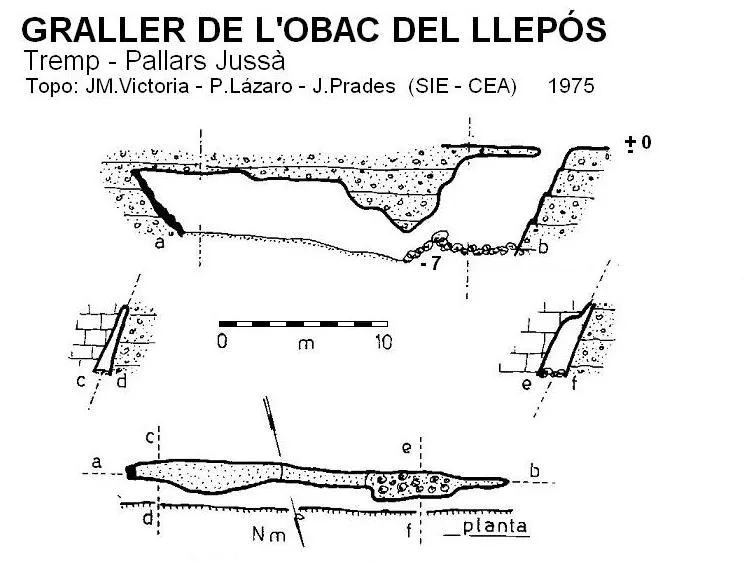
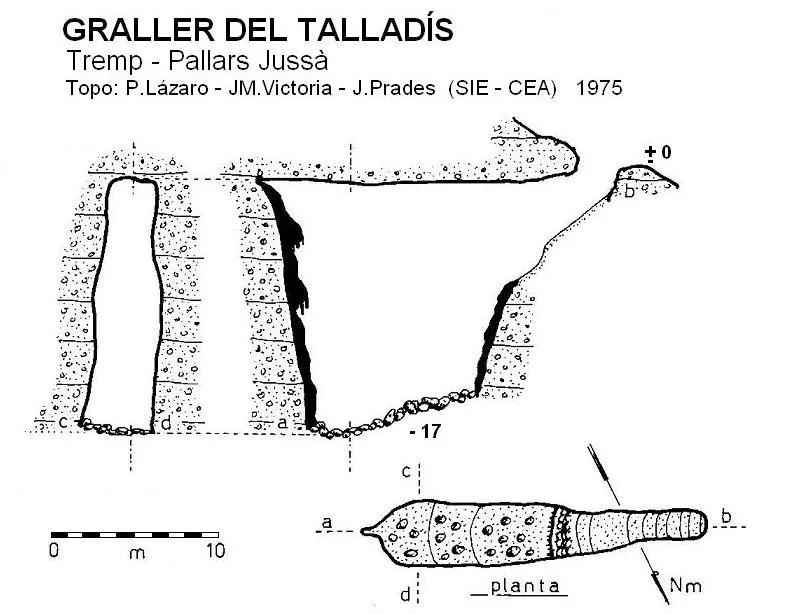
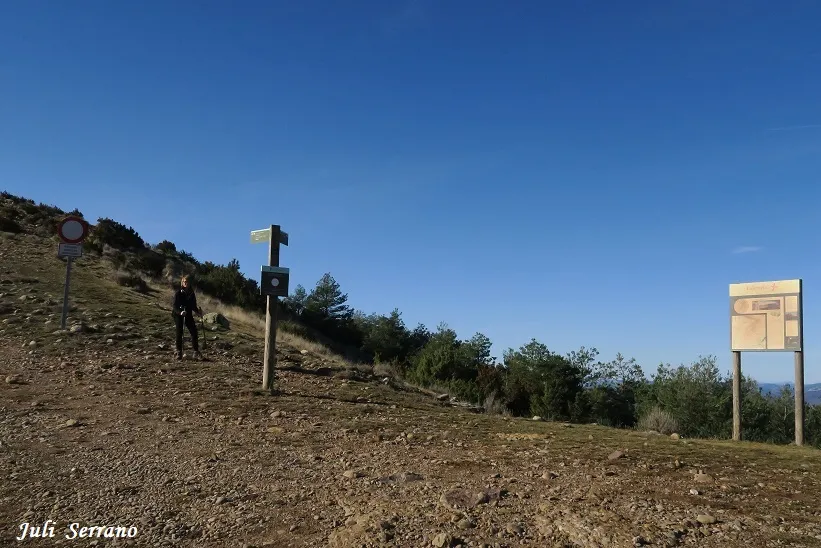


Source: Espeleoindex (espeleoindex.com), modified. CC BY-NC 4.0, https://creativecommons.org/licenses/by-nc/4.0/