
Forat Roig
A pit 18 metres deep in Oliola, with an entrance 0.7 metres in diameter, a 4-metre vertical drop and a pool of water at -18 metres.
EspeleoWorld
Forat Roig
A pit 18 metres deep in Oliola, with an entrance 0.7 metres in diameter, a 4-metre vertical drop and a pool of water at -18 metres.
Oliola · Noguera
Length: 31 m · Depth: 18 m
Updated record
https://espeleoworld.com/en/c/forat-roig-oliola
Information can change. Always verify coordinates, access, weather, and cave conditions before setting out.
A pit 18 metres deep in Oliola, with an entrance 0.7 metres in diameter, a 4-metre vertical drop and a pool of water at -18 metres.
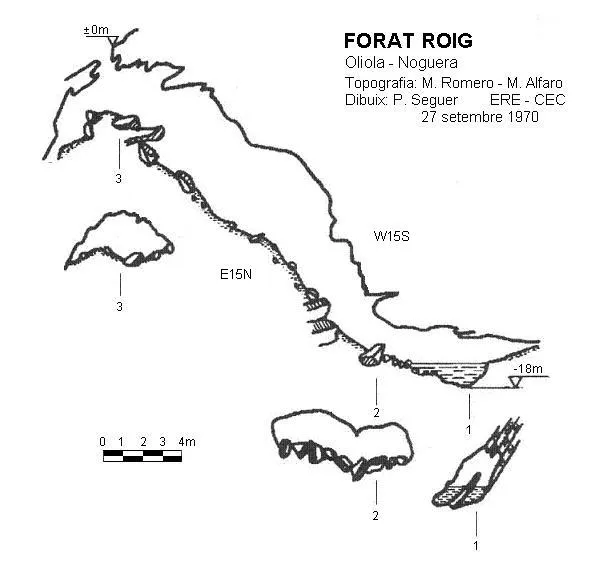
Topographic
Espeleoindex · CC BY-NC 4.0, https://creativecommons.org/licenses/by-nc/4.0/ · Image © its author.
Photos
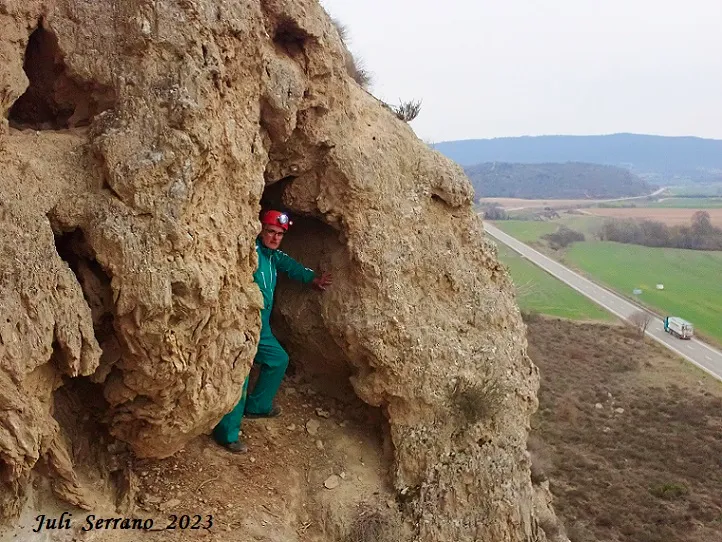
Espeleoindex · CC BY-NC 4.0, https://creativecommons.org/licenses/by-nc/4.0/ · Image © its author.
Description
Morphology
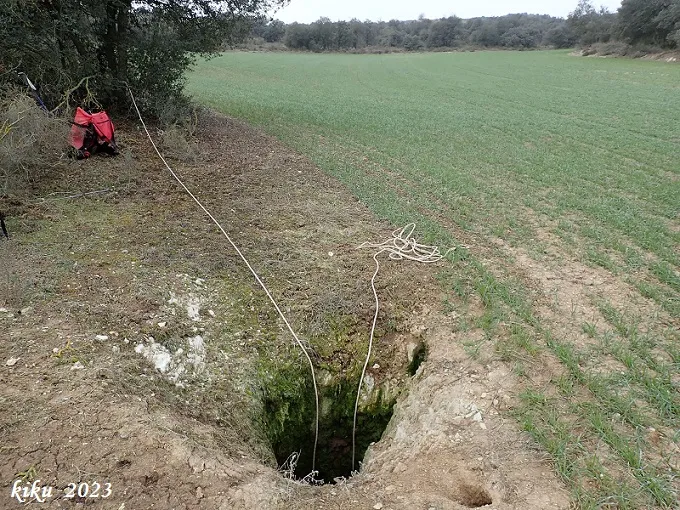
An entrance 0.7 metres in diameter that gives access to a 4-metre vertical drop; at the base we find ourselves at the top of a cone of debris. On the E side, the continuation is very problematic since there is only a small opening that appears to continue, but which would need to be cleared. On the W side, one descends down a steep ramp, very wide, until reaching the deepest zone of the hole (-18 metres).
Hydrology
In the deepest zone of the hole (-18 metres) we find a pool of water.
Progression
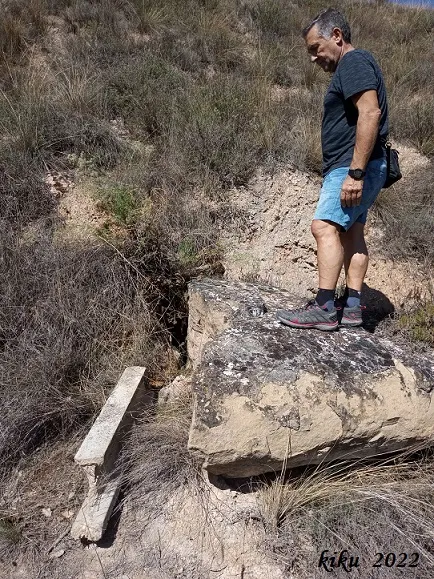
Currently (2022) the entrance is almost blocked by a block of rock and a small cement beam; by removing the beam we can see the shaft and feel the air current, but to be able to enter the entrance would need to be cleared on the side where there is no block of rock. The current entrance would need to be widened in order to pass.
History
During the 1970s, according to information provided by the ERE of the CEC, the first explorers of the cavity, and also by members of the SIE of the CEA who had explored it in those years, it was full of decomposing animal carcasses (lambs, pigs, a horse, etc). Currently (2022) the entrance is blocked by a large block of stone and a piece of beam; by removing this the shaft can be seen.
User Comments (0)
No comments yet.
Be the first to share your experience!
Registered Explorations (0)
No explorations registered yet.
Register your visit to this cave!
Bibliography
- Ferro i Guitart, Antonio.(1972).-“Avance al catastro del karst en yesos de la cuenca del río Llobregós”. EspeleSie (11):55-73.SIE-CE Àliga. Barcelona.
- Romero i Rectoret,Martí; Alfaro i Faus,Manel(1972).-“El karst en guix d'Oliola”. Muntanya (661):100-102.Centre Excursionista de Catalunya. Barcelona.
- Gàzquez i Pons, Josep Lluís.(1995).-“Catàleg Espeleològic de la Noguera”. Grallera (3-4):1-90. GELL – CE Lleida.
- Valles, Jordi de (2008).-”Alt Urgell, Noguera, Pla d'Urgell, Segarra, Solsonès, Urgell”. Catàleg Espeleològic de Catalunya (vol.2):1-384. EC Gràcia/FCE.
- Actualització de dades, coordenades i fotografies facilitades per Juli Serrano (SIE-CEA) i Francesc Rubinat (ERE-CEC) Setembre de 2022.
Nearby caves


Source: Espeleoindex (espeleoindex.com), modified. CC BY-NC 4.0, https://creativecommons.org/licenses/by-nc/4.0/