
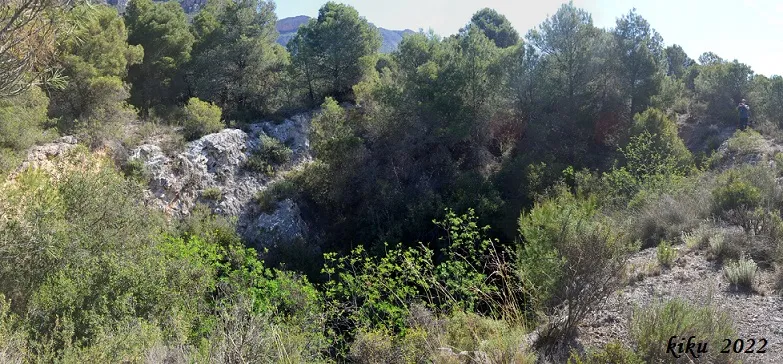
Forat del Túnel
Gran depressió oberta en guixos.
EspeleoWorld
Forat del Túnel
Gran depressió oberta en guixos.
Camarasa · Noguera
Length: 32 m · Depth: 8 m
Updated record
https://espeleoworld.com/en/c/forat-del-tunel
Information can change. Always verify coordinates, access, weather, and cave conditions before setting out.
A large open depression in gypsum, 31x17 metres with 11 metres of vertical drop, full of vegetation, with a railway tunnel passing 75 metres below it.
Topographic
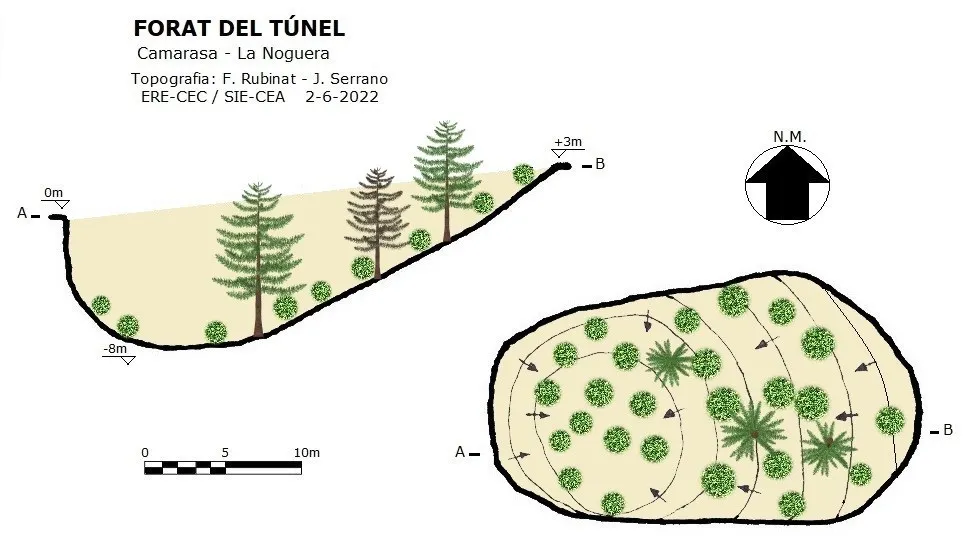
Espeleoindex · CC BY-NC 4.0, https://creativecommons.org/licenses/by-nc/4.0/ · Image © its author.
Photos
Espeleoindex · CC BY-NC 4.0, https://creativecommons.org/licenses/by-nc/4.0/ · Image © its author.
Description
Morphology
It is an open depression in gypsum measuring 31x17 metres, with a vertical drop of 11 metres from the upper lip and 8 metres from the lower lip.
From the E side, where the upper lip is located, a steep ramp allows us to descend to the bottom of the depression; the rest are almost vertical walls. Inside we find it full of vegetation, with some pines as a result of the forest repopulation carried out in the area at the beginning of the 70s of the last century.
Other details
As a curiosity, it is worth mentioning that 75 metres below, in the vertical of the cavity, passes the tunnel of the Lleida-Pobla de Segur railway line.
History
In the history of this cavity, urban legends intertwine with part of reality. Having family ties in Camarasa allowed me during the sixties and seventies of the last century to spend some time there and to have the opportunity to talk with the elderly people who had taken part both in the construction of the Camarasa dam and in the excavation of tunnel 3 of Coll de Porte and who were still alive.
As for the tunnel built in the mid-twenties of the last century, it has the particularity that during its excavation a large cavity was found inside. In order to bypass it, part of the tunnel was built supported by a 70-metre-long viaduct. This viaduct consists of four spans of 10 metres each, supported on double piers. The design makes use of the tunnel's shape so that the tunnel's side walls form two continuous beams on which the deck rests. The elderly people told me that more than seven train wagons loaded with cement were needed to build the viaduct. Furthermore, during the excavation of the tunnel at this point a spring of water appeared, which made them stop the excavation for almost a month until no more water came out; as a result, they said, part of the mountain above collapsed. In the 1945 ICGC aerial photographs it can be seen that the hole was already there.
Taking into account that the terrain is gypsum, the relationship between both phenomena cannot be ruled out.
User Comments (0)
No comments yet.
Be the first to share your experience!
Registered Explorations (0)
No explorations registered yet.
Register your visit to this cave!
Bibliography
- Dades aportades per Joan Cabeza (espeleoblog.blogspot.com) post del dia 5/2/2016.
- Dades, coordenades, topografia, i fotografies aportades per Juli Serrano (SIE-CEA) i Francesc Rubinat (ERE-CEC) +aportació històrica.
Nearby caves


Source: Espeleoindex (espeleoindex.com), modified. CC BY-NC 4.0, https://creativecommons.org/licenses/by-nc/4.0/