
Els òbits
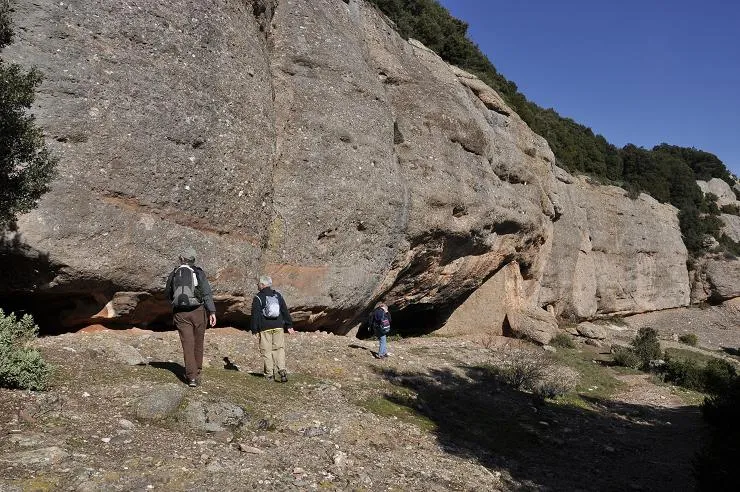
A group of small caves at the foot of the cingle dels Òbits, in Sant Llorenç del Munt, with remains of ancient buildings, a small spring and the Cau de la Moneda.
EspeleoWorld
Els òbits
A group of small caves at the foot of the cingle dels Òbits, in Sant Llorenç del Munt, with remains of ancient buildings, a small spring and the Cau de la Moneda.
Matadepera · Vallès Occidental
Length: 100 m · Depth: 6 m
Updated record
https://espeleoworld.com/en/c/els-obits
Information can change. Always verify coordinates, access, weather, and cave conditions before setting out.
A group of small caves at the foot of the cingle dels Òbits, in Sant Llorenç del Munt, with remains of ancient buildings, a small spring and the Cau de la Moneda.
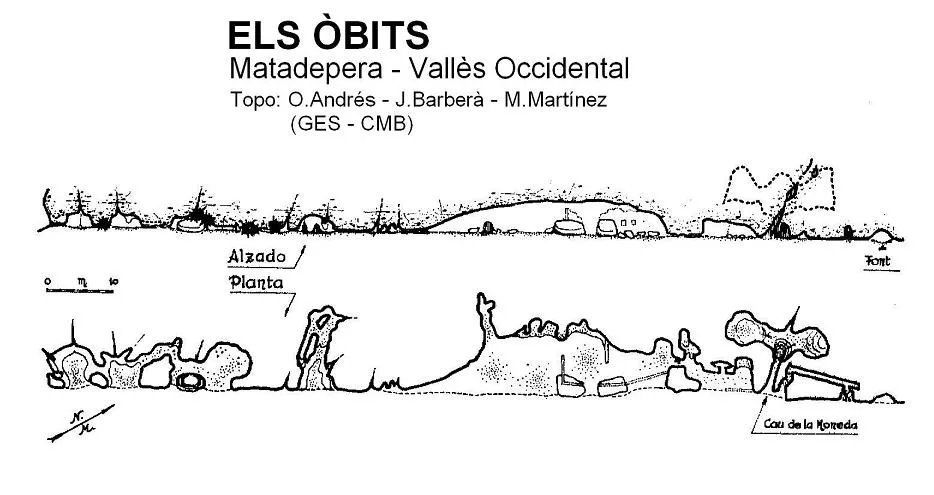
Topographic

Espeleoindex · CC BY-NC 4.0, https://creativecommons.org/licenses/by-nc/4.0/ · Image © its author.
Photos

Espeleoindex · CC BY-NC 4.0, https://creativecommons.org/licenses/by-nc/4.0/ · Image © its author.
Description
Morphology
At the base of the cingle and along some 130 metres of it, a whole series of cavities of different section develops, but all of them of very little length.
The last of the concavities, shortly before reaching the spring, has its own name: Cau de la Moneda. Through an inclined joint one reaches a small chamber of 16 by 4 metres in plan and with a height of some 6 metres.
Hydrology
At the northern end of the group there is a small spring that is fed by small infiltrations.
Progression
The route of approximately 100 metres is the one given by the authors of the survey, who add up the total of existing passages, which nowadays does not seem very orthodox.
Other details
In the broad vestibule of the largest of the entrances, the remains of ancient buildings are still preserved.
History
Known since time immemorial. There is already news of a human settlement in the 12th century. Later it seems that they were used by hermits; at the beginning of the 18th century they were inhabited by a hermit who called himself Bartomeu de Sant Llorenç del Munt, although his name was Andreu Joan Rico. Until the end of the 18th century the cavity was known as Cova del Penitent. Afterwards, some masovers settled in the balmes and they were called Mas del Òbits, which was inhabited until 1860-1865. During the carlinada (1872-1876) the house was set on fire in order to prevent the Carlists from taking refuge there. Until relatively recent times they were used as a corral.
The cavity known as Cau de la Moneda, they say, was used to make counterfeit coin.
Obviously, the cavity has been mentioned in all the old catalogues and in the extensive excursionist bibliography on Sant Llorenç del Munt.
Bio
Coleoptera: Speophilus kiesenwetteri (collected by Novelles).
User Comments (0)
No comments yet.
Be the first to share your experience!
Registered Explorations (0)
No explorations registered yet.
Register your visit to this cave!
Bibliography
- Aymamí, G. (2008).- “Notes d'algunes cavitats de Catalunya emprades en la fabricació de moneda falsa”. EspeleoCat (6): 36-40. Federació Catalana d'Espeleologia. Barcelona.
- GES-CMB (1974).- Catálogo espeleológico de la provincia de Barcelona. 198 pp. Club Montañés Barcelonés /Diputación Provincial de Barcelona.
- Coordenades i fotografies facilitades per Alfred Montserrat (ERE - CEC)
Nearby caves
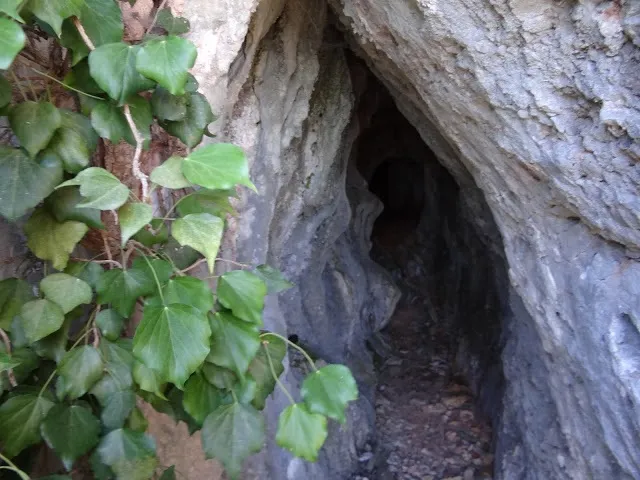
Cova del Cingle dels òbits
0.2 km · NE
Matadepera (Vallès Occidental)
1 topo.3 photos
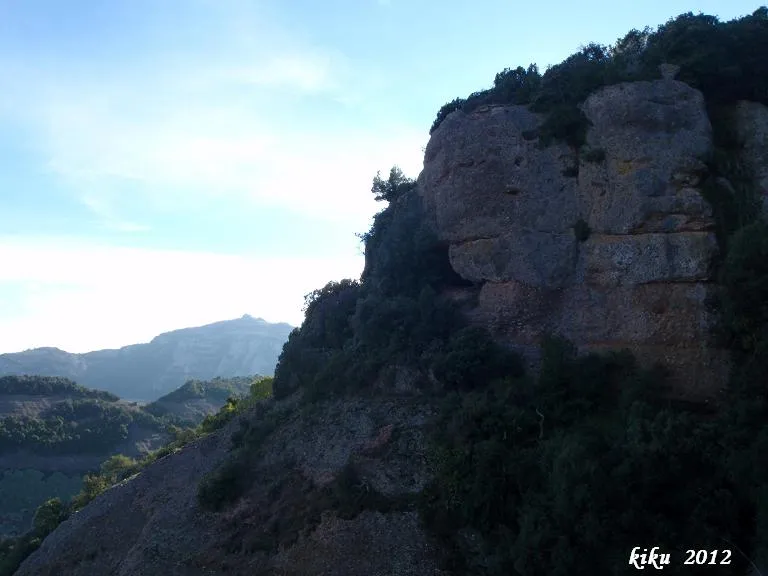
Avenc Quim Solbas
0.3 km · E
Sant Llorenç Savall (Vallès Occidental)
1 topo.12 photos
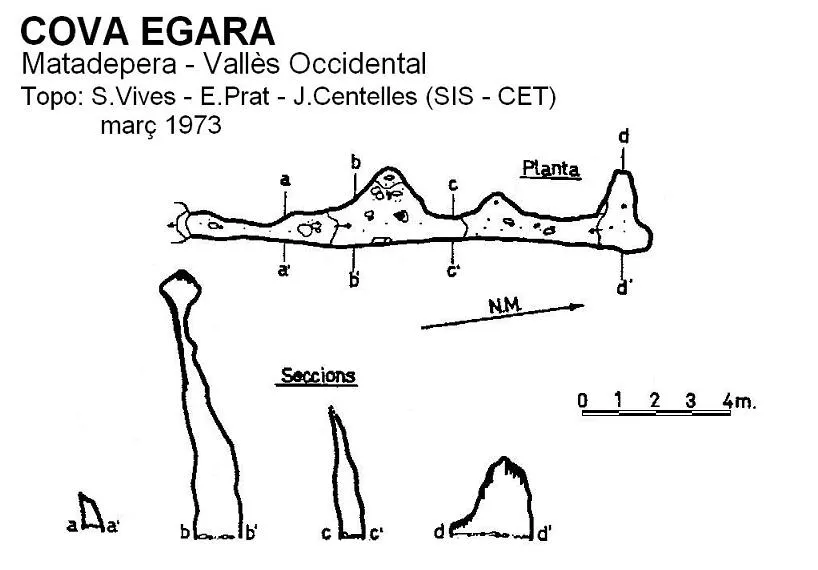
Cova Egara
0.4 km · SW
Matadepera (Vallès Occidental)
1 topo.
Cova de la Canal del Boc
0.4 km · SE
Matadepera (Vallès Occidental)
1 topo.5 photos
Source: Espeleoindex (espeleoindex.com), modified. CC BY-NC 4.0, https://creativecommons.org/licenses/by-nc/4.0/