
EspeleoWorld
Cueva de Maltravieso
A karst cave in Cáceres famous for its prehistoric art, now closed to the public and protected by an interpretation center inaugurated in 1999.
Cáceres
Length: 77 m
Updated record
https://espeleoworld.com/en/c/cueva-de-maltravieso-caceres
Information can change. Always verify coordinates, access, weather, and cave conditions before setting out.
A karst cave in Cáceres famous for its prehistoric art, now closed to the public and protected by an interpretation center inaugurated in 1999.
Photos

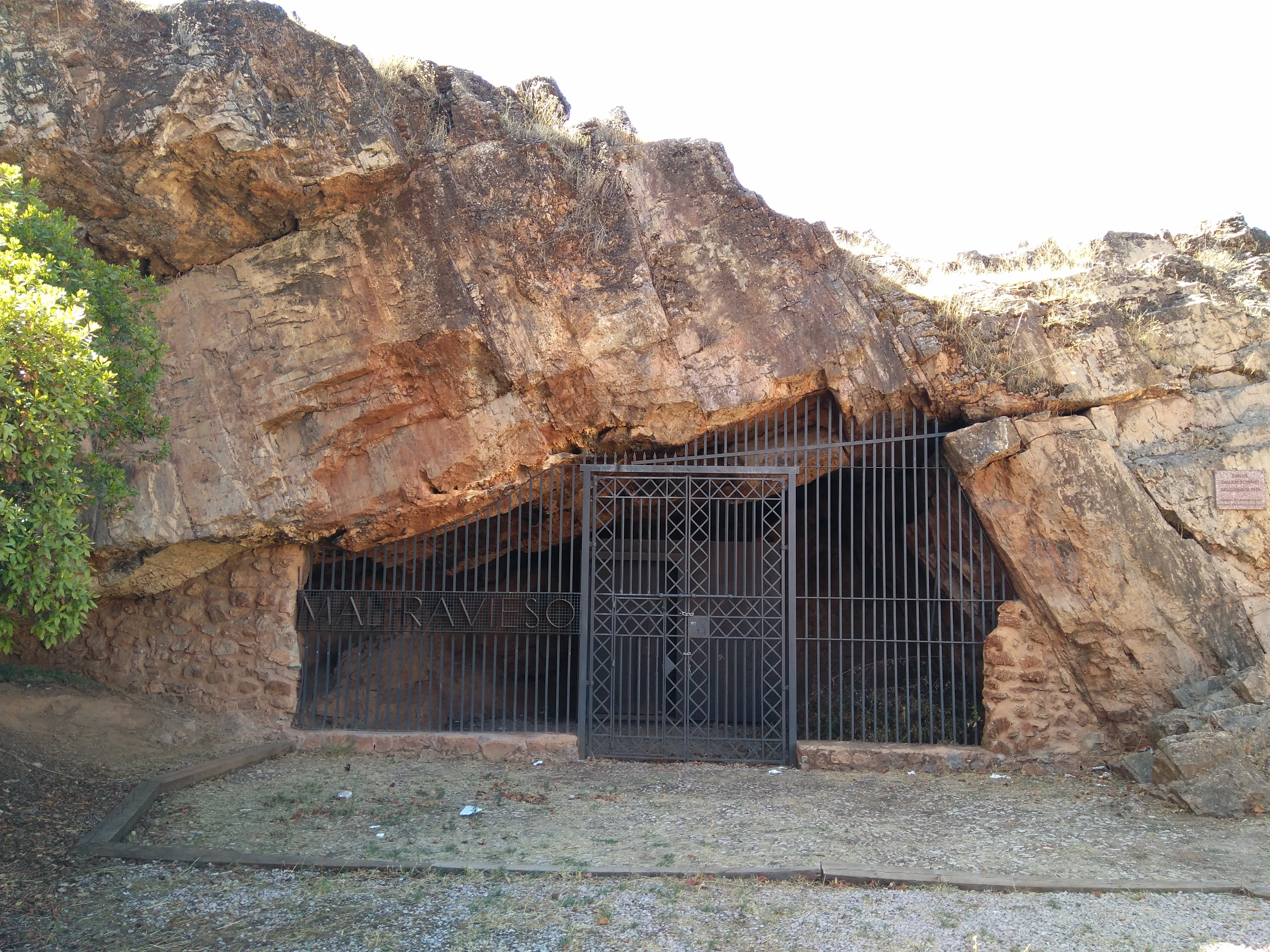
© Edurne Castillo Prieto · CC BY-SA 4.0, https://creativecommons.org/licenses/by-sa/4.0/ · Wikimedia Commons · https://commons.wikimedia.org/wiki/File:Cueva_de_Maltravieso_02.jpg
Description
Morphology
The cave has a length of 77 m today, but is estimated to have been more than 130 m long. The first 30 m of the cave were destroyed in the years following its discovery.
Other details
To protect the cave and its paintings, the Centro de Interpretación de la Cueva de Maltravieso (Interpretation Center of the Cave of Maltravieso) was inaugurated in 1999. It is a subdivision of the Archeology Section of the Cáceres Museum. As the cave paintings are fragile, the cave is closed to the public. The Interpretation Center shows maps and pictures of the cave and the paintings, and gives detailed information about the scientific exploration and the involved researchers.
History
The cave was a shelter for hunter-gatherers for the last 350,000 years. Most remains are from the Upper Paleolithic, Neolithic, and Bronze Age. The early remains are from Homo neanderthalensis, the younger from Homo sapiens. There are Upper Paleolithic reddish paintings and thirty hand negatives, triangular geometric patterns, serpent-like lines and dots with parallel lines. Also, there are engravings, the most impressive of a deer in profile.
The cave was discovered in 1952 during quarry works in a limestone quarry in the city of Cáceres. Despite some initial discoveries of human remains and ceramics, the quarrying went on. The quarry was finally closed in 1956 after Carlos Callejo Serano discovered cave paintings, and the cave was finally set under protection.
User Comments (0)
No comments yet.
Be the first to share your experience!
Registered Explorations (0)
No explorations registered yet.
Register your visit to this cave!
Nearby caves
Contains information from Grottocenter (Wikicaves), grottocenter.org, made available under the Open Database License (ODbL 1.0, https://opendatacommons.org/licenses/odbl/1-0/), modified. · https://grottocenter.org/ui/entrances/20316 · data as of 2026 · Source: Show Caves of the World (Jochen Duckeck) (www.showcaves.com), modified. CC0 1.0, https://www.showcaves.com/english/TermsOfUse.html Show Caves of the World (showcaves.com), Jochen Duckeck · Text by Jochen Duckeck (Cueva de Maltravieso) · adapted by Espeleoworld (normalized, translated); the adaptation is licensed CC0 1.0, https://www.showcaves.com/english/TermsOfUse.html · length, names, description · obtained 2026-11-19 · data as of 2026 · The derived data is available on request under the ODbL: [email protected]