
Cueva de El Soplao
Cave in Cantabria in the sierra de Arnero, famous for its helictites, with 23,253 m of development and 224 m of vertical extent. It is a show cave and an antigua mina (former mine) of zinc and lead.
EspeleoWorld
Cueva de El Soplao
Cave in Cantabria in the sierra de Arnero, famous for its helictites, with 23,253 m of development and 224 m of vertical extent. It is a show cave and an antigua mina (former mine) of zinc and lead.
Rionansa
Length: 23253 m · Depth: 224 m
Updated record
https://espeleoworld.com/en/c/cueva-de-el-soplao-rionansa
Information can change. Always verify coordinates, access, weather, and cave conditions before setting out.
Cave in Cantabria in the sierra de Arnero, famous for its helictites, with 23,253 m of development and 224 m of vertical extent. It is a show cave and an antigua mina (former mine) of zinc and lead.
Photos
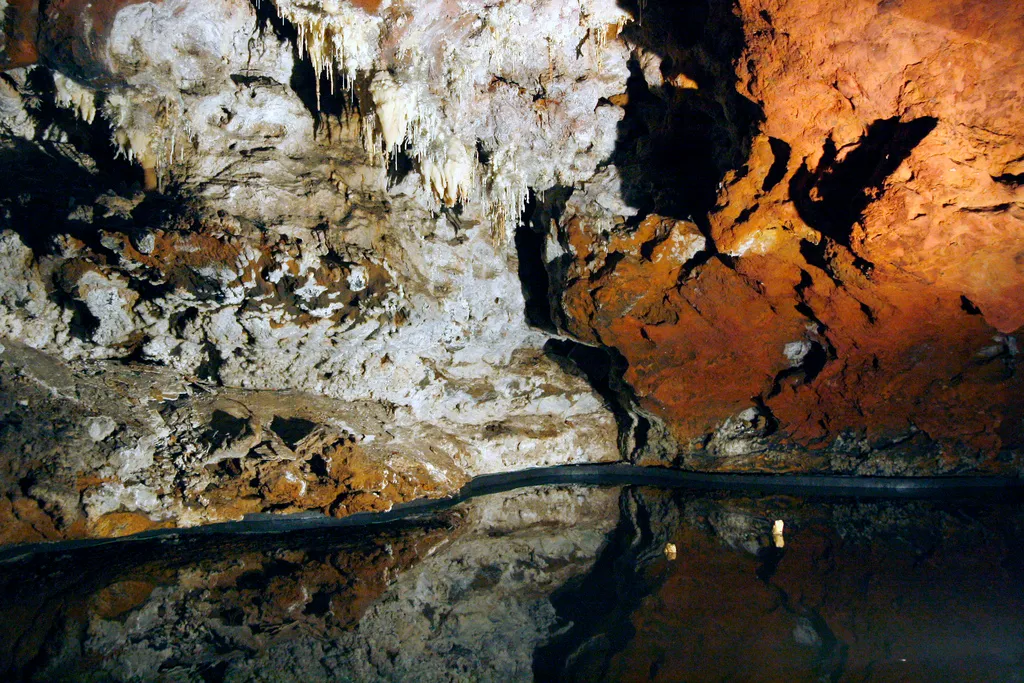
© María Jesús Tomé · CC BY 2.0, https://creativecommons.org/licenses/by/2.0/ · Wikimedia Commons · https://commons.wikimedia.org/wiki/File:Cueva_de_El_Soplao,_Cantabria.jpg
Description
Morphology
The host rock is Aptian dolomite (Lower Cretaceous), with lead and zinc mineralization. The natural network has several levels and is crossed by many mining galleries, so that cave and mine form a single complex.
The length went from about 20 km around 2009 to 21,990 m in 2015 and 23,253 m in the 2019 federation list. The depth is 224 m, measured in 2010.
The Sala de las Catedrales is between 70 and 110 m in diameter. The Sala de los Bloques measures about 140 x 60 m, with ceilings of more than 40 m. Both were found in 2014-2015 and are part of a fossil level located between 40 and 50 m above the main galleries. On the tourist route are the galería de los Fantasmas, about 350 m long, and the Gorda, an artificial lake.
Speleothems
The cave is known for the helictites, calcite that grows in all directions and covers entire ceilings. There are also red and white flowstone deposits from the local minerals, gours, giant columns and nests of cave pearls (pisolites).
The manganese oxide stromatolites, of bacterial origin, are found in an ancient underground channel and are about 1 million years old.
The uncommon mineral zaccagnaite-3R has been identified. Aragonite, calcite, dolomite, sphalerite, galena, marcasite and pyrite are also cited from the mine and the cave.
Hydrology
The cave is today largely dry, but it preserves traces of an ancient underground river, in whose deposits the manganese stromatolites formed. In the tourist sector there is an artificial pool in the Gorda gallery.
Progression
The tourist visit covers a conditioned stretch of about 1,500 m, reached by a mining train. There is also an adventure tourism option that allows entry into less transformed galleries, such as those of the Bosque and the Coliflor. The rest of the cavity is reserved for exploration and surveying with permission.
Other details
About 3 km from the cave is the Rábago amber deposit, announced in July 2008, with abundant Cretaceous insects and other arthropods. The site has been proposed as a geological site of international relevance.
The word "soplao" was used by miners for the natural cavities they found in their works, because of the air current they produced. That current gave the cave its name.
History
Between 1908 and 1910, some miners opening a tunnel in La Florida reached a natural gallery. The air current gave the cave its name. The mineral was extracted for decades, until mining ended in 1978.
The speleological history, by length:
- 1975: the Speleo Club Cántabro carries out the first systematic exploration, with an underground camp of 25 hours (12 September); about 2 km.
- 1977: more than 8 km, two years later.
- 1987: the first complete survey is published, together with that of the Torca Ancha–Torca Juñoso system; somewhat more than 11 km.
- 2009–2010: new 3D survey, with 19,768 m.
- 2014–2015: the Agrupación Espeleológica GET explores new upper galleries.
- Current list of large cavities of the Spanish federation: 23,253 m.
The western sector was opened to the public on 1 July 2005, by the Government of Cantabria.
User Comments (0)
No comments yet.
Be the first to share your experience!
Registered Explorations (0)
No explorations registered yet.
Register your visit to this cave!
Nearby caves

Contains information from Grottocenter (Wikicaves), grottocenter.org, made available under the Open Database License (ODbL 1.0, https://opendatacommons.org/licenses/odbl/1-0/), modified. · https://grottocenter.org/ui/entrances/168708 · data as of 2026 · Source: Grottocenter (Association Wikicaves), worldwide collaborative cave database (grottocenter.org), modified. CC BY-SA 3.0, https://creativecommons.org/licenses/by-sa/3.0/ Grottocenter (Wikicaves) · Text by Biboc (Cueva de El Soplao) · https://grottocenter.org/ui/entrances/168708 · data as of 2026 · Source: Show Caves of the World (Jochen Duckeck) (www.showcaves.com), modified. CC0 1.0, https://www.showcaves.com/english/TermsOfUse.html Show Caves of the World (showcaves.com), Jochen Duckeck · names · obtained 2026-11-19 · data as of 2026 · Text written by Espeleoworld from public sources. Please ask us before reusing it. · Text by José Luis Membrado Julián (Grandes Cavidades Españolas 2024), Agrupación Espeleológica GET (Cueva de El Soplao 2015. Memoria de actividades), Wikipedia (Cueva de El Soplao), Cuevas Turísticas de España (Cueva El Soplao, una cavidad única), Wikipedia (Cave of El Soplao), Wikimedia Commons (Category:Cave of El Soplao) · adapted by Espeleoworld (normalized, translated); the adaptation is licensed Our own text, written from public sources. Please ask us before reusing it. · The derived data is available on request under the ODbL: [email protected]