
EspeleoWorld
Cueva Coventosa
Karst system of Arredondo (Cantabria) with about 37 km of galleries and 829 m of vertical extent, linking Cueto, Coventosa and the Cuvera spring.
Arredondo
Length: 37258 m · Depth: 829 m
Updated record
https://espeleoworld.com/en/c/cueva-coventosa-arredondo
Information can change. Always verify coordinates, access, weather, and cave conditions before setting out.
Karst system of Arredondo (Cantabria) with about 37 km of galleries and 829 m of vertical extent, linking Cueto, Coventosa and the Cuvera spring.
Photos
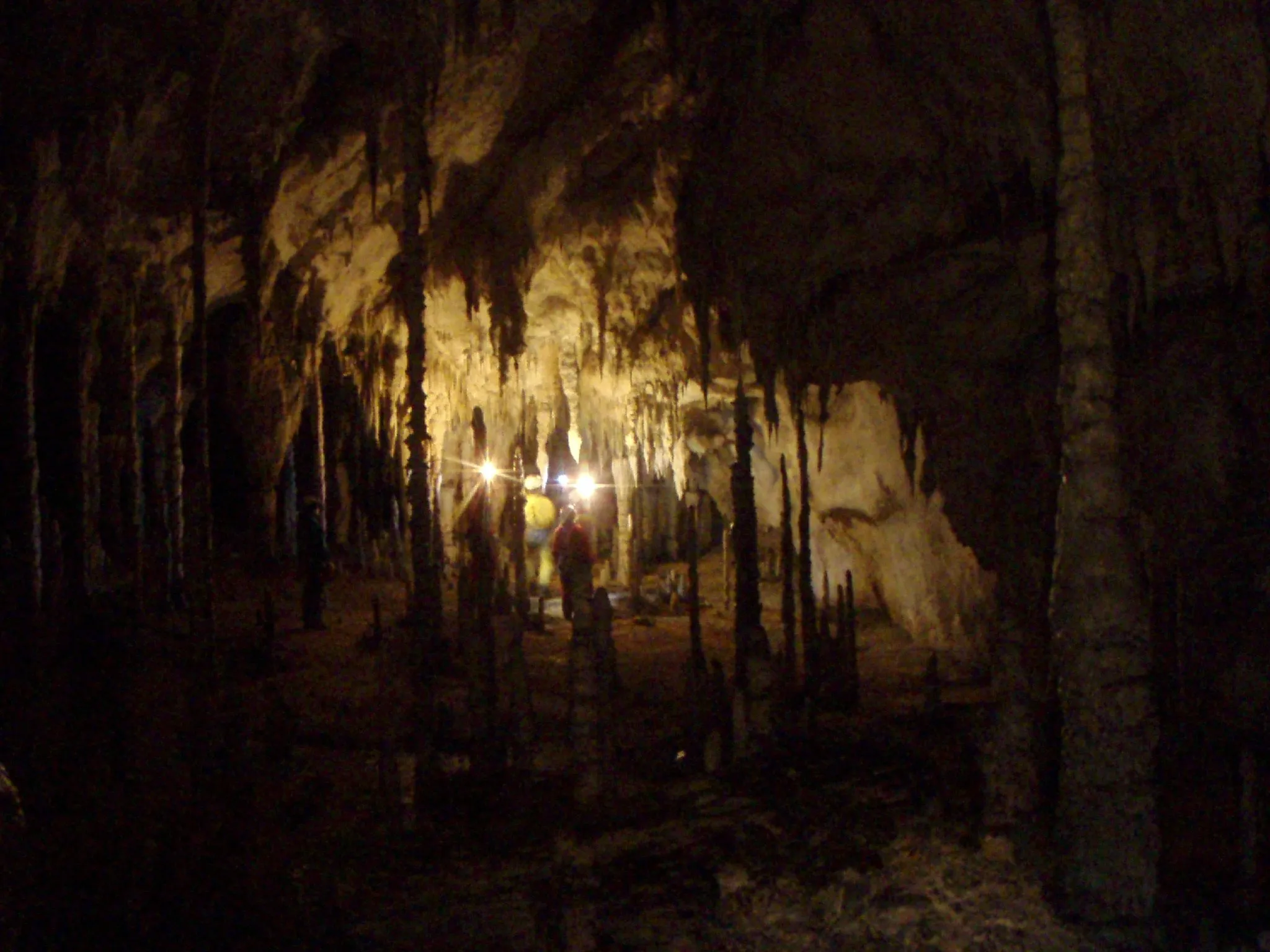
© Roberto Lumbreras · CC-BY-2.0 2.0 · Roberto Lumbreras, CC BY 2.0, via Wikimedia Commons · https://commons.wikimedia.org/wiki/File:Coventosa.jpg
Description
Morphology
The Federación Española de Espeleología includes the system of Cueto, Coventosa, Garma de Bucebrón, Cuvera and Corzo in its list of large cavities. It has 37,258 m of development (November 2020) and 829 m of vertical extent (December 2018). The two figures are from different dates.
The Cueto-Coventosa traverse links the entrances of Cueto and Coventosa, and has been described by foreign clubs. Between the two entrances there are 695 m of vertical extent and the route exceeds 6 km.
Pozo Juhué is about 300 m deep, and there are also several smaller shafts, some with pendulums. The Sala de las Once Horas is a dry fossil gallery of almost 12,000 m². El Chicarrón is a large gallery, about 40 m in diameter. An intermediate network of small and very narrow passages connects the fossil galleries with the lower part.
Hydrology
The water emerges at La Cuvera, next to the Asón-Arredondo road. The active lower part has a river, and floods after rain or thaw can be strong. The Gran Cañón is about 70 m high and about 8 m wide. The lower part has three lakes, from 100 to 150 m long each.
History
In the vestibule of Coventosa, a panel of red figures was located and presented as a set of Palaeolithic art. At the request of the heritage service of the Government of Cantabria, a team from the University of Cantabria directed by Diego Garate Maidagan analysed it. It concluded that the paintings are not Palaeolithic, due to technical and representational errors and to the organisms covering the surface.
User Comments (0)
No comments yet.
Be the first to share your experience!
Registered Explorations (0)
No explorations registered yet.
Register your visit to this cave!
Nearby caves

Contains information from Grottocenter (Wikicaves), grottocenter.org, made available under the Open Database License (ODbL 1.0, https://opendatacommons.org/licenses/odbl/1-0/), modified. · https://grottocenter.org/ui/entrances/24941 · data as of 2026 · Source: Karsteau (Fédération Française de Spéléologie et Canyon) (www.karsteau.org), modified. CC BY-NC-SA (version not stated by the source), https://www.karsteau.org/karsteau/index.php Karsteau (Fédération Française de Spéléologie et Canyon) · names · obtained 2026-11-11 · https://www.karsteau.org/karsteau/recherche/entree/recherche_entree.php?entree=20886 · data as of 2026 · Text written by Espeleoworld from public sources. Please ask us before reusing it. · Text by José Luis Membrado Julián (Grandes Cavidades Españolas 2024), Wessex Cave Club (Cueto Coventosa (through trip description)), Universidad de Cantabria, Actividad Gráfica Prehistórica (Study on the Authenticity of the Coventosa Cave Paintings), Roberto Lumbreras (File:Coventosa.jpg), Roberto Lumbreras (File:Cueva de Coventosa.jpg) · adapted by Espeleoworld (normalized, translated); the adaptation is licensed Our own text, written from public sources. Please ask us before reusing it. · The derived data is available on request under the ODbL: [email protected]