
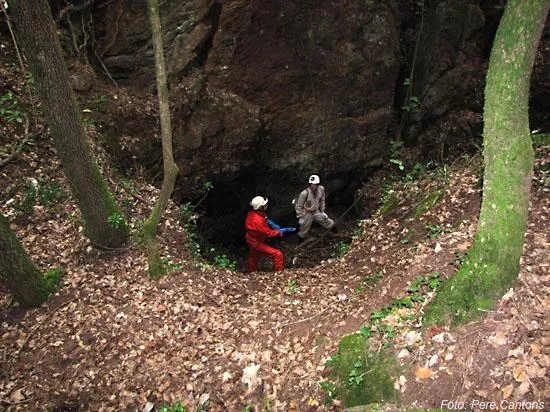
Coves del Masiet
Interessant sistema de 521 metres de recorregut excavat en guixos, a Mont-ral.
EspeleoWorld
Coves del Masiet
Interessant sistema de 521 metres de recorregut excavat en guixos, a Mont-ral.
Mont-ral · Alt Camp
Length: 521 m · Depth: 48 m
Updated record
https://espeleoworld.com/en/c/coves-del-masiet
Information can change. Always verify coordinates, access, weather, and cave conditions before setting out.
A 521-metre-long system excavated in gypsum at Mont-ral, with three sectors: Masiet Vell, Sector Central or the doline sector, and Masiet Nou. Total elevation difference of 48.40 metres (+15.80/-33).
Topographic
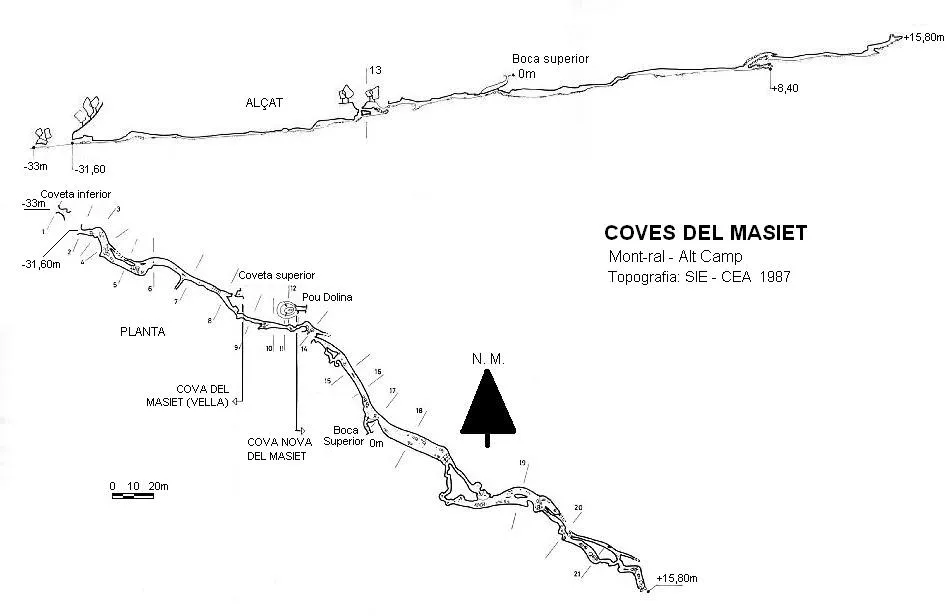
Espeleoindex · CC BY-NC 4.0, https://creativecommons.org/licenses/by-nc/4.0/ · Image © its author.
Photos
Espeleoindex · CC BY-NC 4.0, https://creativecommons.org/licenses/by-nc/4.0/ · Image © its author.
Description
Morphology
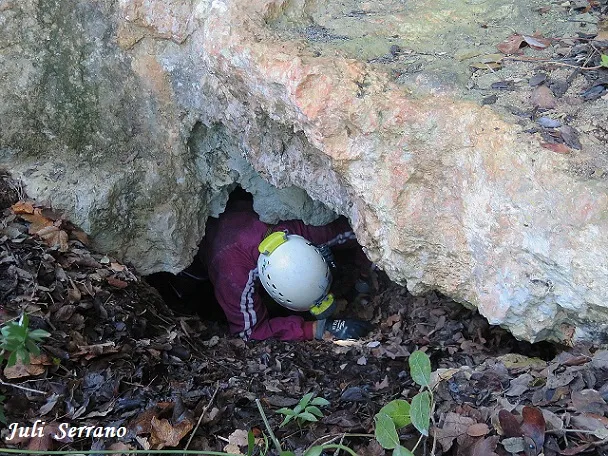
Masiet Vell: This sector has a triangular entrance of 2.50x2.50 metres, located at elevation -31.60 of the cavity. It consists basically of a bedding plane about 100 metres long, slightly meandering, generally oriented at 110º, with a flat ceiling and a floor of silts, except for the entrance chamber, covered with large blocks, and the sector between 20 and 50 metres of greater volume, with the floor full of small and medium-sized debris and an arched ceiling, which follow a more easterly direction.
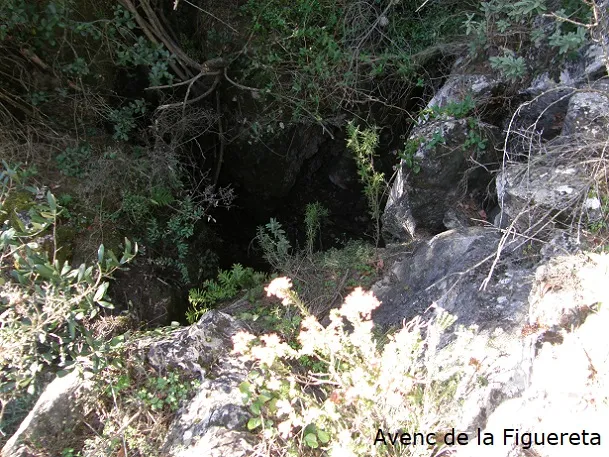
Sector Central or the doline sector: In a doline formed by an earthy funnel about 10 metres in diameter by 6 deep, the lower entrance of Masiet Nou and the entrance of a small shaft of -3.20 metres open. This shaft has a circular plan and an inclined floor, full of debris. We find two continuations, one to the E (a bedding-plane crawl connecting with Masiet Nou) and the other at the bottom of the ramp, narrow and between blocks, which gives access to a bedding plane that a few metres later gains volume, transforming into a small chamber, continuing along a narrow, high gallery (1.20x4 metres), which after 10 metres suddenly transforms into an almost filled bedding plane that links with Masiet Vell.
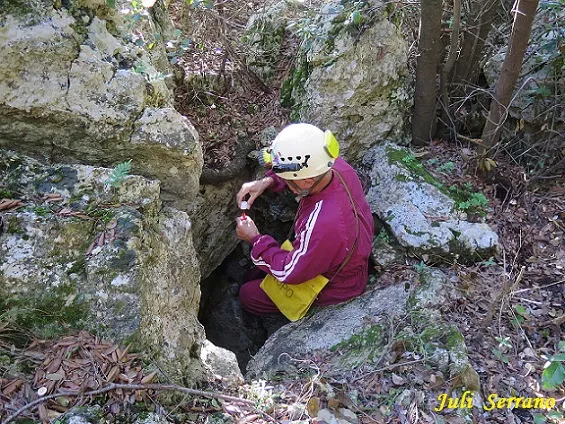
Masiet Nou: About four metres away from the aforementioned doline, the terminal wall of a depression (the bottom of a closed valley) opens, in the lower part of which and on the N wall there are two entrances, one at each end. The NW one, between blocks, descends steeply to the floor of a short gallery that continues towards the NW, on two levels, the lower in the form of a crawl-bedding plane that communicates with the bottom of the doline shaft and the upper one (+2.60 metres) which after 6 metres leads us to the entrance in the wall of the central doline.
Once again at the bottom of the entrance depression, in the E part, there is the second entrance (1.80x1.50 metres) almost blocked by a block, past which the straight gallery continues, bifurcating at 8 metres, to rejoin in a small chamber a few metres later (the left-hand route is recommended). The cavity continues along a straight gallery of 2x3 metres with the floor full of blocks, which communicates after about 20 metres through a corner of a triangular chamber full of debris. In the opposite corner to the right and after overcoming a couple of steps, one can exit again to the outside through a small entrance; this is the upper entrance where elevation 0 of the cavity is located. The cavity continues through the other corner, between blocks, past which we find ourselves at the start of the largest-volume stretch of the cavity, formed by a gallery of 40 metres with a flat ceiling. This sector ends in a set of gours, continuing through crawls located at different levels from one another (passing through the upper one is recommended), and which after 50 metres rejoin. The continuation is a straight stretch of greater volume that becomes a double parallel bedding plane of about 25 metres, rejoining again and the gallery being reduced to a narrow crawl between debris. Practically at the junction of the double part of the bedding plane, there is a ramp between blocks that leads us to elevation +8.40 metres, to a gallery with an average section of 2.50x2 metres, which after a small step of -2.20 metres bifurcates into a crawl at a lower level and a gallery, with the floor formed by block barriers, until they rejoin again about 35 metres further on. A few metres after the junction, a step of +2.50 metres places us in the terminal chamber, which on a steep slope leads us to the maximum elevation of the cavity +15.80 metres. The total elevation difference is 48.40 metres (+15.80/-33) and 521 metres of passage.
Speleothems
In the Masiet Nou sector, after a gallery of 40 metres with a flat ceiling, there is a set of gours.
Hydrology
The floor of the connecting bedding plane is formed by a layer of muddy water about 25 centimetres deep; this makes the attempt turn into a mud immersion.
Progression
To access via the lower entrance, follow the hose for about 80 metres. To access via the Masiet Nou entrance, follow the track to the next torrent and from there follow a path upstream for about 100 metres. In Masiet Nou, past the second entrance, the straight gallery bifurcates at 8 metres and the left-hand route is recommended. Further on, in the set of crawls at different levels, passing through the upper one is recommended.
History
The cova del Masiet was already catalogued and superficially described by Joan Ferraté in 1918.
In 1964 the SIE-CE Àliga explored about 50 metres until reaching a muddy bedding plane where they abandoned the exploration.
On 1 and 2 July 1967 the SIE explored 150 metres of galleries and carried out a partial survey of the cova del Masiet. The cova Nova del Masiet was discovered.
On 8 and 9 July 1967 the SIE explored 150 metres of galleries in the cova Nova del Masiet, completing the survey.
In 1971 the survey of the cova del Masiet was published in the magazine Senderos (146).
On 26 May 1985 the SIE began the survey of the elevation of the cave and the location of the entrances.
On 12 October 1985 the SIE carried out the clearing of the bottom of the doline, explored and surveyed up to the connection with Masiet Vell and began the clearing of the connecting bedding plane; these works ended in September 1986 when the passage continuing with the new part was forced. The survey would be finished in 1987.
Bio
Pseudoscorpions: Neobisium (Neobisium) ventalloi
Amphipods: Pseudoniphargus africanus, Echinogammarus berilloni
Diplopods: Cylindroiulus punctatus, Parathyphloiulus sp.
Coleoptera: Porotachys bisulcatus
User Comments (0)
No comments yet.
Be the first to share your experience!
Registered Explorations (0)
No explorations registered yet.
Register your visit to this cave!
Bibliography
- Borrás, J.; Miñarro, J.M.; Talavera, F.(1978).-”l'Alt Camp, la Conca de Barberà, el Baix Penedès i el Tarragonès”. Catàleg Espeleològic de Catalunya (Vol 2):1-246. Ed políglota. Barcelona.
- Cardona i Oliván, Ferran.(1990).-”El sistema mediterrani i la depressió central”. Grans Cavitats de Catalunya (Segon Volum):1-484. EC Gràcia. Barcelona.
- Fadrique, F.(1971).-”La Cova de Can Masiet”. Senderos (146):23-26. Unió Excursionista de Catalunya.
- Fadrique, F.(1972).-”Cova Nova de Can Masiet”. Senderos (158):23-26. Unió Excursionista de Catalunya.
- Ferraté, J.(1918).- Espeleologia a les Comarques Tarragonines.134 pp. Reus.
- Ferro, Antoni.(1990).-”El sistema en guixos de les Coves Can Masiet”. EspeleoSie (31):38-43. SIE – CE Àliga. Barcelona.
- Coordenades i fotografies extretes del blog “Espeleobloc” post del dia 18 d'abril de 2011.
Nearby caves


Source: Espeleoindex (espeleoindex.com), modified. CC BY-NC 4.0, https://creativecommons.org/licenses/by-nc/4.0/