
Coves de Mura
A 184 m long cave in Mura (Serra de l'Obac), with a single N-S gallery, aragonite formations and a history dating back to the 19th century.
EspeleoWorld
Coves de Mura
A 184 m long cave in Mura (Serra de l'Obac), with a single N-S gallery, aragonite formations and a history dating back to the 19th century.
Mura · Bages
Length: 184 m · Depth: 8 m
Updated record
https://espeleoworld.com/en/c/coves-de-mura
Information can change. Always verify coordinates, access, weather, and cave conditions before setting out.
A 184 m long cave in Mura (Serra de l'Obac), with a single N-S gallery, aragonite formations and a history dating back to the 19th century.
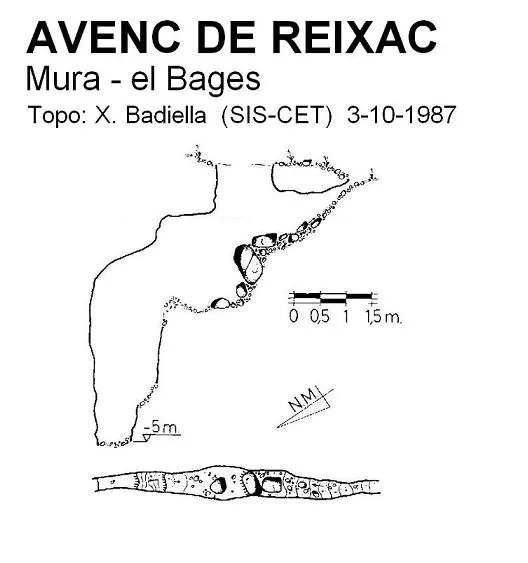
Topographic
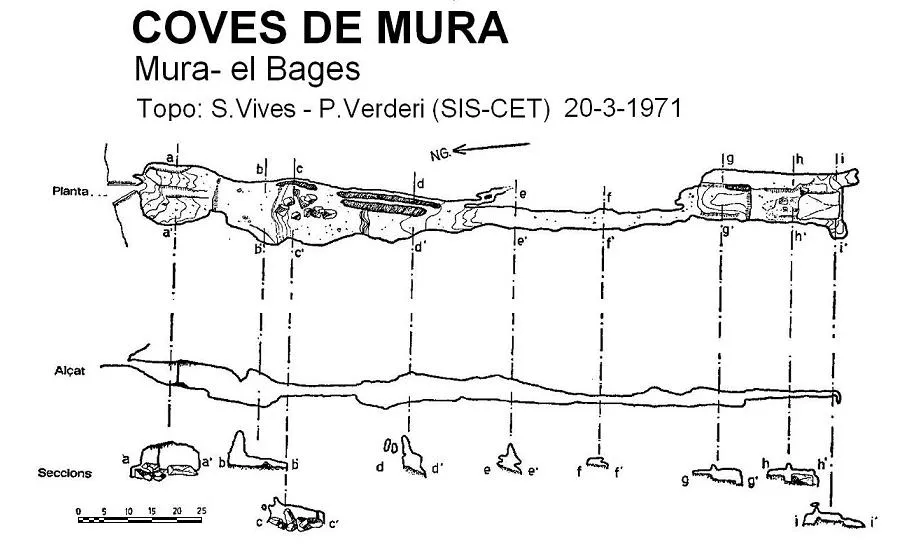
Espeleoindex · CC BY-NC 4.0, https://creativecommons.org/licenses/by-nc/4.0/ · Image © its author.
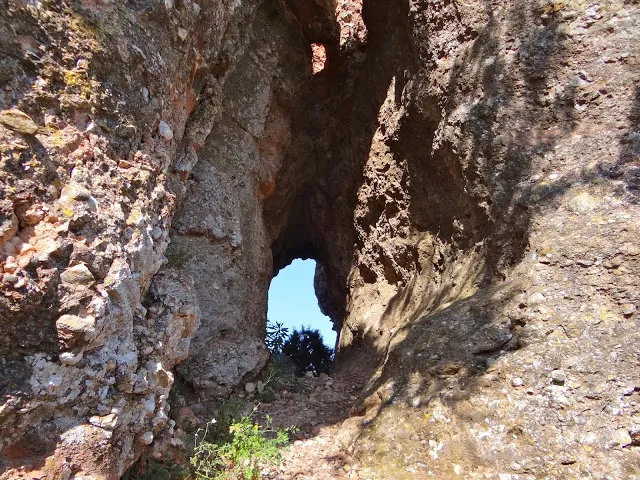
Photos
Espeleoindex · CC BY-NC 4.0, https://creativecommons.org/licenses/by-nc/4.0/ · Image © its author.
Description
Morphology
The cave consists of a single gallery, with some lateral side passages, following a general N-S direction. Once past the entrance, a small ramp leads straight into the wide gallery. Following the gallery, it narrows a little and on the left side there are passages parallel to the main gallery, which return to it after about 15 metres. The cave becomes narrower and the floor inclined. The ceiling descends but, suddenly, it rises again and the gallery regains width. Past this point it is necessary to climb over some blocks to reach the final stretch of the cave immediately afterwards.
Speleothems
In the wide gallery a stalagmitic column stands out in the very middle. On the ceiling, around this column, there is a group of stalactites that are the only ones preserved intact in the cavity. On the ceiling there are no longer any signs of stalactitic formations, but on the other hand, despite vandalic actions, some very interesting aragonite crystallizations are still preserved (for more information on these formations see the blog: espeleobloc (23-1-2013). When the gallery regains width, parietal formations can again be observed. The tip of one of them was called by the people of Mura el cocodril and another el camell.
Progression
Once past the entrance, a small ramp leads straight into the wide gallery. Following the gallery, it narrows a little and on the left side there are passages parallel to the main gallery, which return to it after about 15 metres. Past the point of the parietal formations it is necessary to climb over some blocks to reach the final stretch of the cave immediately afterwards.
History
It is said that around the year 1850 a farmer from Mura saw that very often birds came and went and disappeared among some brambles, at the foot of some rocks. Full of curiosity they rummaged among the brambles and saw a hole through which one entered with great difficulty. They widened the entrance and in a short time the cave was much visited.
The first written reference about the cavity is given by Casiano del Prado in 1864 and it immediately appears in all the later old speleological catalogues (Puig y Larraz; Font i Sagué; Faura i Sans), being mentioned and visited several times by members of the incipient Catalan excursionist movement of the end of the 19th century.
It seems that the first speleological visit was the one made by M. Faura i Sans in August 1908. In April 1911, a group of members of the new Centre Excursionista de Terrassa, led by Domènec Palet i Barba, made an excursion of a scientific nature and among other objectives they visited the cavity, making the first topographic sketch that is known. The results of this excursion are collected in the work “Excursió geològica i espeleològica a Mura i contorns”.
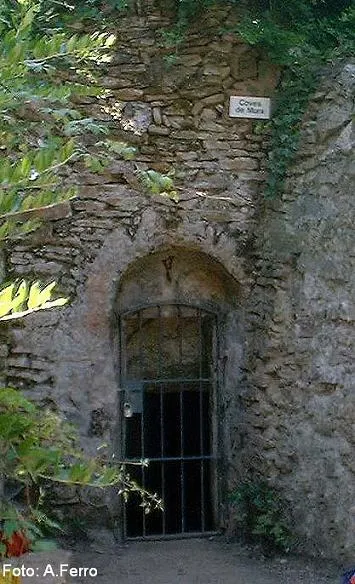
Due to the little respect of the people who visited it, in 1919 the owner of the land where the cave is located, Mr. Armengou, from Manresa, had the cavity closed by putting a door on it. The key was held by the sharecropper Francesc Piqué, of the masia de la Vila. Some price rates were established (up to two visitors: 1 pesseta per person; up to five, 75 cèntims; up to twelve, 50 cèntims and for more than twelve there was a price reduction proportional to the number of visitors. After some years that door disappeared and the current grille was placed around the mid-1980s.
On 4 March 1934 it was visited and studied by a large group of members of the Club Muntanyenc Barcelonès, who the following year published a detailed work about the cavity.
User Comments (0)
No comments yet.
Be the first to share your experience!
Registered Explorations (0)
No explorations registered yet.
Register your visit to this cave!
Bibliography
- Llopis Lladó, N. (1935).- “Cova de Mura”. Sota Terra (II): 29-37. Club Muntanyenc Barcelonès.
- Vives, Salvador (1980).- “ Les cavitats dels contorns de Mura” Arxiu del Centre Excursionista de Terrassa (22): 215-223. Centre Excursionista de Terrassa
- Coordenades, situació i fotografies extretes del blog: Espeleobloc (dies 21 al 24-1-2013)
- Foto boca: Antoni Ferro (SIE – CEA)
Nearby caves


Source: Espeleoindex (espeleoindex.com), modified. CC BY-NC 4.0, https://creativecommons.org/licenses/by-nc/4.0/