
EspeleoWorld
Cova sa Campana
Cave in the Serra de Tramuntana, in Escorca, with a surveyed development of 1,600 m and a lowest point at -358 m.
Escorca
Length: 1939 m · Depth: 317 m
Updated record
https://espeleoworld.com/en/c/cova-sa-campana-escorca
Information can change. Always verify coordinates, access, weather, and cave conditions before setting out.
Cave in the Serra de Tramuntana, in Escorca, with a surveyed development of 1,600 m and a lowest point at -358 m.
Photos

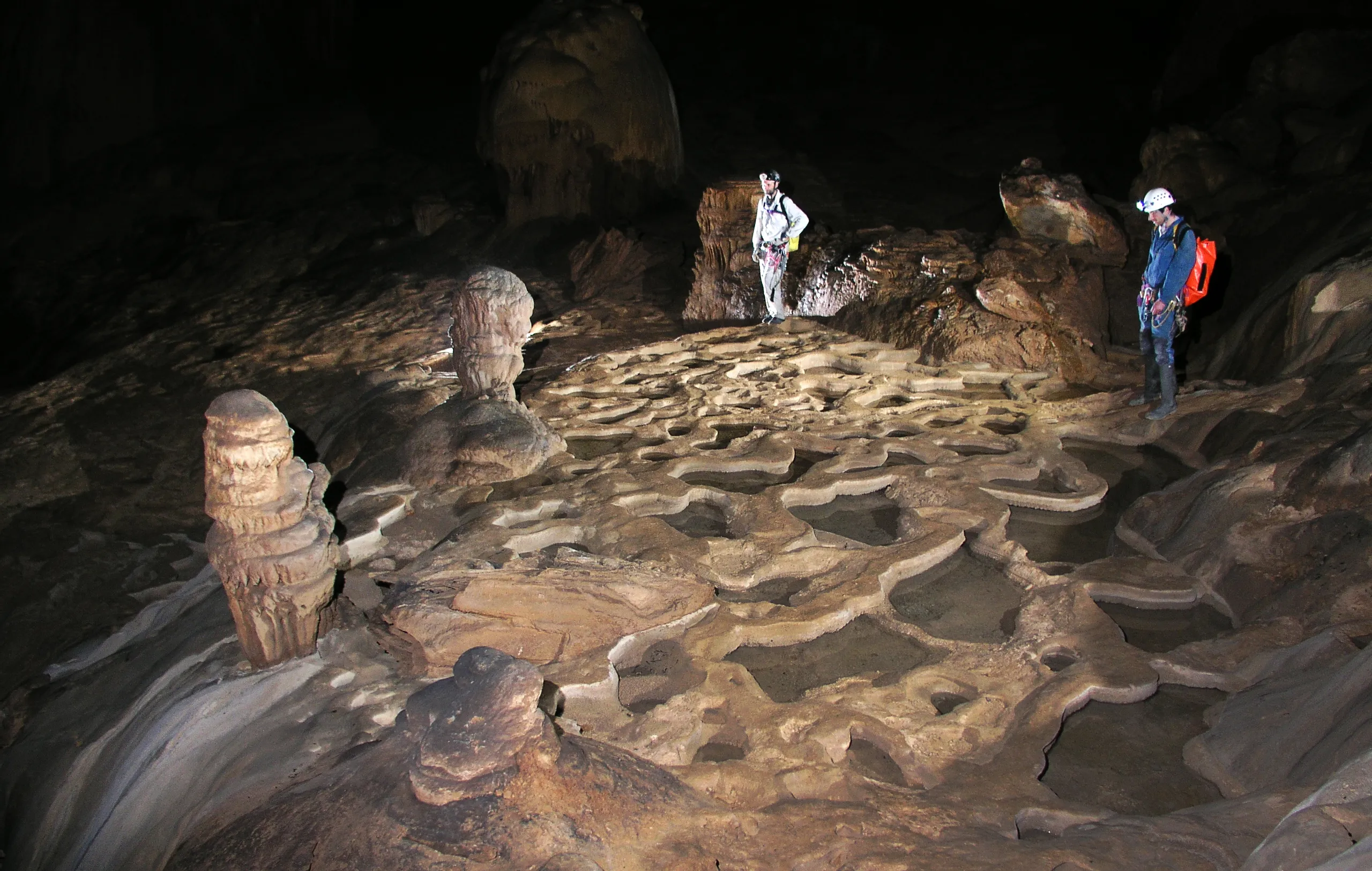
© JYB Devot · CC BY-SA 4.0, https://creativecommons.org/licenses/by-sa/4.0/ · Wikimedia Commons · https://commons.wikimedia.org/wiki/File:Cova_de_Sa_Campana_Majorque_P1010981_mod.jpg
Description
Morphology
The cave is excavated in grey Lower Lias limestones, which rest on Triassic marls, carniolas and dolomites. Down to about -216 m it consists of a succession of very large chambers and galleries, covered with speleothems and with a pronounced slope; below that level, the shafts descend almost to sea level. The cavity is in a heavily karstified area, with fields of dolines around the Castellots, interpreted as surface dissolution forms and not as collapse dolines.
The Sala Campament, the first chamber, measures 45 x 20 m with an average height of about 25 m. The Sala Gràcia measures about 150 x 100 m and reaches a maximum height of 40 m. The Rampa del Fang, or Rampa de les Excèntriques, measures 120 x 70 x 10 m, with an average slope of 30 degrees. The Sala dels Gorgs measures 120 x 40 m, with a ceiling varying between 15 and 32 m, and is reached at about -186 m. The Sala dels Blocs measures 100 x 30 m, with a maximum height of 18 m and a slope greater than 40 degrees. The Sala del Rascler contains a 38 m shaft, and the Pou de sa Pintada is a 15 m shaft.
Speleothems
The Sala Gràcia contains large flowstone floors and gours. The Rampa del Fang features very white eccentric formations and cracked mud 25 cm thick over large blocks. The Pou de sa Pintada houses large coralloid formations and red paintings on its walls.
Hydrology
The water that infiltrates into the Sala dels Blocs feeds the lake located below. The Llac Minguillón measures about 30 m in length and about 25 m in depth, with 1.5-3 m of width at the surface, and widens underwater; during the dive the visibility was approximately 1 m and the bottom is a pyramidal mud bank.
Other details
Among the objects found in the cave are coins of the Spanish Provisional Government of 1870 (2 and 10 céntimos), Moroccan 1-franc coins dated 1945/1364, and three 7 x 57 mm Mauser bullets from the Spanish Civil War. A historic smuggling route from the mouth of the torrent, along the camí de ses Voltes, passed by the cave and the Clot d'Infern towards Turixant and Alaró.
History
The cave already appeared in 1958 in J. Mascaró Pasarius's toponymic cartography of Mallorca. In 1973 the Grup Geogràfic de Gràcia completed the survey and established a maximum depth of -317 m. Pilar García and Rafael Minguillón (G.A.M.E.) carried out a new survey and exploration, discovering new chambers and, in 2015, the Llac Minguillón. On 3 October 2015 the team found a narrow 30 cm passage; after widening it, Marina Vergara entered the great Sala GAME on 21 November 2015, and the passage was named pas MarinaGuey. On 5 December 2015 Rafael Minguillón dived the Llac Minguillón and reached a muddy bottom at -358 m, the lowest point of the cave.
User Comments (0)
No comments yet.
Be the first to share your experience!
Registered Explorations (0)
No explorations registered yet.
Register your visit to this cave!
Nearby caves
Contains information from Grottocenter (Wikicaves), grottocenter.org, made available under the Open Database License (ODbL 1.0, https://opendatacommons.org/licenses/odbl/1-0/), modified. · https://grottocenter.org/ui/entrances/24812 · data as of 2026 · Text written by Espeleoworld from public sources. Please ask us before reusing it. · adapted by Espeleoworld (normalized, translated); the adaptation is licensed Our own text, written from public sources. Please ask us before reusing it. · data as of 2026 · The derived data is available on request under the ODbL: [email protected]