
Cova dels Pilons
Cova d'un centenar de metres de recorregut a Sarroca de Bellera.
EspeleoWorld
Cova dels Pilons
Cova d'un centenar de metres de recorregut a Sarroca de Bellera.
Sarroca de Bellera · Pallars Jussà
Length: 100 m · Depth: 8 m
Updated record
https://espeleoworld.com/en/c/cova-dels-pilons
Information can change. Always verify coordinates, access, weather, and cave conditions before setting out.
A cave of about a hundred metres at Sarroca de Bellera, with a large rock shelter 43 m wide, square pillars and a descending gallery.
Topographic
Espeleoindex · CC BY-NC 4.0, https://creativecommons.org/licenses/by-nc/4.0/ · Image © its author.
Photos
Espeleoindex · CC BY-NC 4.0, https://creativecommons.org/licenses/by-nc/4.0/ · Image © its author.
Description
Morphology
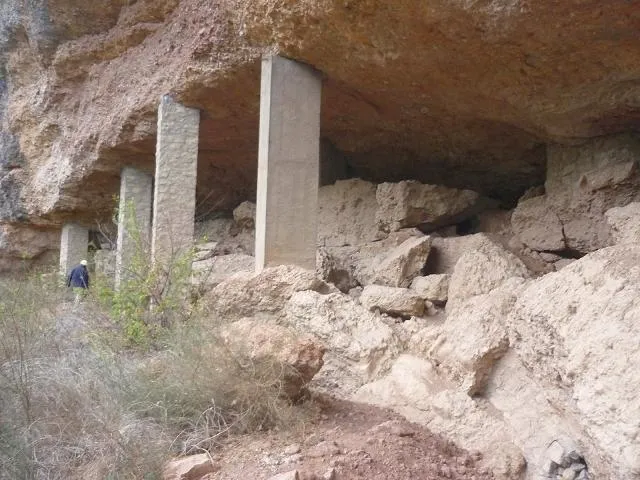
We are before a large rock shelter 43 m wide by 8 m high and 6 m deep at most. Its base is full of blocks fallen from the ceiling.
The most curious feature of this espluga is the existence of 4 large pillars, and one small one, which seem to prop up the ceiling of the cavity. The pillars are square, 1X1 metres.
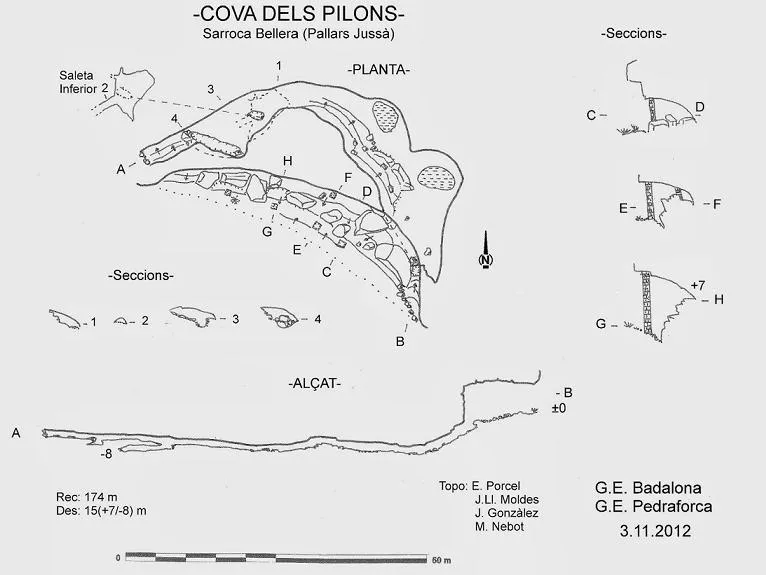
We find the continuation of the cave at the far right, where a descending passage leads us, 8 m further on, to an opening that by means of a small step and a ramp brings us out into a room with a low ceiling (1 metre high) where we find a flooded area where water coming from outside accumulates. We are in an inclined stratum that turns out to be the continuation of the rock shelter. We will advance some forty metres towards the NE, the ceiling continues low and the widths are about 8-10 metres approximately. Here we find a small collapse that leads us to a lower little room of about 8X4 metres with no exit. This spot gives us the maximum depth of the cave (-8 m). Some 10 metres further on we find another collapse, in this case elongated, which also leads nowhere. Ten metres more and the gallery ends.
Regarding the route of 174 metres and elevation change of +7 metres, indicated in the updated survey (GEB-GEP), we understand that the width and elevation change of the rock shelter are being counted; what is strictly the cave has no more than a hundred metres of route.
Hydrology
Flooded area where water coming from outside accumulates.
Progression
Descending passage, small step and ramp, room with a low ceiling, advance towards the NE, collapses and a lower little room with no exit.
History
The first known speleological exploration was carried out in 1975 by the SIEP of the CE Poblet de Barcelona, although they mistakenly place it in the municipality of Senterada.
We do not know the origin of the pillars that seem to hold up the vault of the Balma, but someone, some time ago, explained to us that it was done precisely with this intention, when the road passed right next to the rock shelter and there was a danger that in the event of a collapse it would fall onto the road.
User Comments (0)
No comments yet.
Be the first to share your experience!
Registered Explorations (0)
No explorations registered yet.
Register your visit to this cave!
Bibliography
- Talavera, Ferran (1978).-”Cova dels Pilons”. Boletín Espeleológico SIEP (10):6-8. SIEP-CE Poblet. Barcelona
- Borràs, J.; Miñarro, J.M.; Talavera, F. (1978):”el pallars jussà”. Catàleg Espeleològic de Catalunya (vol. 1):174-175. Ed. Políglota. Barcelona.
- Coordenades, topografia actual i fotografies extretes del blog: cavitatsdecatalunya.blogspot (de Jordi de Valles). Apunt 10-4-2014.
Nearby caves



Source: Espeleoindex (espeleoindex.com), modified. CC BY-NC 4.0, https://creativecommons.org/licenses/by-nc/4.0/