
Cova del Temple
La cavitat més important del conjunt de l'Esplugues de Carme (l'Anoia)
EspeleoWorld
Cova del Temple
La cavitat més important del conjunt de l'Esplugues de Carme (l'Anoia)
Carme · Anoia
Length: 103 m · Depth: 6 m
Updated record
https://espeleoworld.com/en/c/cova-del-temple
Information can change. Always verify coordinates, access, weather, and cave conditions before setting out.
The most important cavity in the Esplugues de Carme group (l'Anoia): the Balç de les Roquetes, with galleries, the Cova del Temple and a rich historical record.
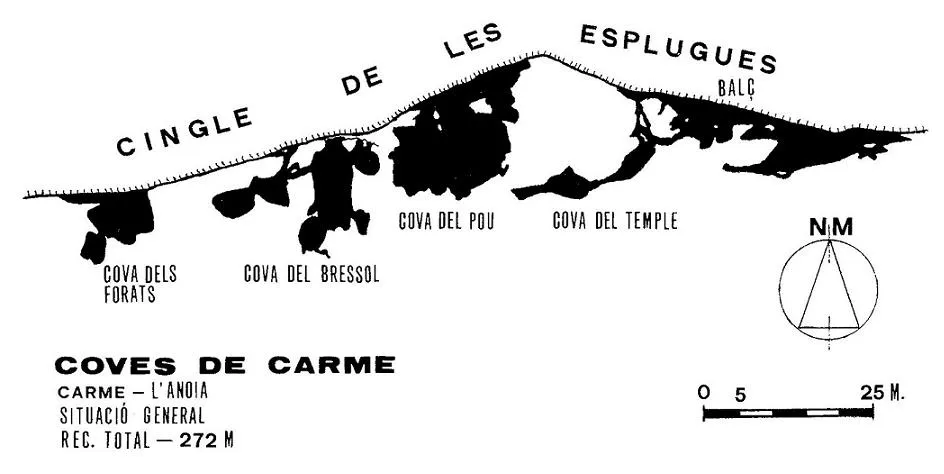
Topographic
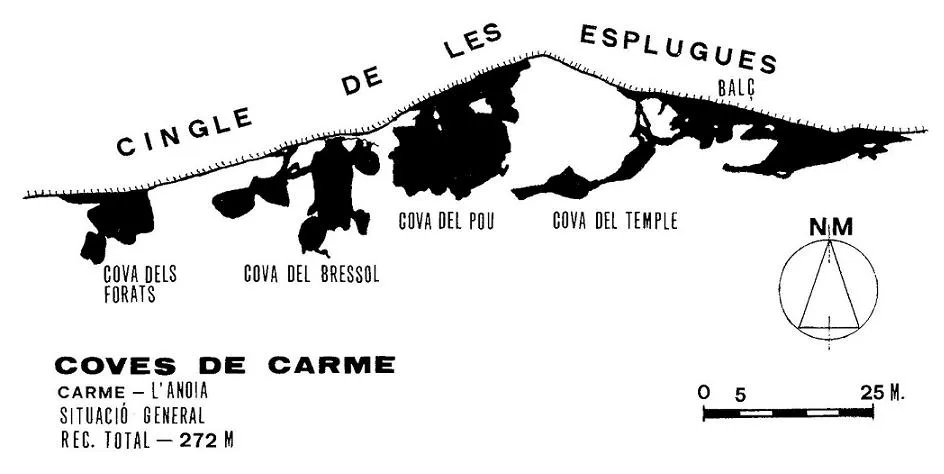
Espeleoindex · CC BY-NC 4.0, https://creativecommons.org/licenses/by-nc/4.0/ · Image © its author.
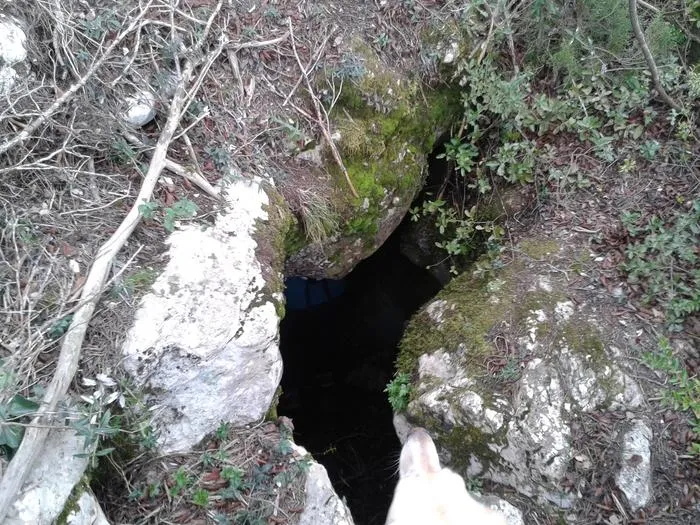
Photos
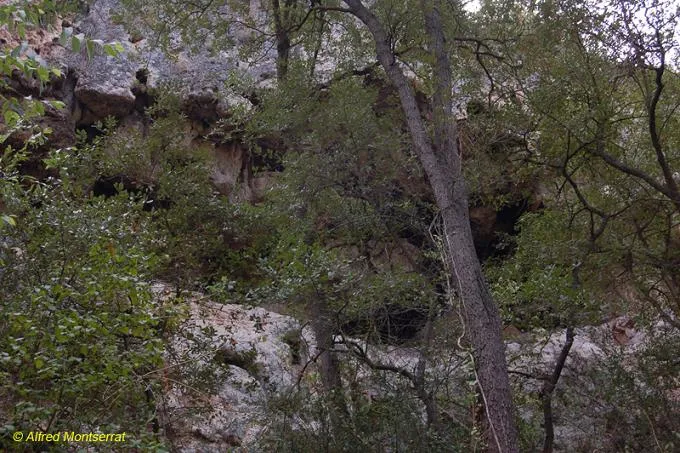
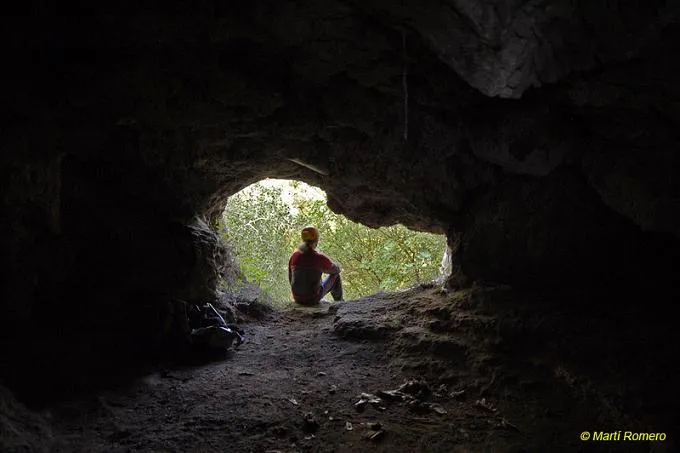
Espeleoindex · CC BY-NC 4.0, https://creativecommons.org/licenses/by-nc/4.0/ · Image © its author.
Description
Morphology
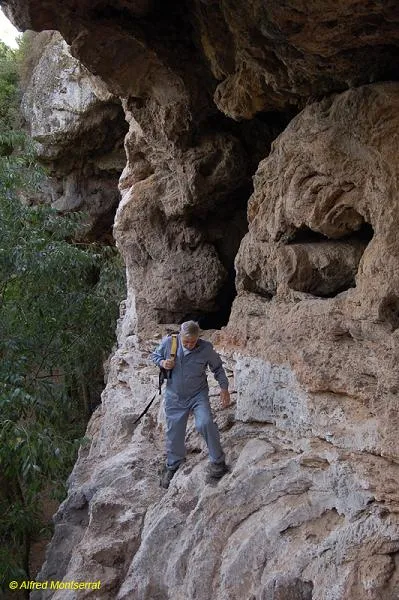
The Balç de les Roquetes forms a broad balcony hanging at a height of about 10 metres. It has a width on the order of 30 metres by a maximum depth of 7 metres. The tufa rock forms curious shapes as a result of karstification. From the balcony emerge some small galleries, of which only the so-called Cova del Temple need be mentioned, formed by three conduits joined by narrower passages, reaching the last one which forms a small chamber wider than the first ones, which the first explorers called the temple. In the easternmost sector of the Balç de les Roquetes an opening can still be found in the ceiling which, once passed, leads out into an upper level that opens to the outside through a broad doorway.
Speleothems
We can observe ancient water impoundment levels clearly marked on the walls and which correspond in the opposite sense with the void of the cliff, which indicates to us that the cavities were much larger and have been cut by the erosion that has made the cliff recede. The abundant formations make us imagine an important former water activity. Some human bones have been found embedded in the stalagmitic formations.
Hydrology
Everywhere we see water level marks, which indicates to us that they functioned in a humid period, possibly very close in time (speaking in geological terms); currently all the cavities are completely dry and full of an omnipresent dust originating from the decomposition of the tufa itself. We find no drip.
Progression
From the balcony of the Balç de les Roquetes emerge some small galleries. In the Cova del Temple a grille can still be seen that in past times closed off access to the gallery. In the easternmost sector of the Balç de les Roquetes an opening can still be found in the ceiling which, once passed, leads out into an upper level that opens to the outside through a broad doorway.
Other details
The most important cavity in the Esplugues de Carme group (l'Anoia).
History
Known since time immemorial. It was already used in the Magdalenian period, in part as a dwelling and in part as a cemetery. Flint, pottery and some basalt axe have been found there, but the most abundant has been human bones.
The oldest data from a description of these caves are due to the Piarist P. Calonge, who visited them on 12 July 1885 and of which he made a careful description, in addition to naming each cavity with a particular name: Temple, Pou, Bressol and Forats.
Later they were visited by Font i Sagué and by Almera, without much dissemination. This came at the hands of Marià Faura i Sans who, on 14 September 1907, accompanied by Dr. Colomines, his nephew Timoteu Colomines (then president of the Club Muntanyenc) and the owner of Mas Guineu and of the land where the caves are located, made a visit while leaving a record of the writings by P. Calonge.
For years the caves have been visited by a multitude of people, some without many scruples when it came to maintaining their integrity.
It is not until the summer of 1973 that members of the GE Pedraforca again take an interest and make a topographic survey of the four cavities, naming them Coves de les Esplugues and numbering them from 1 to 4, from the westernmost to the easternmost.
Finally, F. Cardona publishes in 1989 a documented work on the group of cavities, with new topographies and other data, the product of the visits made with companions from the Espeleo Club de Gràcia.
User Comments (0)
No comments yet.
Be the first to share your experience!
Registered Explorations (0)
No explorations registered yet.
Register your visit to this cave!
Bibliography
- Cardona, Ferran (1989).- “Les coves de Carme. Cent anys després de la visita del P. Calonge”. Exploracions (13): 31-37. Espeleo Club de Gràcia. Barcelona.
- Faura i Sans, M. (1909).- “Les Coves del Balç de les Roquetes, a Carme”. Sota Terra (I): 73-98. Club Muntanyenc. Barcelona.
- Mor, Jordi (1975).- “Les Coves de les Esplugues”. Ildobates (6): 32-51. GEP – Agrupació Excursionista Pedraforca. Barcelona.
- Fotografies facilitades per Alfred Montserrat (ERE-CEC).
Nearby caves


Source: Espeleoindex (espeleoindex.com), modified. CC BY-NC 4.0, https://creativecommons.org/licenses/by-nc/4.0/