
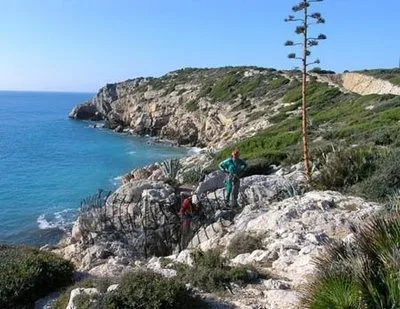
Cova del Gegant-llarga
The Cova del Gegant is the most interesting and largest of the Coves de Sitges, with three access mouths and a total route of approximately 180 metres.
EspeleoWorld
Cova del Gegant-llarga
The Cova del Gegant is the most interesting and largest of the Coves de Sitges, with three access mouths and a total route of approximately 180 metres.
Sitges · Garraf
Length: 180 m · Depth: 14 m
Updated record
https://espeleoworld.com/en/c/cova-del-gegant-llarga
Information can change. Always verify coordinates, access, weather, and cave conditions before setting out.
The Cova del Gegant is the most interesting and largest of the Coves de Sitges, with three access mouths and a total route of approximately 180 metres.
Topographic
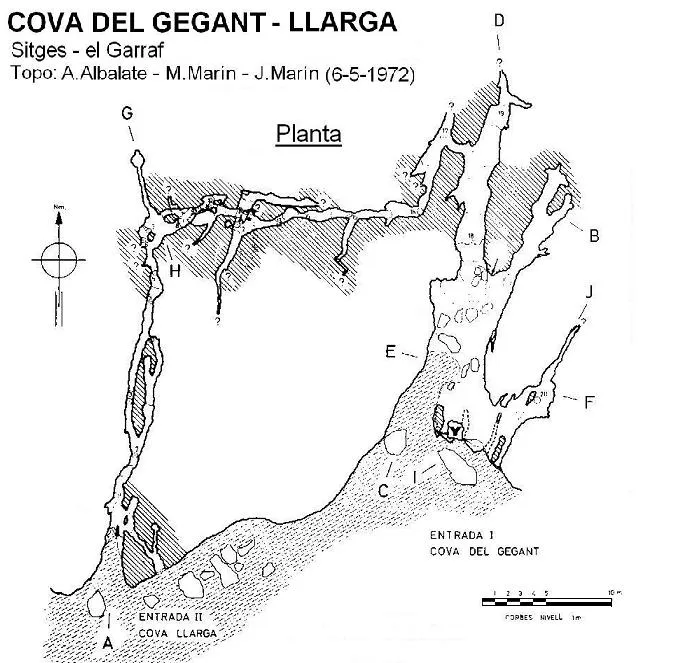
Espeleoindex · CC BY-NC 4.0, https://creativecommons.org/licenses/by-nc/4.0/ · Image © its author.
Photos
Espeleoindex · CC BY-NC 4.0, https://creativecommons.org/licenses/by-nc/4.0/ · Image © its author.
Description
Morphology
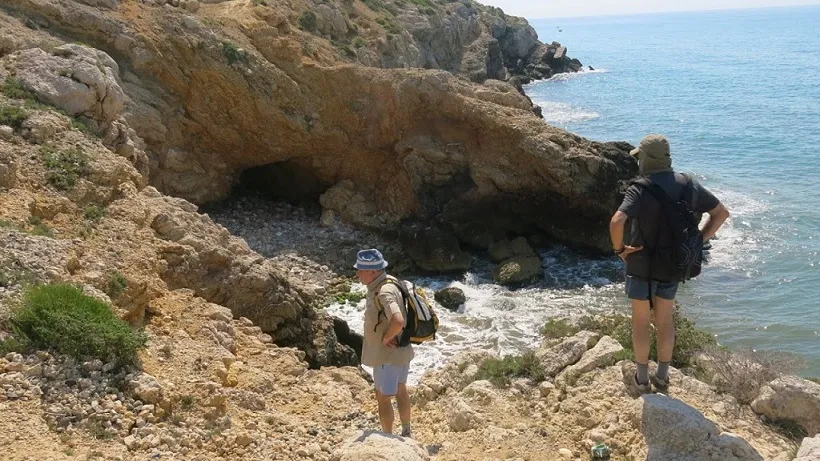
The modest Gegant – Llarga system has three access mouths: the Cova del Gegant and the Cova Llarga, with their mouths at sea level, and the upper pit of the Cova del Gegant, which connects with it in the entrance hall. The vestibule of the cave measures about 25 x 5 metres. To the right of the entrance chamber, a couple of short galleries develop. The gallery continues a few metres further in until it becomes impenetrable, completely filled with sediments.
Hydrology
On days of rough sea, the waves reach the very foot of the pit, so that the landing can be somewhat wet.
Progression
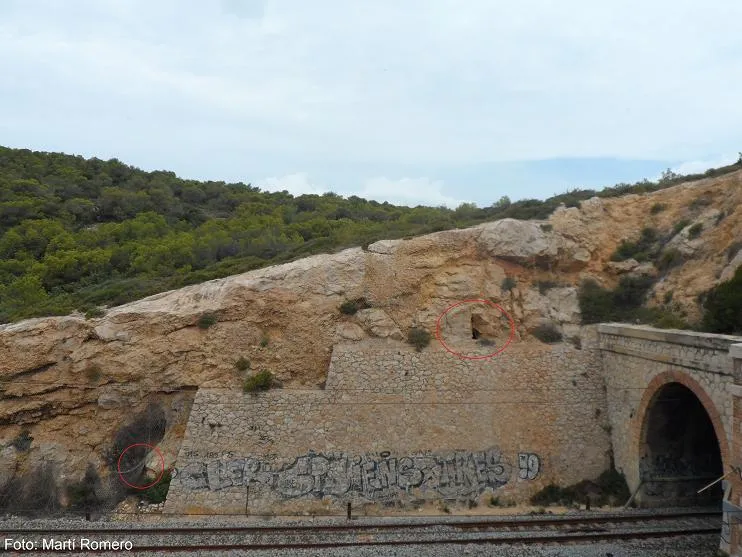
The most comfortable access is via the upper pit of the Cova del Gegant, which has a vertical drop of 14 metres and whose base leaves us practically in the vestibule of the cave. Shortly before, on the left, through a small opening, it is possible to access a series of passages, with very narrow points, which after approximately a hundred metres of route, emerges into the entrance vestibule of the Cova Llarga. This cavity, because of its narrow characteristics, is known by some speleological groups as La Gatera. The total route is calculated at approximately 180 metres.
History
Like the rest of the coves de Sitges, known since time immemorial. As can be seen in photographs from the early 20th century, there was still a beach about 10 metres wide between the mouth of the cave and the sea, which apparently disappeared, among other causes, due to the construction of the port of Vilanova. The first speleological mention is that provided by Font i Sagué in his Catàleg (1897) and by Faura i Sans in his Recull (1909); the latter already mentions the upper mouth. It is not until the 1950s that studies are recorded at the cave in order to save the remains of the Quaternary deposit (Agrupació Muntanyenca de Sitges, 1956; Museu Biblioteca Víctor Balaguer de Vilanova i la Geltrú). In the early 1960s, Antoni Ferrer with other colleagues from Vilanova carry out research and survey work in all the cavities of the Punta de les Coves. And it is they who, in January 1965, after forcing many narrow passages, manage to achieve the union between the Cova del Gegant and the Cova Llarga. During the first years of the 1970s, researchers led by R. Viñas and J. F. Villalta carry out a new campaign of investigation of the Quaternary remains. It is in this same period that the most complete and accurate survey of the cave is made. Still, in July 1985 an emergency excavation was carried out (J. Martínez, J. Miret, R. Mora and I. Muro) in order to save some remains of the site, increasingly damaged by the action of the sea. In mid-2005, a human jaw from the first excavations made by Mn. Santiago Casanova during the 1950s was made known, and it was in a collection of more than 500 pieces that were handed over in 1998 to the Arxiu Històric de Sitges and whose director X. Miret provided to the archaeologists of the UB, J. Daura and M. Sanz, who along with others identified it as a valuable jaw of Neanderthal man.
User Comments (0)
No comments yet.
Be the first to share your experience!
Registered Explorations (0)
No explorations registered yet.
Register your visit to this cave!
Bibliography
- Daura, J.; Sanz, M. (2006).- “El neandertal de la Cova del Gegant. Sitges (Garraf)” EspeleoCat (4): 31-34. Federació Catalana d'Espeleologia. Barcelona.
- Ferrer, A. (1966).- “Las coves de Sitges” Cavernas (7): 216-219. Grup d'Espeleologia de Badalona.
- Petit,
Mª A. Petit; Rovira, J. et al. (1980).- “El jaciment arqueològic
de la Cova Verda i alguns problemes del neolític i l'edat del
bronze a Catalunya”. Quaderns
de treball
(3): 83 pp. Inst. de Preh. i Arq. de la Diputació de Barcelona –
Dep. de Preh. i Arq. de la Universitat Autònoma de Barcelona.
(Aquest treball inclou un capítol redactat per Antoni Ferrer: “Les coves de Sitges i els seus voltants”, que amplia i actualitza el publicat per ell mateix a Cavernas l'any 1966).
- Viñas, R. (1972).- “Observaciones sobre los depósitos cuaternarios de la Cova del Gegant. Sitges (Barcelona)” Speleon (19): 115-126. Centre Excursionista de Catalunya. Barcelona.
· Fotografies i altres dades extretes del blog: Espeleobloc (post del 24-11-2008).
Nearby caves
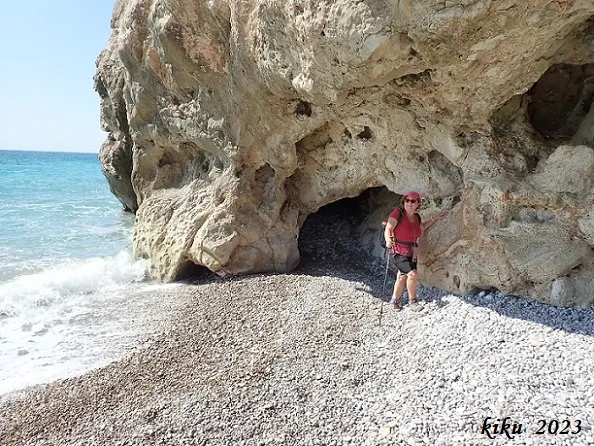
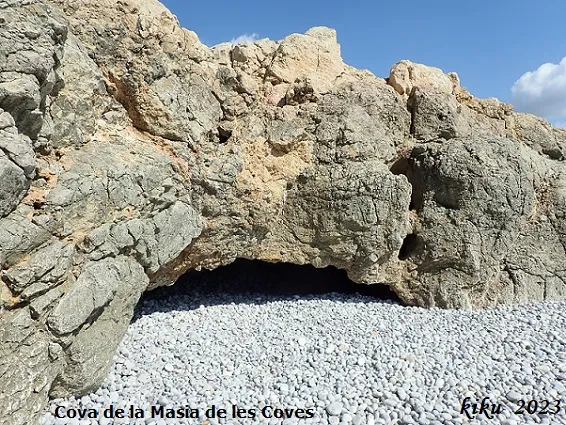


Source: Espeleoindex (espeleoindex.com), modified. CC BY-NC 4.0, https://creativecommons.org/licenses/by-nc/4.0/