
Cova de la Punta Grossa
A cave of about 50 m of passage beside the railway line, in Sitges, formed by a network of small dissolution conduits.
EspeleoWorld
Cova de la Punta Grossa
A cave of about 50 m of passage beside the railway line, in Sitges, formed by a network of small dissolution conduits.
Sitges · Garraf
Length: 50 m · Depth: 18 m
Updated record
https://espeleoworld.com/en/c/cova-de-la-punta-grossa-sitges
Information can change. Always verify coordinates, access, weather, and cave conditions before setting out.
A cave of about 50 m of passage beside the railway line, in Sitges, formed by a network of small dissolution conduits.
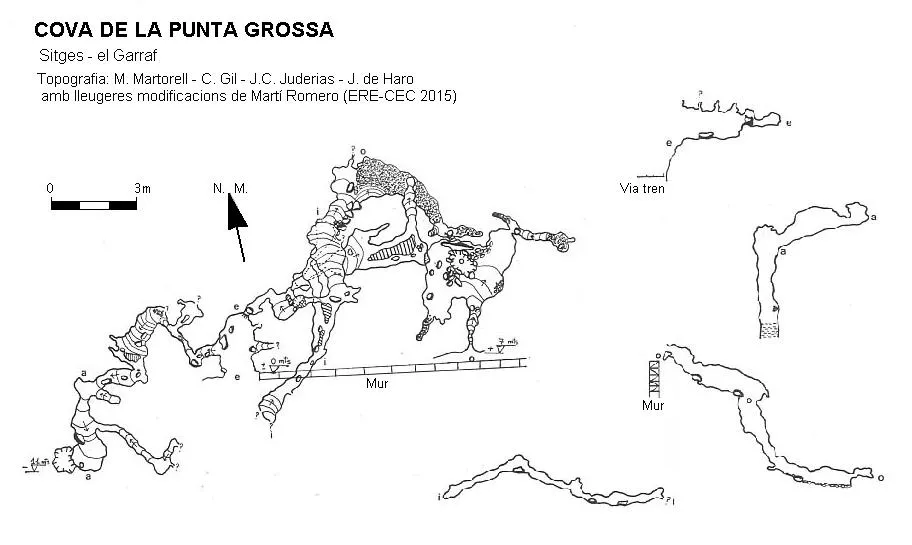
Topographic
Espeleoindex · CC BY-NC 4.0, https://creativecommons.org/licenses/by-nc/4.0/ · Image © its author.
Photos
Espeleoindex · CC BY-NC 4.0, https://creativecommons.org/licenses/by-nc/4.0/ · Image © its author.
Description
Morphology
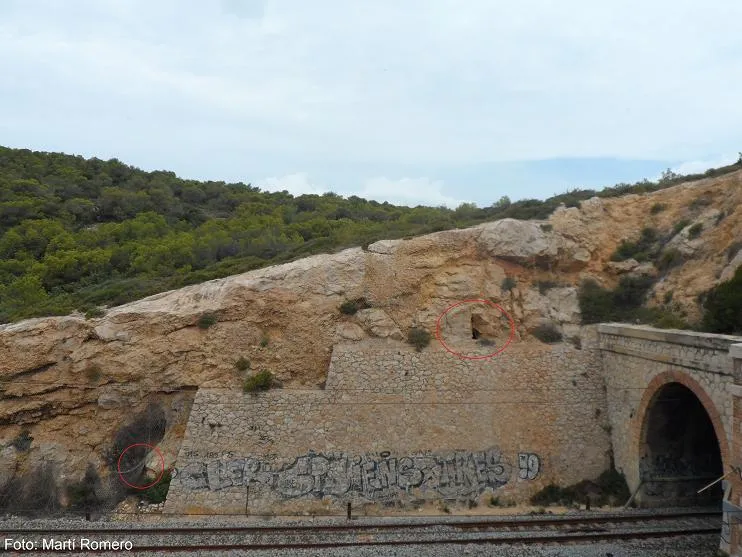
The cave is a network of small dissolution conduits joined by narrow passages that not everyone can get through. From the main mouth two branches begin. On the left the conduit descends until it ends in a small shaft (elevation – 11 m) with a flooded bottom. To the right, the conduits are more varied and also descending at first, before the final stretch takes an upward turn that leads to the second mouth situated some 7 metres above the main one.
The 50-metre route is entirely an estimate, based on the only survey we have.
Hydrology
The small shaft of the left-hand branch has a flooded bottom (we do not know whether it is a water table or a seepage of seawater).
Progression
The first metres of the hole are unpleasant to traverse because of the quantity of “stinking rubbish” deposited by a local Diogenes who must use it as a hiding place. (This circumstance noted by J.M. Victoria in 2010, it should be said that it continued in the summer of 2015).
Other details
As is mentioned in Espeleobloc, our colleague Enric Porcel (GEB) had already made a new survey, but it has not yet been made known.
History
The cave was opened during the construction works of the railway from Barcelona to Vilanova i la Geltrú along the Garraf slopes during the last third of the 19th century, when the cutting was opened after the exit of the tunnel. The first news we have of it is provided by T. Creus in 1880, saying: “On the slopes of this mountain, and beside the sea, these caves are found, very well known and visited. When the works for the opening of the tunnel in the same Punta Grossa (railway from Valls to Vilanova and Barcelona) were being done, large cavities were found, covered with concretions, which communicated with the caves of the beach; but part of the opening that remained above the brick vault of the tunnel had to be covered. In the part that could be examined it was seen that there were different widenings that communicated by very narrow corridors, in one of which were found bones of half-petrified animals”. (sic).
These data are later reproduced by Puig y Larraz (1896) and Font i Sagué (1897) in their catalogues. Later it is cited only in the lists of Faura i Sans.
Little more is known of this cave until many years later. It seems very strange to us that the late Josep Castell, a resident of Vilanova and a RENFE worker, who knew the most unlikely corners of the Garraf, had never spoken of this cavity. Quite a few years ago, members of the UME de Gavà had spoken to us of a cave near Vilanova that they called “Les gateres”, and we think it could be this same cave.
Around 1987, J.C Juderias, a former colleague at the SIE, passed on to us a survey of a cave where he had been years earlier with colleagues from another club (Gelera ?) and which they named Cova del 15 de Agosto (sic) and which we soon supposed to be the Cova de la Punta Grossa. This is, for the moment, the only survey we know of the cavity.
In 2010, the colleagues of the Espeleodijous, accompanied by Josep Pastor, of Sitges, make a partial visit to the cavity, leaving a record on the blog Espeleobloc and naming it Cova de la Via, which is how the speleologists of Sitges and of Vilanova possibly know it. Already at that time, Jordi de Valles makes a comment to them that in reality it must be the Cova de la Punta Grossa.
User Comments (0)
No comments yet.
Be the first to share your experience!
Registered Explorations (0)
No explorations registered yet.
Register your visit to this cave!
Bibliography
- Creus, Theodor (1880).- “Noticia de algunas trovallas arqueológicas fetas en lo districte municipal de Vilanova y Geltrú...”. Butlletí de l'Associació d'Excursións Catalana (21): 165. Barcelona.
- Fotografies i altres dades extretes del blog: espeleoblog.blogspot (apunt del 19-5-2010)
- Actualització de dades i fotografies (juliol 2015) facilitades per Martí Romero (ERE - CEC)
Nearby caves


Source: Espeleoindex (espeleoindex.com), modified. CC BY-NC 4.0, https://creativecommons.org/licenses/by-nc/4.0/