
Cova del Blai
Coneguda cova de 164 m. de recorregut a Pratdip (Baix Camp).
EspeleoWorld
Cova del Blai
Coneguda cova de 164 m. de recorregut a Pratdip (Baix Camp).
Pratdip · Baix Camp
Length: 164 m · Depth: 18 m
Updated record
https://espeleoworld.com/en/c/cova-del-blai
Information can change. Always verify coordinates, access, weather, and cave conditions before setting out.
A 164 m long cave in Pratdip (Baix Camp), known since time immemorial and explored in 1911. It includes galleries, chambers and lithogenic formations.
Topographic
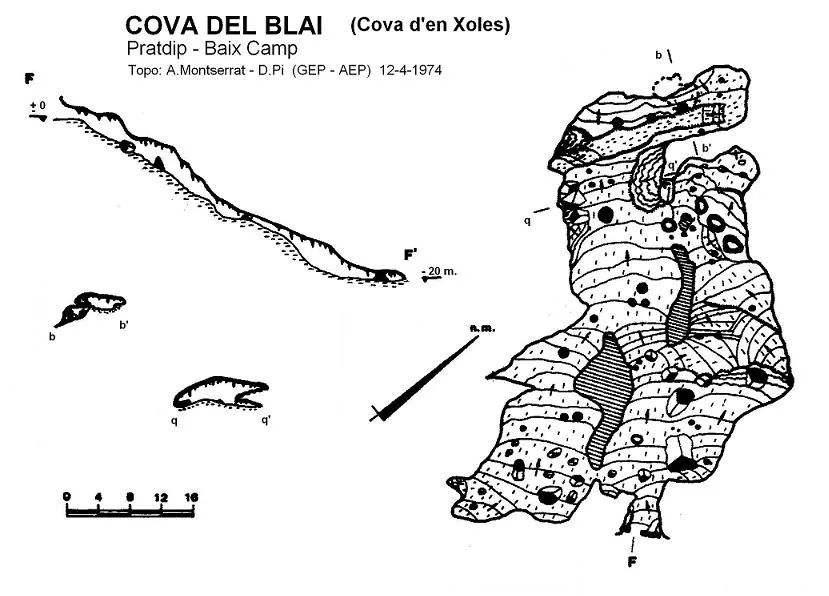
Espeleoindex · CC BY-NC 4.0, https://creativecommons.org/licenses/by-nc/4.0/ · Image © its author.
Photos
Espeleoindex · CC BY-NC 4.0, https://creativecommons.org/licenses/by-nc/4.0/ · Image © its author.
Description
Morphology
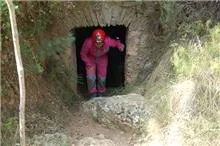
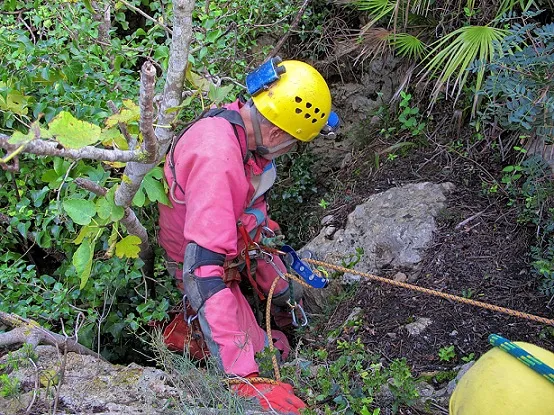
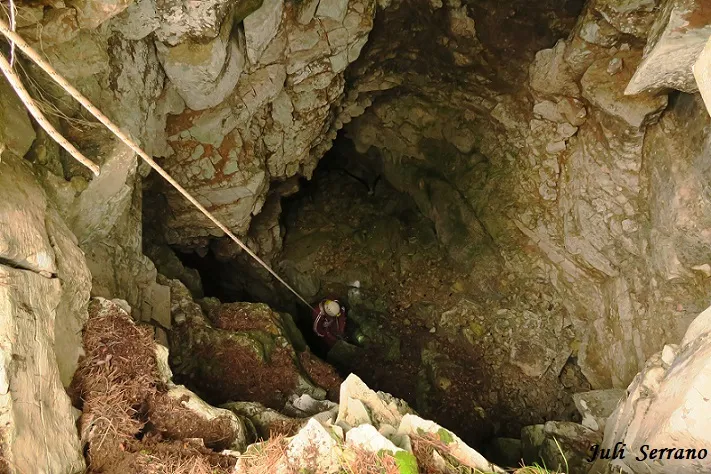
The mouth is surrounded by a masonry frame that in other times would have housed a door. It begins with a gallery on a steep slope, in which stone slabs have been made into steps on the floor, and after about 20 metres of passage it reaches a chamber of regular dimensions. To the W a passage continues which, after overcoming a narrow spot, connects two small low chambers filled with lithogenic formations. In this same passage there is a small portico that opens into the largest chamber of the cavity. In the northernmost section of it there is an area of blocks at floor level, partly cemented by lithogenesis, which allows passage between them to small vertical conduits, some of them interconnected. At the opposite end of this chamber an ascending gallery begins, subdivided by an enormous chaos of blocks, and in its upper section it connects with the entrance gallery, a few metres from the mouth.
Speleothems
The small chambers of the west passage are filled with lithogenic formations. In the main chamber, an area of blocks is partly cemented by lithogenesis. An important chemolithogenic phase shaped the current appearance of the cave.
Hydrology
Cavity originated along the bedding planes that present a strong dip towards the NW. The different joint systems allowed the absorption of waters that excavated a primitive cavity constituted very possibly by a single chamber, later affected by an important clastic process that subdivided it, and subsequently an important chemolithogenic phase was superimposed that shaped the current appearance of the cave.
History
Cavity known in the area since time immemorial. Puig y Larraz (1896) mentions an “Avench de Pratdip”, taking the data from a report on earthquakes (Bayo, 1845). From the brief description he gives, we understand that he is not referring to the avenc de Pratdip (Avenc del Pla), but to the cave of the same name.
The first exploration of speleological interest of which we have news is the one carried out on 12 March 1911 by members of the Agrupació Excursionista de Reus. At that time, the owner of the estate where it is located, Mr. Pellicer Domènech, of Reus, had already had a wooden door installed to protect it from acts of vandalism, although this measure did not prevent one from occurring in 1915 (and many others later).
Recognised in the early years of the 1930s by the biospeleologists F. Español and J. Vilarrubias and shortly afterwards, on 27 October 1935, a large group of members of the Club Muntanyenc Barcelonès visited it and N. Llopis made a careful study.
From the beginning and for many years it had been catalogued as Cova de Pratdip, but in 1917, S. Vilaseca calls it Cova del Mas Monet. Llopis, in 1935, already says that in Pratdip they call it that, but in Llaberia they call it d'en Xoles. Despite this, the people of the area call it cova del Blai and that is how it appears on the ICC map. To complicate things further, someone calls it: Cova del Blai d'en Xoles.
Bio
Coleoptera: Duvalius berthae s.sp. vilasecai Zar. (Carabid widely known in the cavities of Llaberia and described by Zariquiey in 1920)
User Comments (0)
No comments yet.
Be the first to share your experience!
Registered Explorations (0)
No explorations registered yet.
Register your visit to this cave!
Bibliography
- Ferraté, J. (1918).- Espeleologia de les comarques tarragonines. 133 pp. Agrupació Excursionista de Reus.
- Llopis Lladó, N. (1935).- “ Els fenòmens càrstics de la Muntanya Blanca de Pratdip” Sota Terra (II): 91-101. Club Muntanyenc Barcelonès.
- Miñarro, JM.; Lázaro, P. (1977).- “Breves notas descriptivas sobre algunas cavidades de la Serra de Llaberia (Baix Camp, T).” EspeleoSie (20): 45-63. SIE del CE Àliga. Barcelona.
- Montserrat, A. (1979).- “Sobre algunes cavitats de les comarques del Baix Camp i Priorat”. Espeleòleg (28): 489-530. ERE del CEC. Barcelona.
· Coordenades, fotografies i dades de situació actualitzades i facilitades per Alfred Montserrat (ERE del CEC).
Nearby caves


Source: Espeleoindex (espeleoindex.com), modified. CC BY-NC 4.0, https://creativecommons.org/licenses/by-nc/4.0/