
Cova de Nerola
A 144-metre-long cave in Vimbodí i Poblet, on the northern edge of the muntanyes de Prades, with galleries, shafts and the wall formation known as “la cascada”.
EspeleoWorld
Cova de Nerola
A 144-metre-long cave in Vimbodí i Poblet, on the northern edge of the muntanyes de Prades, with galleries, shafts and the wall formation known as “la cascada”.
Vimbodí i Poblet · Conca de Barberà
Length: 144 m · Depth: 16 m
Updated record
https://espeleoworld.com/en/c/cova-de-nerola
Information can change. Always verify coordinates, access, weather, and cave conditions before setting out.
A 144-metre-long cave in Vimbodí i Poblet, on the northern edge of the muntanyes de Prades, with galleries, shafts and the wall formation known as “la cascada”.
Topographic
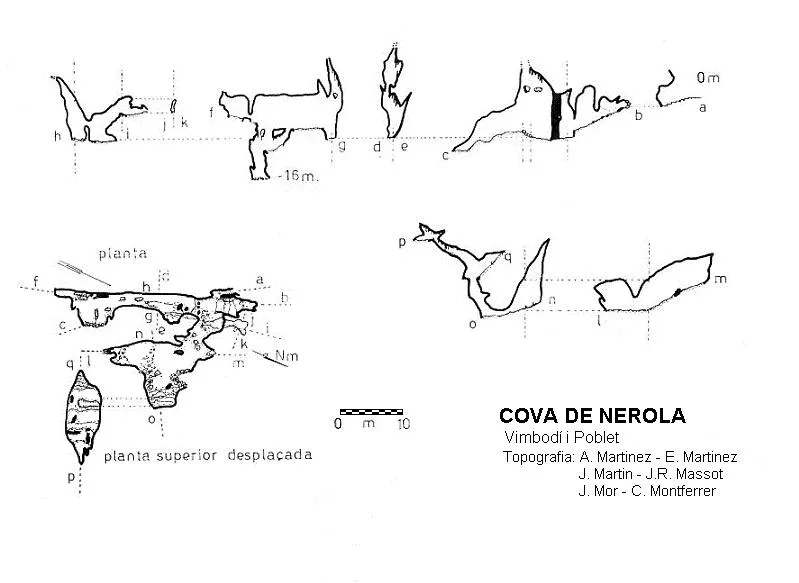

Espeleoindex · CC BY-NC 4.0, https://creativecommons.org/licenses/by-nc/4.0/ · Image © its author.
Photos

Espeleoindex · CC BY-NC 4.0, https://creativecommons.org/licenses/by-nc/4.0/ · Image © its author.
Description
Morphology
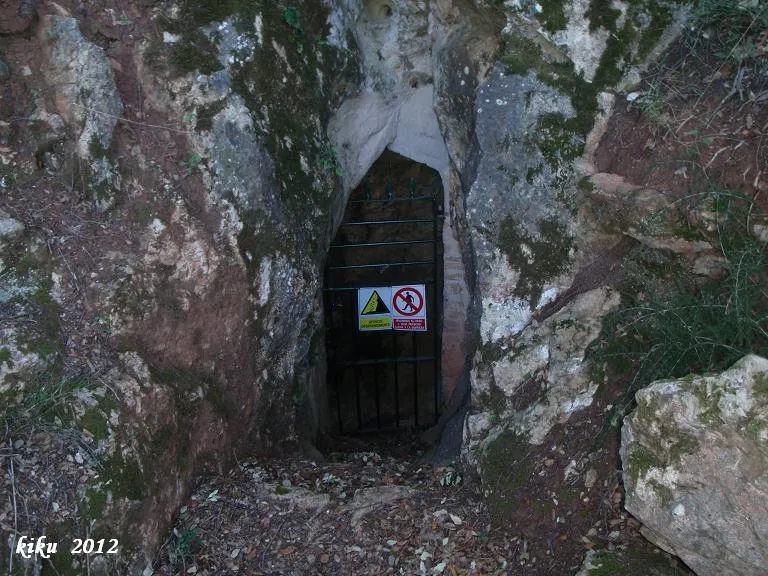
The current entrance is closed by a grille; after it, the access point is provided with some masonry steps that allow us to descend a small drop of about three metres until we are at the foot of a rectilinear gallery that follows the NW-SE direction for almost 30 m in length and that progressively gains height until it reaches some 7 or 8 m in height, while the floor continues with a gentle slope up to a small step, almost towards the end, and which leads us to two small semicircular cavities. Some ten metres before the end of the gallery, we can climb a small drop on our right, where another joint converges that leads along a narrow gallery, at the foot of which there are two narrow shafts of 4 and 8 m in depth that constitute the lowest point of the cavity. Further on, on the left, the gallery communicates by means of elliptical conduits with the final little chambers of the main gallery, while if we continue climbing linearly some four metres, we reach the bottom of the cavity.
Standing once again at the start, almost beside the steps we find on our left an elliptical conduit that communicates with the main chamber with dimensions of 18x3x10 m, which is structured on a joint parallel to that of the main gallery. In the middle of the chamber, after a small drop, we find a second passage that leads us to a modest final chamber.
Speleothems
In the modest final chamber there is a beautiful wall formation known as “la cascada” in the form of a flowstone that, although like the rest of the lithogenic processes of the cavity it has suffered a certain vandalism from visitors, is in a better state, and is the feature that gives the cave most of its character. At the very top of this formation, there is a small conduit of difficult access that quickly becomes closed.
Progression
The current entrance is closed by a grille; after it, the access point is provided with some masonry steps that allow us to descend a small drop of about three metres until we are at the foot of a rectilinear gallery. Some ten metres before the end of the gallery, we can climb a small drop on our right, where another joint converges that leads along a narrow gallery, at the foot of which there are two narrow shafts of 4 and 8 m in depth that constitute the lowest point of the cavity. Further on, on the left, the gallery communicates by means of elliptical conduits with the final little chambers of the main gallery, while if we continue climbing linearly some four metres, we reach the bottom of the cavity. Standing once again at the start, almost beside the steps we find on our left an elliptical conduit that communicates with the main chamber. In the middle of the chamber, after a small drop, we find a second passage that leads us to a modest final chamber.
Other details
Cave of 144 metres in length in Vimbodí i Poblet.
History
Font i Sagué mentions, in his Catàlech (1897), the Cova de Nerola or dels Assedegats, indicating that the citation comes from the Interrogatori that the CEC had made the previous year; the only datum that accompanies it is that it is found near the town, referring to l'Espluga de Francolí (?).
Joan Ferraté in his work Espeleologia de les comarques tarragonines (1918) again cites the Cova de Nerola, but from the data he gives it is quite clear that he is referring to the font de Nerola, opened by the monks of Poblet and which supplied water to the monastery for centuries.
According to the colleagues from Montblanc, the current access to the cavity was opened at the beginning of the decade of the 1940s with dynamite, from the enlargement of a crevice where animals were thrown. This makes us think that the cavity cited by Font and by Ferraté is not this one that concerns us. Of course, how did they enter during prehistory? The important archaeological remains found are quite evident.
Thus, the cave was much visited from the 1940s and has received many names over time and we would not know which would be the most correct. In principle we opt for Cova de Nerola.
Currently it is closed by a grille with a padlock, we imagine for reasons of some archaeological intervention.
User Comments (0)
No comments yet.
Be the first to share your experience!
Registered Explorations (0)
No explorations registered yet.
Register your visit to this cave!
Bibliography
- Bosch, M, Cervelló, J.M., Romero, M. (1991): Noves dades sobre l'Espluga. Espeleòleg, 39: 4-10.
- Cervelló, J.M. i Freixes, A. (1986): Materials per a una guia del carst de l'Espluga de Francolí. Servei geològic de Catalunya (inèdit).
- Cervelló, J.M. (1986): El carst conglomeràtic de l'Espluga de Francolí. Espeleòleg, 37: 3-6.
- Mor, J. i Martínez, A. (1975-76).- “Sobre qualcunes observacions hidrogeològiques i tèrmiques dels sistemes freàtics i càrstics de Riudabella (Vimbodí – Tarragona)” Speleon (22): 75-107. Centre Excursionista de Catalunya. Barcelona.
- Palau, Ramon i Pallisé, Joan (2006).- “Ressenya de quatre fenòmens càrstics a la zona limítrofa del PNIN de Poblet”. Actes de les Segones Jornades sobre el Bosc de Poblet i les Muntanyes de Prades. Departament de Medi Ambient. Generalitat de Catalunya.
Nearby caves
Cova de la Mata
1.1 km · W
Vimbodí i Poblet (Conca de Barberà)
1 topo.9 photos
Avenc del Julivert
2.1 km · W
Vimbodí i Poblet (Conca de Barberà)
2 topo.6 photos
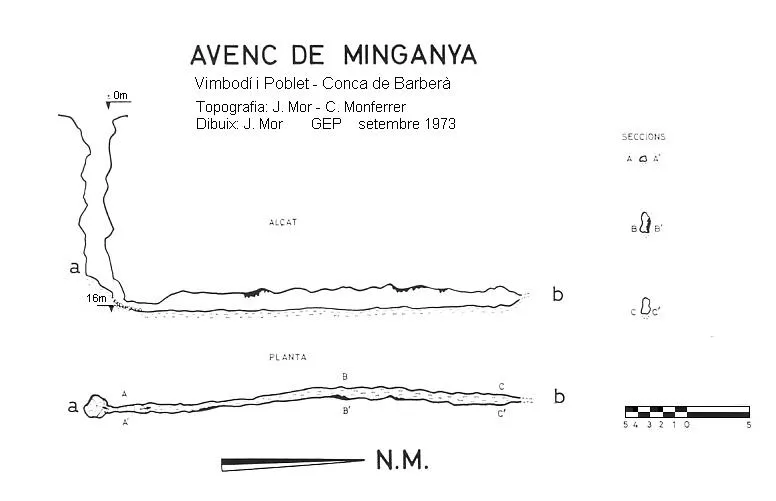
Avenc de Minganya
2.5 km · W
Vimbodí i Poblet (Conca de Barberà)
2 topo.
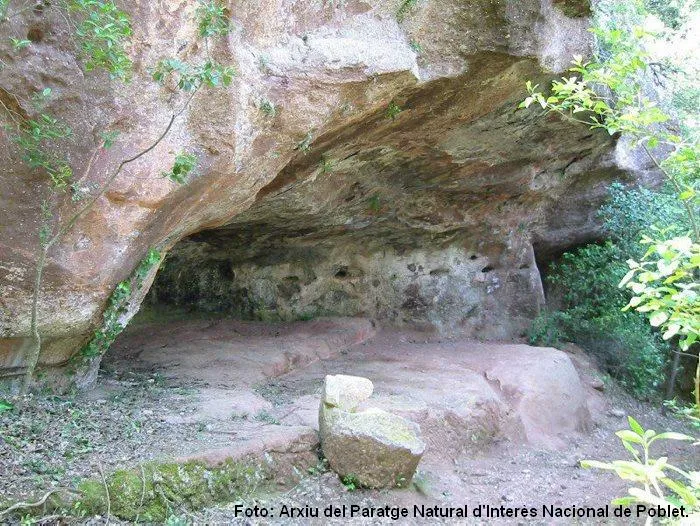
Cova de Fra Marginet
2.7 km · E
Vimbodí i Poblet (Conca de Barberà)
1 photos
Source: Espeleoindex (espeleoindex.com), modified. CC BY-NC 4.0, https://creativecommons.org/licenses/by-nc/4.0/