
Cova de la Gorja del Gaià
Archaeologically interesting cave with a 91 m route near Pontils (Conca de Barberà), known since ancient times and explored in 1934 by Salvador Vilaseca.
EspeleoWorld
Cova de la Gorja del Gaià
Archaeologically interesting cave with a 91 m route near Pontils (Conca de Barberà), known since ancient times and explored in 1934 by Salvador Vilaseca.
Pontils · Conca de Barberà
Length: 91 m · Depth: 8 m
Updated record
https://espeleoworld.com/en/c/cova-de-la-gorja-del-gaia
Information can change. Always verify coordinates, access, weather, and cave conditions before setting out.
Archaeologically interesting cave with a 91 m route near Pontils (Conca de Barberà), known since ancient times and explored in 1934 by Salvador Vilaseca.
Topographic
Espeleoindex · CC BY-NC 4.0, https://creativecommons.org/licenses/by-nc/4.0/ · Image © its author.
Photos
Espeleoindex · CC BY-NC 4.0, https://creativecommons.org/licenses/by-nc/4.0/ · Image © its author.
Description
Morphology
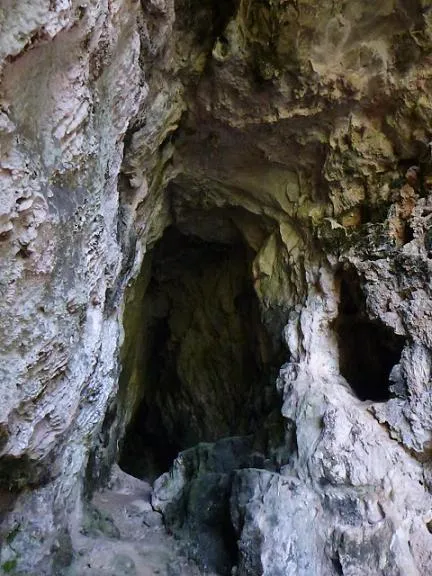
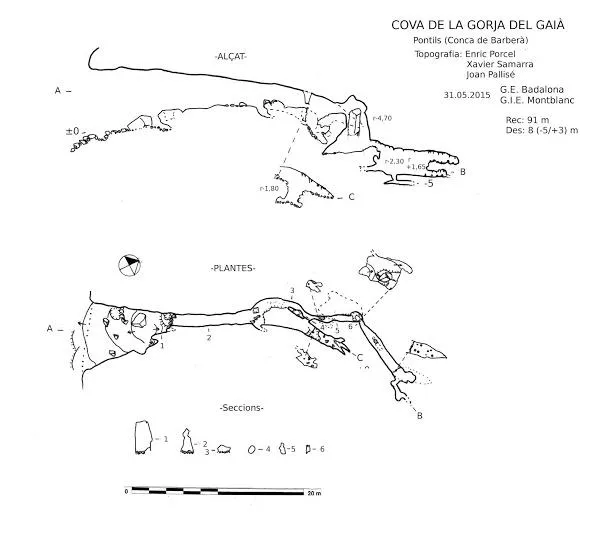
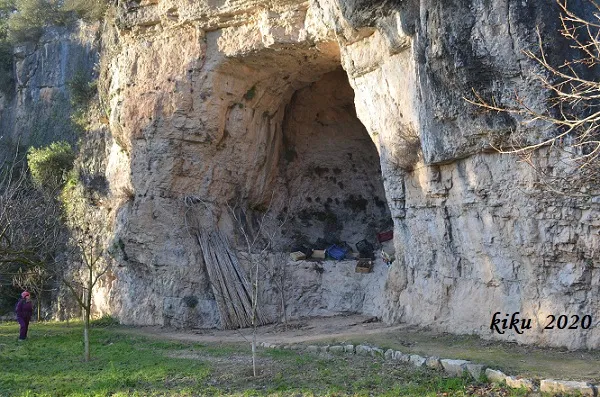
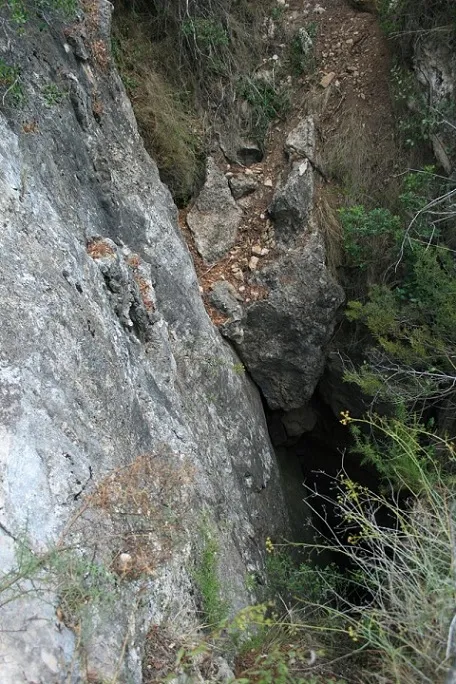
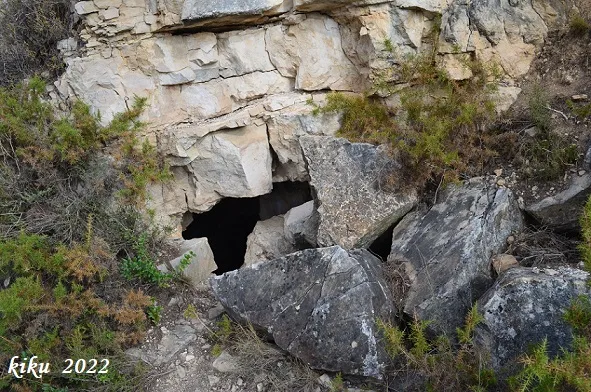
We find a large entrance mouth 7.50 metres wide by 7.30 metres high, at the foot of a small cliff. We advance along an ascending gallery full of rubble, disturbed in some places, the effect of digs and treasure searches as Dr. Vilaseca comments in his account. This comfortable gallery continues in a NE direction for about 25 metres; here we find on our left a small irregular window 0.45 x 0.50 metres that leads to a small room; to access it we must descend a r-1.90.
About 5 metres before, if we go along the left wall, we will reach a narrow passage, for now impassable, that communicates with this small room. If we ignore the window, the entrance gallery ends about 6 metres further on; a couple of metres away we find a small pit (r-1.80) with no continuation.
Returning to the previous small room, and past the window, we will find a small pit on the left about 0.40 metres in diameter and 1.80 metres deep; we will descend it, and we find ourselves in a small chamber of little more than 1 metre, with the peculiarity that an impenetrable fissure that we find on the left at ground level communicates with a room that we will describe later and that is at a lower level.
At the back of the small room, on the right we find a narrow section 0.25 metres wide by 0.66 metres high, a selective passage that leads us to the dome of a room where we easily climb down a r-4.70. We find some formations; on the left and on the ceiling there is the aforementioned connection. The room is about 4 x 2 metres; we find some graffiti by young people from the surrounding villages: "Jaume, Galo i Robert" from Queralt 23-5-75. This graffiti confirms that this area, despite not appearing on the SIE topography, was already known previously.
At the base of the drop we find another crawlway 0.70 x 0.27 metres that leads us to a final gallery with many formations; we will descend a r-2.30. We are in a gallery 6 metres long oriented E; at 1.50 metres, a small hole in the ground, through which we will enter with great difficulty (r-1), leads us to the lowest point of the cavity: -5 metres; it is a small lower floor beneath the concretion that covers the floor of the gallery.
The end of the gallery divides into two branches that end in less than 2 metres; they are narrow conduits with many formations. Before entering these branches, if we climb up the flowstone a r+1.65, we will reach an upper gallery beautifully decorated with concretions, along which we can advance about 4 metres more.
History
Cavity known since ancient times in the region.
The first known mention is that of Font i Sagué, who in his Catàlech Espeleològich de Catalunya (1897) mentions by references a cave in Pontils at the place called "la Garganta" and that it is walled up so that it cannot be used as a refuge by people of ill repute.
Faura (1909) and Ferraté (1918) mention it again without providing new data.
It is not until 2 September 1934 that Salvador Vilaseca, Josep Iglésies, Manuel Mata and Mn. Josep Vilarrubí, rector of Santa Perpètua, accompanied by the owner of the estate, Josep Ferrer, make the first documented exploration and the first archaeological data of the cavity. Vilaseca already mentions the earth movements caused by previous visitors in search of treasures.
On 4-5 September 1971 it is visited by the SIE-CEA who call it Cova de la Garganta (one of its popular names) and assign it 51 metres of route in a brief mention of their annual activities.
In 1975 it is explored by the young people of Santa Coloma de Queralt, led by Àngel Nicolàs (who years later would join the EGAN of Igualada), passing a narrow crawlway and discovering the new galleries at the end. We also find a graffiti by Jaume, Galo i Robert from 23-5-75. "Galo" is the nickname of Salvador Palau i Rafecas.
On 5 October 1975 it receives the visit of the ERE of the CEC, who also call it cova de la Garganta and assign it 50 metres of route.
At the end of that same year 1975, on 14 December, it is visited again by members of the SIE-CEA, who carry out the first known topography, although, like those of the ERE, they do not visit the final galleries and calculate 40 metres of route. This first topography is not published until 1978 in the second volume of the Catàleg Espeleològic de Catalunya.
It is not until 31 May 2015 that members of the GE Badalona and the GIEM (Montblanc) visit the cave again, carrying out a documented record and a new topography, this time including all the galleries and totalling a route of 91 metres.
Bio
Coleoptera
- Troglocharinus (Troglocharinus) elongatus Zariquiey 1950
User Comments (0)
No comments yet.
Be the first to share your experience!
Registered Explorations (0)
No explorations registered yet.
Register your visit to this cave!
Bibliography
- Borràs, J.; Miñarro, J.M.; Talavera, F. (1978).- Catàleg Espeleològic de Catalunya. Vol. 2 :
- Vilaseca, S. (1935).- "La cova de la Gorja del Gaià, a Pontils" Butll. CEC (484):347-353. Centre Excursionista de Catalunya. Barcelona.
- Actualització de dades, topografia (2015) i fotografies, extretes del blog: cavitatsdecatalunya.blogspot (de Jordi de Valles). Apunt del 15-7-2015. Text fitxa: E. Porcel (GE Badalona); Biospeleologia: J. Pallisé (GIE Montblanc); Fotografies: X. Samarra (GE Badalona) i A. Nicolàs (EGAN)
Nearby caves


Source: Espeleoindex (espeleoindex.com), modified. CC BY-NC 4.0, https://creativecommons.org/licenses/by-nc/4.0/