
Cova de l'Ormini
Cova de 160 metres de recorregut a la serra de Sant Joan, Coll de Nargó.
EspeleoWorld
Cova de l'Ormini
Cova de 160 metres de recorregut a la serra de Sant Joan, Coll de Nargó.
Coll de Nargó · Alt Urgell
Length: 160 m · Depth: 27 m
Updated record
https://espeleoworld.com/en/c/cova-de-l-ormini
Information can change. Always verify coordinates, access, weather, and cave conditions before setting out.
A 160-metre-long cave in the serra de Sant Joan, Coll de Nargó, known since ancient times and cited by Madoz, with access by track from Organyà passing through Montanissell.
Topographic
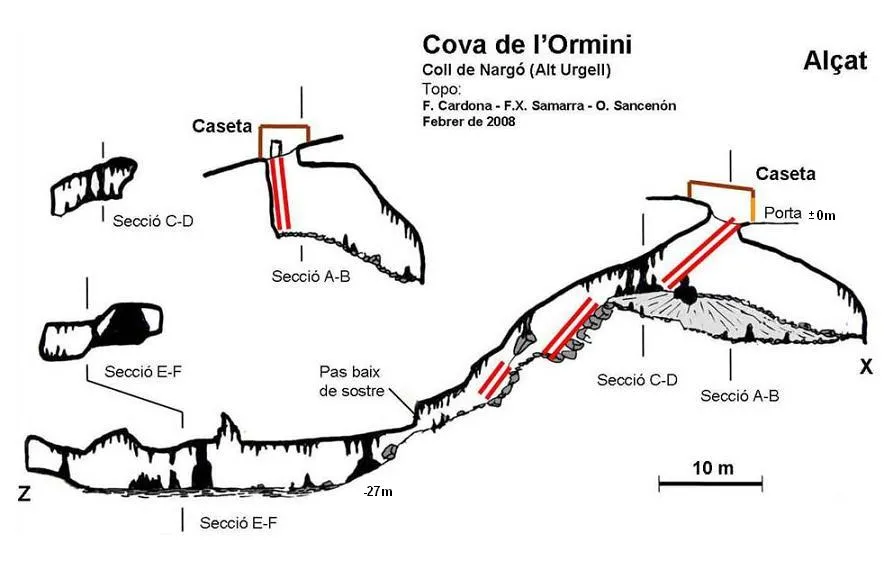
Espeleoindex · CC BY-NC 4.0, https://creativecommons.org/licenses/by-nc/4.0/ · Image © its author.
Photos
Espeleoindex · CC BY-NC 4.0, https://creativecommons.org/licenses/by-nc/4.0/ · Image © its author.
Description
Morphology
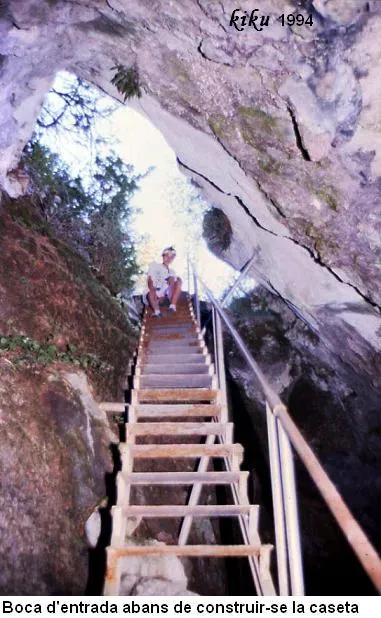
A construction in the manner of a hut measuring 4.7x6.2 metres with a grille door protects the mouth of the cave. This gives way to a vertical drop of 7 metres. This places us in a chamber 27x15 metres, with the floor occupied by medium-sized blocks and sloping towards the west. The cavity continues descending with a steep slope, forming a ramp-like gallery with an irregular layout. In this way one reaches a low ceiling passage where one must crouch momentarily to get through it. On the other side, the cave regains its dimensions until, shortly after, reaching the widest and most comfortable point of the cave; this is a chamber with a fairly flat floor, with maximum dimensions of 36x18 metres, although it is subdivided by some stalagmitic masses.
Speleothems
For their spectacular nature, some colonnades located in the N sector of the chamber stand out. The stalagmitic masses give the sector a particular beauty; these formations stand out for their black colouration, produced very probably by the contribution of manganese oxide.
Progression
The 7-metre vertical drop is overcome by means of a metal ladder with a handrail installed permanently. Two sections of fixed ladder help to overcome the most committing passages. At the beginning of 1990 the access to the cavity was already arranged with the metal ladder and the rope handrails, but the track still did not reach the mouth; this was made in 1994 and later the hut was built.
Other details
Toponymy: The word ormini, bulurmini, oli ermí, olimini, boli ermini, which we find in different cavities of the region, as well as bolumini or bolimini in others in the País Valencià, seems to come from the Bol armeni, a type of reddish clay that together with other substances formed a paste that was used to gild objects. It is also known that in the País Valencià it was used for pharmaceutical purposes. It is unknown whether this type of material was extracted from the cova de l'Ormini or whether it is merely attributed by popular imagination.
History
Known since ancient times, it is already cited by Pascual Madoz in the “Diccionario Geográfico-Estadístico-Histórico de España y sus posesiones de ultramar” published between 1845 and 1850. It is also recorded in the old catalogues of Puig y Larraz (1896); Font i Sagué (1897); Faura i Sans (1909).
On 25 August 1910 it is visited by Faura i Sans, Jeannel and Racovitza, making a detailed description and with the aim of collecting fauna.
Although known and visited by many hikers and speleologists, its topography was not published until 1978 and was made by members of the SIE - CEA a few years earlier.
Bio
Coleoptera: Troglocharinus (s.str.) fonti Jeannel (1910) (formerly Speophylus fonti).
User Comments (0)
No comments yet.
Be the first to share your experience!
Registered Explorations (0)
No explorations registered yet.
Register your visit to this cave!
Bibliography
- Borràs, J.; Miñarro,JM.; Talavera, F: (1978).- Catàleg espeleològic de Catalunya. Vol. 1 (l'Alt Urgell i la Cerdanya): 166. Ed. Políglota. Barcelona.
- Cardona, Ferran.(Març 2008).-”La Cova de l'Ormini, estudi i diagnosi” aparegut al blog: Espeleobloc en el post del dia 20 d'abril de 2008.
- Faura, M. (1911).- “Excursiones espeleológicas realizadas durante el año 1910 en la región catalana” Bol. R.Soc. Española de Hist. Nat. Madrid.
- Senent, J.; Victoria, JM. (1965).- “Datos para el conocimiento espeleológico del macizo del Boumort” Montaña(100): 269-281. CEC – Barcelona.
- Valles, J. de (2009).- Catàleg Espeleològic de Catalunya. Vol. 3. 379 pp. EC de Gràcia i Federació Catalana d'Espeleologia.
- Fotos 'JNC' facilitades per Jordi Navarro, (Centre Excursionista de Castellar del Vallès).
Nearby caves
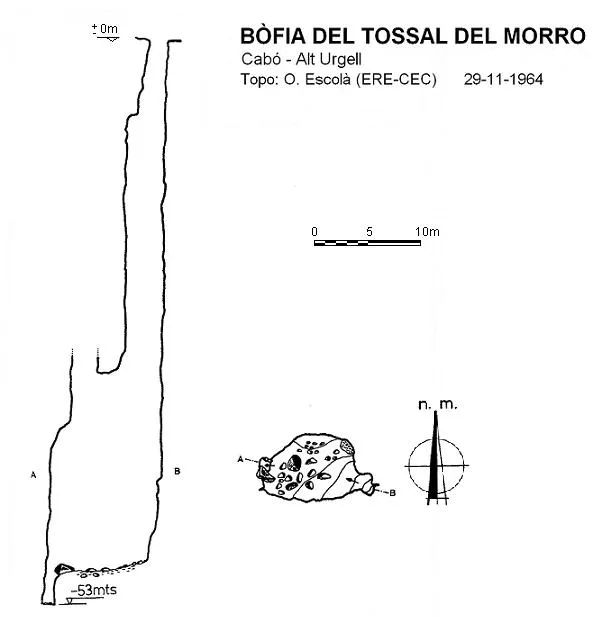


Source: Espeleoindex (espeleoindex.com), modified. CC BY-NC 4.0, https://creativecommons.org/licenses/by-nc/4.0/