
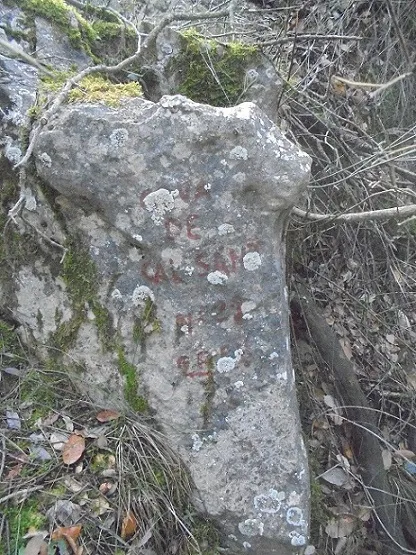
Cova de Cal Sant
Cova d'uns 60 m. de recorregut a la Llacuna.
EspeleoWorld
Cova de Cal Sant
Cova d'uns 60 m. de recorregut a la Llacuna.
Llacuna, La · Anoia
Length: 60 m · Depth: 10 m
Updated record
https://espeleoworld.com/en/c/cova-de-cal-sant
Information can change. Always verify coordinates, access, weather, and cave conditions before setting out.
A cave about 60 m long in La Llacuna, formed by a landslide of strata. It served as a hiding place during the 1936 war and has been the subject of speleological and biospeleological work.
Topographic
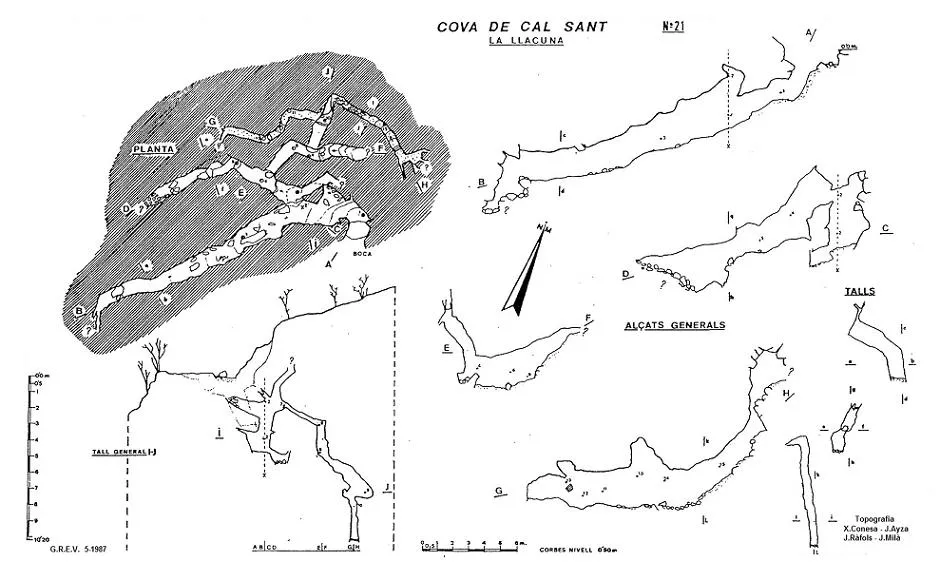
Espeleoindex · CC BY-NC 4.0, https://creativecommons.org/licenses/by-nc/4.0/ · Image © its author.
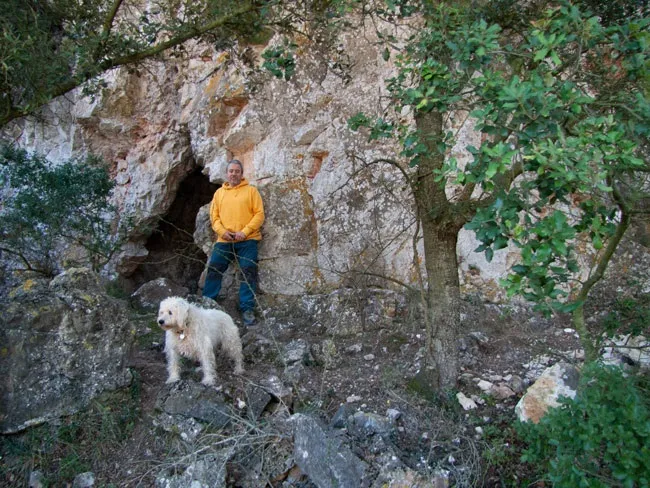
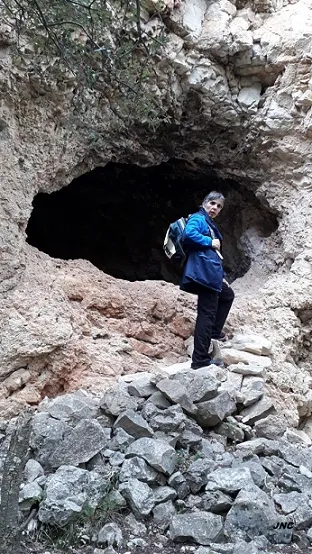
Photos
Espeleoindex · CC BY-NC 4.0, https://creativecommons.org/licenses/by-nc/4.0/ · Image © its author.
Description
Morphology
Cavity formed by a landslide of strata, which creates a number of fissures. Some of them are decomposed and in others some small flowstone and concretions have formed. Once past the entrance we find ourselves in the main gallery (A-B). It is about 20 metres long. A few metres from the entrance there is a large stone leaning against the wall and wedged with stones at the bottom, which apparently were placed in wartime so that it would not obstruct the passage of the hidden men who took refuge there. From the entrance mouth, about 4 metres in, on one side of the ceiling, is the access to another fissure (C-D) about 3 metres above the floor, about 11 metres long by 70 to 80 centimetres wide. Three metres from point (X), we find another gallery (E-F) 2 metres high by about 6 metres long and 70 centimetres wide. In the 3 and a half metres a small hole opens, between 35 and 40 centimetres, which currently gives access to what we believe is the end of the fissures explored inside. This last one (G-H) is about 15 metres long by about 40 or 50 centimetres wide and its height, at its highest point, is about 7 metres on the E side of the fissure (H). At this place another entrance to the cavity can be seen, but it is inaccessible because of the balance of the stones. This entrance is about 7 metres from the main mouth where, from the outside, possibilities of continuation in a N direction can be seen.
(This description is made from the text and survey published by the GREV, which seems the most complete and most precise of the three that exist).
History
We found a curious blog: covadecalsant.blogspot, consisting of a single entry and where Josep Bargalló, son of Cal Sant, explains how and when the cave was found. In 1936, when the war broke out, many people of La Llacuna decided to hide in the mountains. The few and small caves of the area were not enough for all the hidden men; it was then that his father, Joan Bargalló, remembered a small hole where he had thrown a fox. In the early days very few people fitted in it, so they decided to enlarge the continuation of the entrance gallery until they found a human skull. He explains that they even brought wooden beds and that almost twenty people came to sleep there.
After the war ended, Josep Bargalló accompanied Mr. Baqués, a cava maker in Guardiola de Font-rubí and an archaeology enthusiast, who for months went up every weekend to sieve the earth and recover all the archaeological material from inside. The two of them handed over all the finds to the Museum of Vilafranca, including the skull that the hidden men had dug up.
It was not until 1971 that, on a visit by the ERE – CEC to the avenc de la Plana d'Ancosa, a tenant farmer of the area indicated a series of holes in the Cal Sant area. D. Schibi and T. Nubiola locate and explore them on 8-8-1971. In one of them (see Avenc de Cal Sant) they find fauna, but not in the other (Cova de Cal Sant). In May 1972 members of the ERE – CEC visit and survey the two cavities, surveys that had remained unpublished until now.
Later, in 1987, members of the GREV – Biblioteca Museu Víctor Balaguer (Vilanova i la Geltrú) make a complete study of the cavity, although it is not published until 1991. In 1988 it was also visited by members of the SIRE – UEC Sants.
On 15-1-2017, Joan Pallisé and colleagues rediscover the cave for biospeleological purposes and find only remains (elytra) of Troglocharinus. On 12-8-2017, the same Pallisé manages to collect 9 specimens.
Bio
Coleoptera
- Troglocharinus (Troglocharinus) schibii (Español, 1972)
On 12-8-2017, Joan Pallisé was able to capture for the first time in this cavity 9 specimens of this species.
User Comments (0)
No comments yet.
Be the first to share your experience!
Registered Explorations (0)
No explorations registered yet.
Register your visit to this cave!
Bibliography
- Conesa, X.; Jansà, JMª; Ferrer, A.; Mormeneo, L. (1991).- “ Les coves de l'Hort Xic i de Cal Sant. Unes cavitats de la Serra d'Ancosa. La Llacuna” Butlletí de l'Agrupació Excursionista Talaia (gener-març): 33-39. Vilanova i la Geltrú.
- SIRE UEC Sants (1988).- “Cova de Cal Sant. La Llacuna (Anoia)”. Excursionisme (156): 156-157. Unió Excursionista de Catalunya. Barcelona.
- Dades i topografia inèdites de l'arxiu ERE – CEC. Ampliades per l'Oleguer Escolà
- Revisió de coordenades, dades biospeleològiques i fotografies facilitades per Joan Pallisé Coflent (gener 2021)
Nearby caves
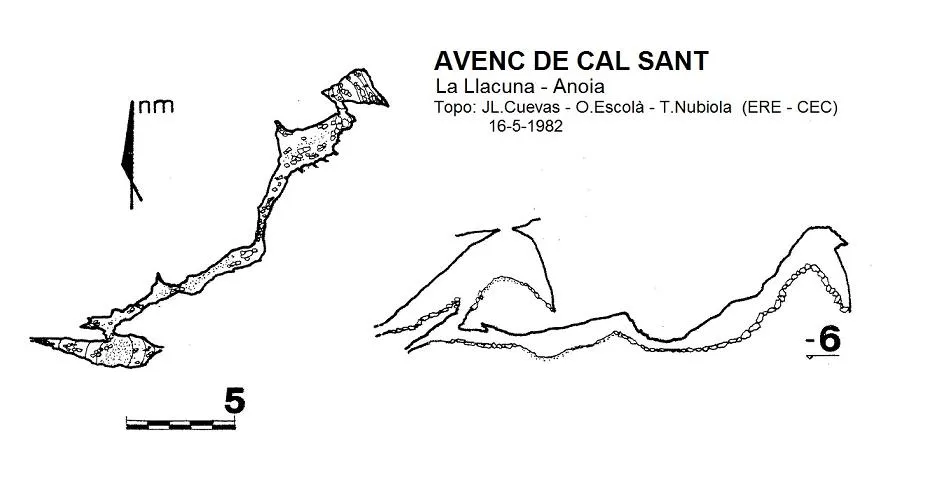
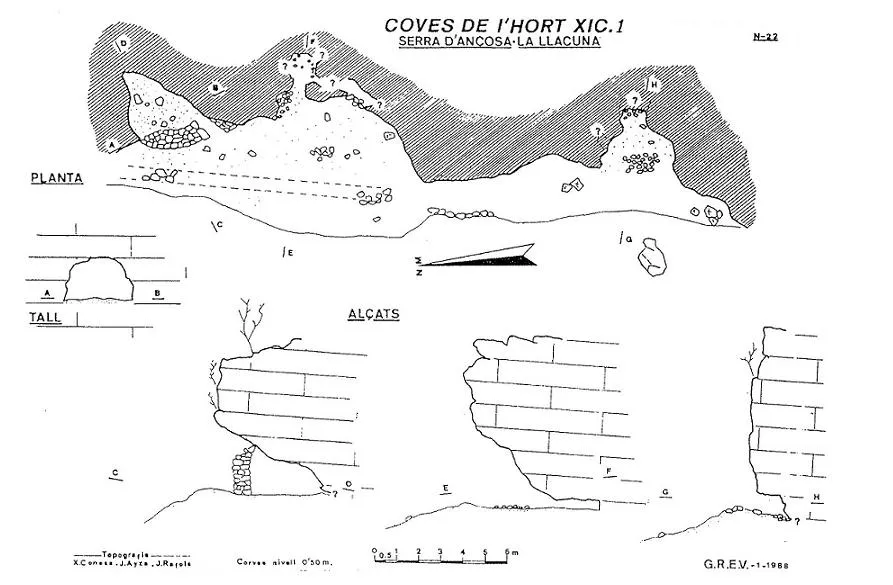


Source: Espeleoindex (espeleoindex.com), modified. CC BY-NC 4.0, https://creativecommons.org/licenses/by-nc/4.0/