
Cova d'en Peixet
A cavity with 546 metres of passage and significant archaeological interest, with two entrances, chambers such as the Sala dels Gravats and the Sala Blanca, and a rich Neolithic heritage.
EspeleoWorld
Cova d'en Peixet
A cavity with 546 metres of passage and significant archaeological interest, with two entrances, chambers such as the Sala dels Gravats and the Sala Blanca, and a rich Neolithic heritage.
Febró, La · Baix Camp
Length: 546 m · Depth: 39 m
Updated record
https://espeleoworld.com/en/c/cova-d-en-peixet
Information can change. Always verify coordinates, access, weather, and cave conditions before setting out.
A cavity with 546 metres of passage and significant archaeological interest, with two entrances, chambers such as the Sala dels Gravats and the Sala Blanca, and a rich Neolithic heritage.
Topographic
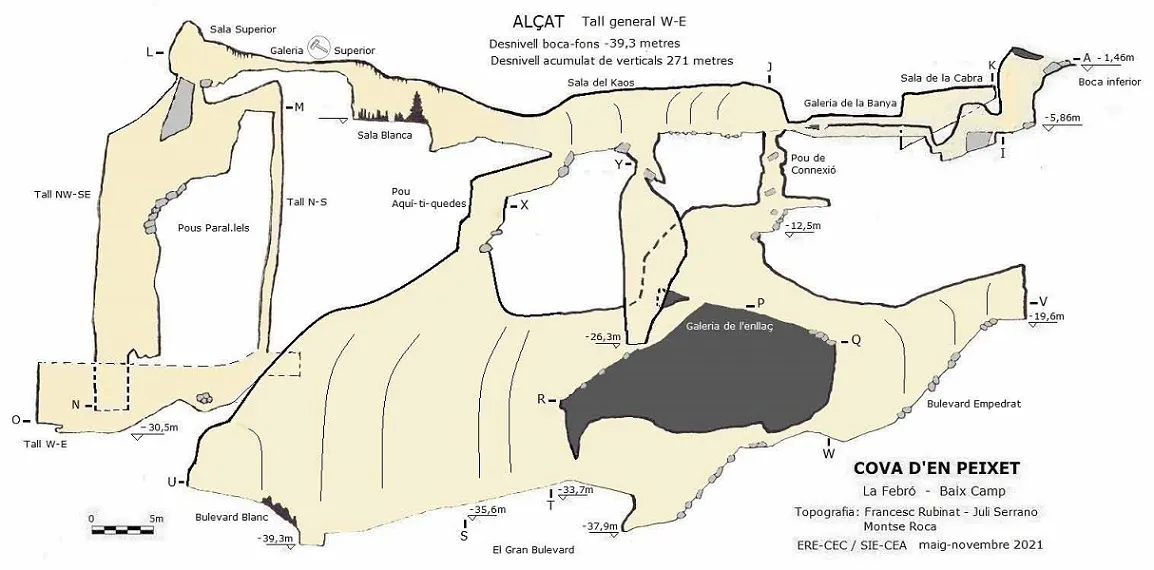
Espeleoindex · CC BY-NC 4.0, https://creativecommons.org/licenses/by-nc/4.0/ · Image © its author.
Photos
Espeleoindex · CC BY-NC 4.0, https://creativecommons.org/licenses/by-nc/4.0/ · Image © its author.
Description
Morphology
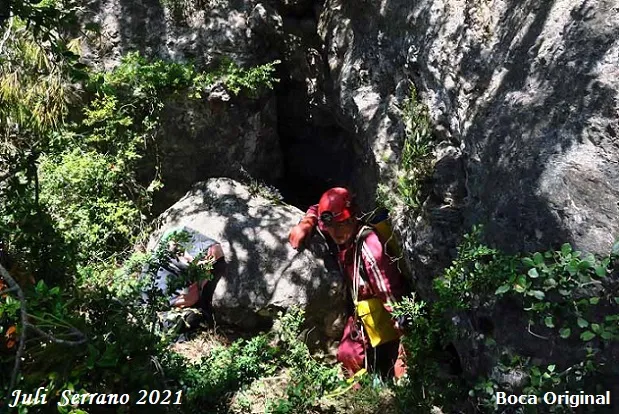
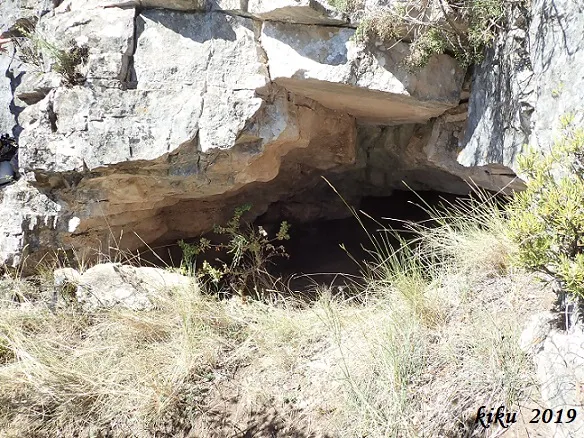
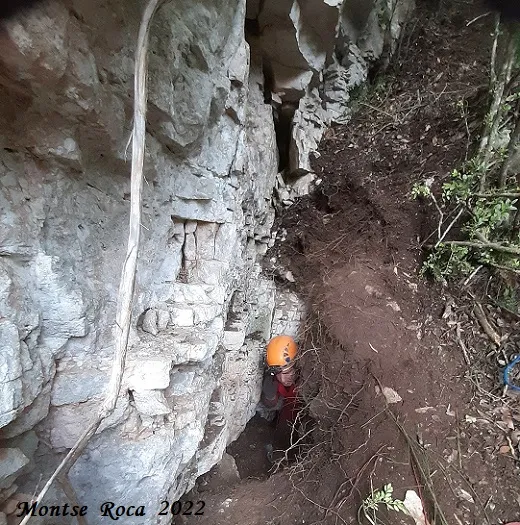
The cavity has two entrances, the upper one approximately 1 metre in diameter with a vertical drop of about 8 metres that opens into the middle of the entrance chamber, and the lower one which is the one used to access the cavity; this is located a few metres further to the E.
Once past the entrance grille, we access by a short ramp that places us on a drop of -4 metres equipped with handholds; the base is a chamber of 6x4 metres and on the ceiling the upper entrance can be seen.
From the base of the shaft and in a SE direction we find a gallery of about 5 metres descending; at the end it rises again and after about three metres it ends, but a narrow hole of about 10 centimetres in diameter allows the outside light to be seen; this point externally is located at the Canal de la Cova de la Vila.
Again at the base of the entrance shaft we descend the chamber along the side of the S wall; at the end we find a small drop; at its base we find a crawl that turns back and leads to the gallery described above.
Once again at the base of the drop we find a gallery that is currently almost flat as a result of the work carried out by the archaeologists to prepare the access; at the end the gallery is closed by blocks, but on the right side a passage opens that had to be cleared to gain access; it has now been widened and closed with a sliding iron door. Past the door one enters a rounded chamber of 10x9x4 (Sala dels Gravats) where on the E side wall we find more than a hundred engravings with anthropomorphic forms belonging to the Neolithic, with probably some from the Palaeolithic; a bivalve shell has also been found there, probably used as a lamp to provide light.
Once again at the base of the entrance shaft, we will follow the right-hand wall (NE) for a couple of metres where a joint opens; this gives access to a small chamber that immediately drops for a couple of metres and gives access to some narrow passages that climb a couple of metres to a conduit 9 metres long, wide and with a low ceiling. At the end of this conduit we have two continuations; if we turn 180 degrees to the right we will follow a conduit similar to the previous one but at a higher level, which after travelling about 10 metres reaches a chamber of 9x8x3 metres (Sala de la Cabra) where remains of Neolithic pottery and some animal bones have been found.
Once again at the point of the junction mentioned above, if we continue straight on we enter a narrow joint where the Pou de Connexió is located, which we will describe later. Following the joint after 8 fairly narrow metres one reaches the mid-height of the Sala del Kaos of 8x7x5 metres; this point has been equipped with a fixed handrail; the base of the chamber has a strong slope and large blocks; beneath one of these blocks a fairly unstable shaft opens that ends in a cul-de-sac at -26 metres.
Crossing the chamber in a NE direction, on the other side we find two superimposed galleries; following the lower one to the end we find a shaft of -24.5 metres, this is the Aquí-t'hi-quedes shaft; at -5 metres it becomes fairly narrow, then widens as one descends; once at the base located at -35.6 metres we can travel the fissure in both directions, this is the Gran Bulevard. If we continue towards the E, the gallery climbs and soon descends again until we find a shaft of -3 metres; once at the base the gallery climbs steeply until reaching a wider flat area where the fissure closes; at this point on the left side a crawl three metres long gives us access to a new sector of the fissure, in this area called the Bulevard Empedrat. The gallery climbs steeply again by means of large wedged blocks up to a flat area where the gallery ends at the level -19.6 metres.
Once again at the base of the Aquí-t'hi-quedes shaft, continuing in a W direction the gallery continues in the form of a meander and descends until finding a small shaft of -1 metre, which is the lowest point of the cavity located at -39.3 metres; from here the gallery climbs until it becomes impassable.
Once again at the Sala del Kaos, we follow the upper gallery, equipped with a fixed handrail; after six metres it gives access to a first chamber followed by another located at a higher level, this is the Sala Blanca. At the end of the Sala Blanca on the left a fixed rope is installed which must be climbed 5 metres to ceiling level; we are in the Galeria Superior; here we find a crawl that had to be cleared and that leads us to the Sala Superior. On the left side of the chamber we find a shaft of 7.5 metres that places us at the base of a wide joint; following it downwards we reach a shaft of -19 metres that ends in a cul-de-sac; this shaft at its upper part communicates with the Sala Superior through an impassable passage.
Once again at the base of the shaft coming from the Sala Superior, we will climb the joint about 5 metres and place ourselves at the head of a shaft of 21.5 metres; once at its base we can travel the joint along about 25 metres; the depth level at this point is -30.5 metres.
Placing ourselves again at the start of the joint that leads to the Sala del Kaos, on the ground we find that the joint drops away; this is the Pou de la Connexió; without the need for equipment but with some loose stones to be careful of, one descends about 9 metres; at this point we find a shaft of about 6 metres; at the base we are in the Galeria de l'Enllaç; if we continue towards the W we reach a narrow descending passage which, once passed, places us at the head of a shaft of about 8 metres that descends to the Gran Bulevard at the level -33.7 metres, quite close to the base of the Aquí-t'hi-quedes. shaft. Once again in the Galeria de l'Enllaç, continuing in an E direction we will reach the head of a shaft of about 9 metres that will take us to the Bulevard Empedrat, just after passing the three-metre crawl.
Speleothems
In the Sala Blanca we find abundant white-coloured lithogenic formation, with a spectacular stalagmite about 3 metres high and 1 metre wide.
Hydrology
As a curiosity, in this fissure we find marked an ancient phreatic level about 5 metres high, with coralline formations on the walls up to the indicated level; the white of these formations contrasts with the darkness of the dolomites above this level; this area we call the Bulevard Blanc.
Progression
Once past the entrance grille, we access by a short ramp that places us on a drop of -4 metres equipped with handholds; the base is a chamber of 6x4 metres and on the ceiling the upper entrance can be seen.
From the base of the shaft and in a SE direction we find a gallery of about 5 metres descending; at the end it rises again and after about three metres it ends, but a narrow hole of about 10 centimetres in diameter allows the outside light to be seen; this point externally is located at the Canal de la Cova de la Vila.
Again at the base of the entrance shaft we descend the chamber along the side of the S wall; at the end we find a small drop; at its base we find a crawl that turns back and leads to the gallery described above.
Once again at the base of the drop we find a gallery that is currently almost flat as a result of the work carried out by the archaeologists to prepare the access; at the end the gallery is closed by blocks, but on the right side a passage opens that had to be cleared to gain access; it has now been widened and closed with a sliding iron door. Past the door one enters a rounded chamber of 10x9x4 (Sala dels Gravats) where on the E side wall we find more than a hundred engravings with anthropomorphic forms belonging to the Neolithic, with probably some from the Palaeolithic; a bivalve shell has also been found there, probably used as a lamp to provide light.
Once again at the base of the entrance shaft, we will follow the right-hand wall (NE) for a couple of metres where a joint opens; this gives access to a small chamber that immediately drops for a couple of metres and gives access to some narrow passages that climb a couple of metres to a conduit 9 metres long, wide and with a low ceiling. At the end of this conduit we have two continuations; if we turn 180 degrees to the right we will follow a conduit similar to the previous one but at a higher level, which after travelling about 10 metres reaches a chamber of 9x8x3 metres (Sala de la Cabra) where remains of Neolithic pottery and some animal bones have been found.
Once again at the point of the junction mentioned above, if we continue straight on we enter a narrow joint where the Pou de Connexió is located, which we will describe later. Following the joint after 8 fairly narrow metres one reaches the mid-height of the Sala del Kaos of 8x7x5 metres; this point has been equipped with a fixed handrail; the base of the chamber has a strong slope and large blocks; beneath one of these blocks a fairly unstable shaft opens that ends in a cul-de-sac at -26 metres.
Crossing the chamber in a NE direction, on the other side we find two superimposed galleries; following the lower one to the end we find a shaft of -24.5 metres, this is the Aquí-t'hi-quedes shaft; at -5 metres it becomes fairly narrow, then widens as one descends; once at the base located at -35.6 metres we can travel the fissure in both directions, this is the Gran Bulevard. If we continue towards the E, the gallery climbs and soon descends again until we find a shaft of -3 metres; once at the base the gallery climbs steeply until reaching a wider flat area where the fissure closes; at this point on the left side a crawl three metres long gives us access to a new sector of the fissure, in this area called the Bulevard Empedrat. The gallery climbs steeply again by means of large wedged blocks up to a flat area where the gallery ends at the level -19.6 metres.
Once again at the base of the Aquí-t'hi-quedes shaft, continuing in a W direction the gallery continues in the form of a meander and descends until finding a small shaft of -1 metre, which is the lowest point of the cavity located at -39.3 metres; from here the gallery climbs until it becomes impassable.
Once again at the Sala del Kaos, we follow the upper gallery, equipped with a fixed handrail; after six metres it gives access to a first chamber followed by another located at a higher level, this is the Sala Blanca. At the end of the Sala Blanca on the left a fixed rope is installed which must be climbed 5 metres to ceiling level; we are in the Galeria Superior; here we find a crawl that had to be cleared and that leads us to the Sala Superior. On the left side of the chamber we find a shaft of 7.5 metres that places us at the base of a wide joint; following it downwards we reach a shaft of -19 metres that ends in a cul-de-sac; this shaft at its upper part communicates with the Sala Superior through an impassable passage.
Once again at the base of the shaft coming from the Sala Superior, we will climb the joint about 5 metres and place ourselves at the head of a shaft of 21.5 metres; once at its base we can travel the joint along about 25 metres; the depth level at this point is -30.5 metres.
Placing ourselves again at the start of the joint that leads to the Sala del Kaos, on the ground we find that the joint drops away; this is the Pou de la Connexió; without the need for equipment but with some loose stones to be careful of, one descends about 9 metres; at this point we find a shaft of about 6 metres; at the base we are in the Galeria de l'Enllaç; if we continue towards the W we reach a narrow descending passage which, once passed, places us at the head of a shaft of about 8 metres that descends to the Gran Bulevard at the level -33.7 metres, quite close to the base of the Aquí-t'hi-quedes. shaft. Once again in the Galeria de l'Enllaç, continuing in an E direction we will reach the head of a shaft of about 9 metres that will take us to the Bulevard Empedrat, just after passing the three-metre crawl.
Other details
Currently the cave has a passage length of 546 metres and an entrance-to-bottom height difference of -39.3 metres; the accumulated height difference of all the verticals is 271 metres.
The cavity is awaiting the corresponding archaeological work and in order to preserve both the archaeological content and the engravings, the IPHES has installed a protection grille at the entrance and an iron door in the Sala dels Gravats; access to the cavity is therefore restricted.
It should be noted that at present the Cova d'en Peixet and the nearby Cova de la Vila, despite their proximity, are not physically connected and are therefore two different cavities.
History
The cave was located around 2018 by Albert Peixet, a resident of Capafonts, when he was in fact looking for the cova de la Vila, whose location had been lost since the time of the explorations carried out by Dr. Vilaseca (1941-44).
However, it seems that someone from la Febró knew of the existence of the cavity, and some even called it Cova de la Vila de Dalt, but the great majority wrongly thought that it was the cova de la Vila, and so when the members of the IPHES, who wanted to carry out a study at the cova de la Vila, asked in la Febró about the location of the cova de la Vila, they were directed to this other cavity.
All this happened at the same time that Albert Peixet made contact to report the find to Juli Serrano, Montse Roca (SIE-CEA) and Francesc Rubinat (ERE-CEC), regular collaborators of EspeleoÍndex and with whom Albert Peixet had already collaborated previously in various cavities in the area.
Due to the mobility restrictions caused by Covid-19, they could not begin the explorations of the cavity until 13 May 2021. That same day, after carrying out a clearance, they accessed a chamber full of engravings; likewise in another sector of the cavity they found bones and pottery scattered on the ground. They proceeded to contact Miquel Nebot, head of the Villalta Section of Archaeology and Palaeontology of the Catalan Federation of Speleology, so that they would make the find known to the competent authorities.
From that moment on, various explorations were carried out in which the following took part jointly at different times: Josep Vallverdú, member of the IPHES; Dr. Ramon Viñas Vallverdú (Archaeology of Symbolic Behaviour. Researcher-collaborator of the IPHES and CIAR, Centre d'Interpretació de l'Art Rupestre de les Muntanyes de Prades.); Tània Álvarez, Head of the section for the protection of archaeological and palaeontological heritage; Imma Teixell, archaeologist of the territorial services of archaeology and palaeontology; Daria Calpena, Archaeologist of the section for the protection and dissemination of archaeological and palaeontological heritage; Miquel Nebot and Teresa Hernández of the Villalta Section of Archaeology and Palaeontology of the Catalan Federation of Speleology; Lluís Domingo, President of the Catalan Federation of Speleology; and Lourdes Martorell, mayor of la Febró, together with Isidre Martorell and Joan Carles Santos of la Febró.
The exploration team formed by Montse Roca, Juli Serrano and Francesc Rubinat continued with the tasks of exploration, equipment and surveying of the cavity, which would conclude in December 2021. The work carried out both in the cova d'en Peixet and in the group of cavities found in the barranc de la cova del Corral was presented at the XXXII Premi Norbert Font i Sagué in 2022, the work presented being awarded the first prize.
Currently (2022) the cavity has been officially declared a Bé Cultural d'Interès Nacional (BCIN).
On 17 March 2023, within an event organised in la Febró, the department of Culture of the Generalitat made the official presentation of the cavity and of the Sala dels Gravats to the media, where both the archaeologists of the IPHES and the authorities of the village wished to emphasise that these engravings are in the cova de la Vila.
It is more than evident that this is NOT the cova de la Vila that Dr. Vilaseca excavated 80 years ago, and we do not understand the fact that they present it with this name to the media, while the original cova de la Vila, the one excavated by Dr. Vilaseca, is renamed Boca Prunera. Nor do we understand the reason or the purpose behind this interest in the name change, but for now they are two independent cavities that have no communication between them, and we understand that the cova de la Vila is sufficiently documented in the bibliography to change its name at this stage.
Bio
Coleoptera:
- Col. Leiodidae Lepthodirini Troglocharinus orcinus orcinus (Jeannel)
20-XI-2021 4 specimens collected by Serrano & Roca leg.
8-XII-2021 3 specimens collected by Serrano & Roca leg.
- Col. Staphylinidae
8-XII-2021 2 specimens collected by Serrano & Roca leg.
Diplura:
- Campodeidae
8-XII-2021 3 specimens collected by Serrano & Roca leg.
(Identification data provided by Jordi Comas)
User Comments (0)
No comments yet.
Be the first to share your experience!
Registered Explorations (0)
No explorations registered yet.
Register your visit to this cave!
Bibliography
- Albert Manent (1967).- Toponímia del terme municipal de la Febró. (Premi Eduard Brossa 1968 de la Societat Catalana de Geografia). Butlletí Arqueològic. Reial Societat Arqueològica Tarraconense, 1973, Núm. 121-128, p. 163-192.
- Totes les dades, coordenades, topografia i fotografies han estat facilitades per Montse Roca, Juli Serrano i Francesc Rubinat (SIE-CEA i ERE-CEC).
Nearby caves


Source: Espeleoindex (espeleoindex.com), modified. CC BY-NC 4.0, https://creativecommons.org/licenses/by-nc/4.0/