
Cova d'en Mata
A cavity with 102 m of passage and -15.75 m of vertical drop in Vilaverd, with archaeological remains, excavated by Dr. Salvador Vilaseca.
EspeleoWorld
Cova d'en Mata
A cavity with 102 m of passage and -15.75 m of vertical drop in Vilaverd, with archaeological remains, excavated by Dr. Salvador Vilaseca.
Vilaverd · Conca de Barberà
Length: 102 m · Depth: 15 m
Updated record
https://espeleoworld.com/en/c/cova-d-en-mata
Information can change. Always verify coordinates, access, weather, and cave conditions before setting out.
A cavity with 102 m of passage and -15.75 m of vertical drop in Vilaverd, with archaeological remains, excavated by Dr. Salvador Vilaseca.
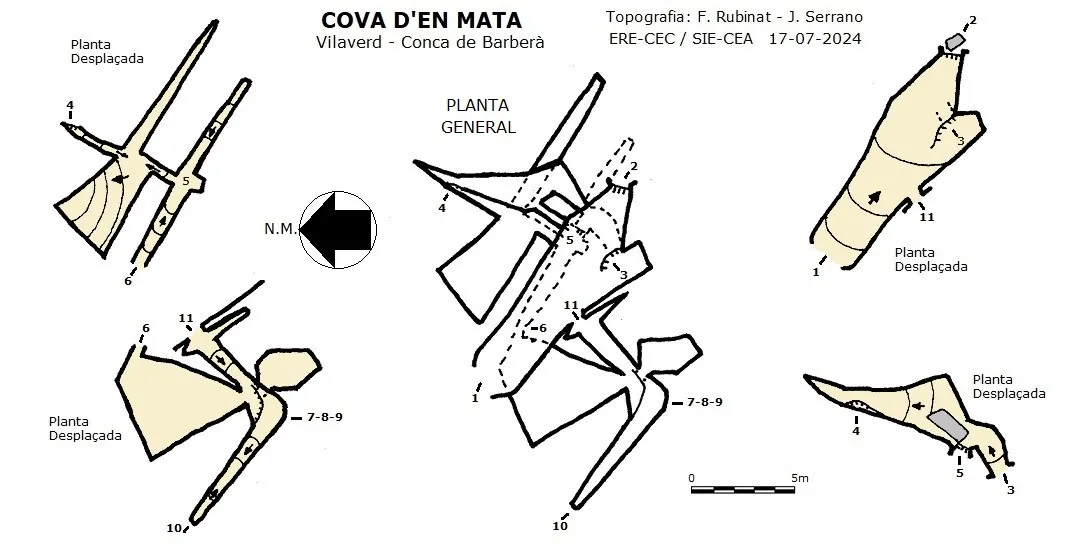
Topographic
Espeleoindex · CC BY-NC 4.0, https://creativecommons.org/licenses/by-nc/4.0/ · Image © its author.
Photos
Espeleoindex · CC BY-NC 4.0, https://creativecommons.org/licenses/by-nc/4.0/ · Image © its author.
Description
Morphology
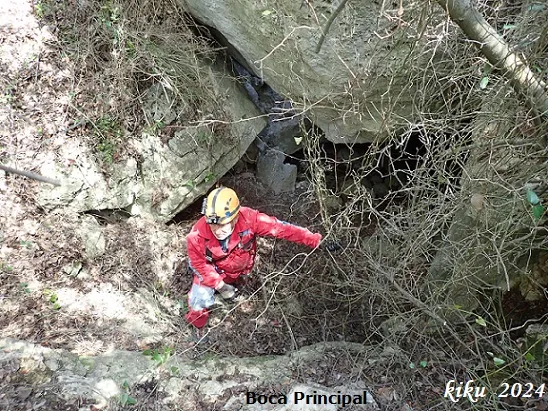
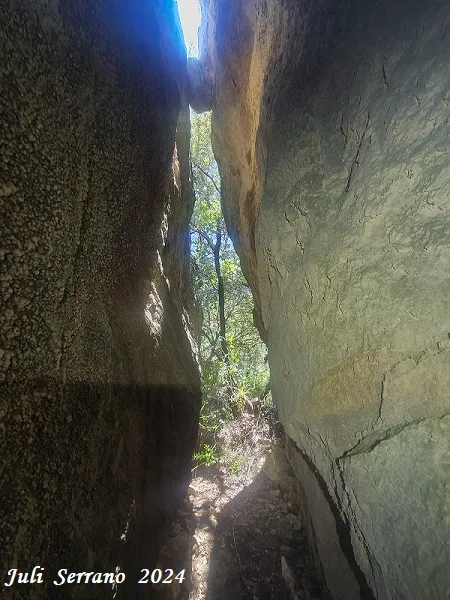
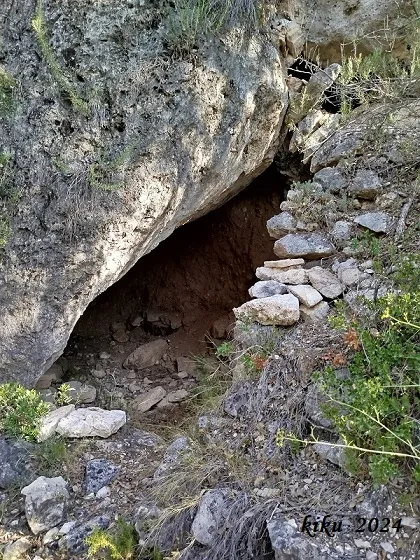
Cavity structured in several superimposed levels and formed by large blocks from the collapse of the cliff due to the excavation of the Brugent river. It has a vertical drop of -15.75 metres and a passage of 102 metres. The wide main mouth opens in the ground. In the wide room with a low ceiling (0.80 m) is the deepest point of the cavity (-15.75 m).
Speleothems
A wide gallery but with a very low ceiling and full of water drips.
Progression
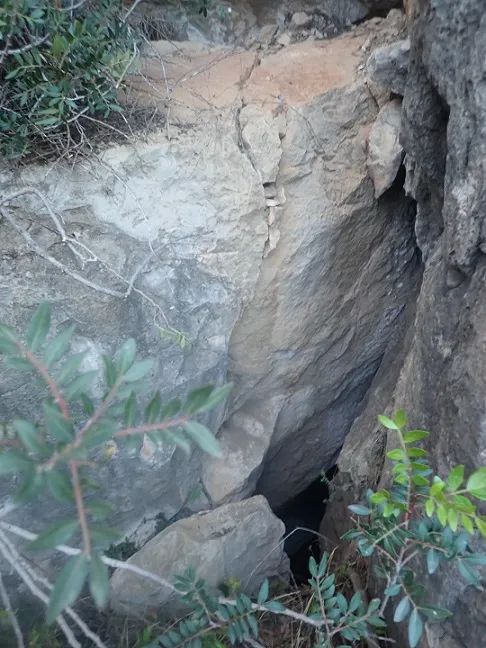
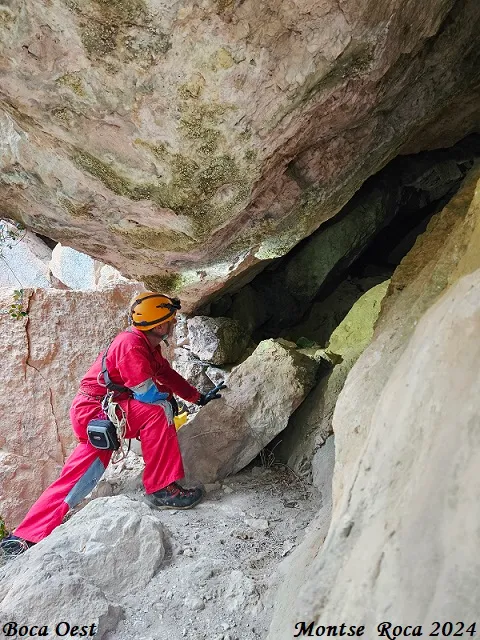
Access is via a small step; the gallery that descends in a slope leads us to a point where on the left we find an exit to the outside that opens onto the cliff that descends towards the Brugent river, here we find some small cracks without continuity. Positioning ourselves again in the entrance gallery at its final part, on the left side just below a small step we find a crawlway; following it we soon find on the left a passage that opens onto a shaft about 5 metres deep that soon bells out. Continuing forward along the crawlway, we descend a step and on the left we find a conduit that leads us back to the aforementioned shaft, but at a lower level. We follow the conduit on the right, which ends after a few metres; a little before reaching the end we find on the left a small shaft with a drop of 1.80 metres, followed by a downward ramp that leads us to a junction of joints; to the left it ends after a few metres, while to the right a wide room opens but with a low ceiling (0.80 m), in the centre of this room is the deepest point of the cavity (-15.75 m). From the previous junction we continue straight ahead in a slight climb, positioning ourselves in a new and wide junction of joints that is the base of the 5-metre shaft mentioned above; the conduit on the left ends after a few metres, with some impenetrable passage that gives onto the outside through the cliff area. We continue to the right along a gallery that climbs and is quite high; at the end a narrow passage on the left places us in a wide gallery but with a very low ceiling and full of water drips. Once at the end we come out into a gallery where at about 9 metres high there is a wide access mouth in the form of a shaft; one can climb up to almost half the height of the shaft by means of a large inclined block leaning against the wall; once up we access a parallel gallery without continuity. Positioned again at the base of the shaft, on the right we have a small room with no further passage, while on the left the gallery climbs and passing a somewhat narrow passage comes out again into the entrance gallery, but on its right side.
History
It was discovered at the beginning of the 30s of the last century and later excavated by Dr. Salvador Vilaseca with the collaboration of Josep Iglésies and Manuel Mata, from this collaborator the cavity takes its name. Archaeological remains were found consisting of animal bones, one of them worked, and 13 fragments of pottery; Roman pottery was also found. It happens that Vilaseca prepared an article in Catalan collecting this work, but the outbreak of the war stopped the publication; later in 1942 he published the same article in Spanish in the journal Ampurias.
User Comments (0)
No comments yet.
Be the first to share your experience!
Registered Explorations (0)
No explorations registered yet.
Register your visit to this cave!
Bibliography
- Vilaseca Anguera, Salvador. (1936).-”Proves d'un article (no publicat) per al volum V del Butlletí de l’Associació Catalana d’Antropologia, Etnologia i Prehistòria, ca. 1936.
- Vilaseca Anguera, Salvador (1942).-“Mas cuevas y enterramientos prehistóricos en el bajo Brugent (Término de Vilavert, provincia de Tarragona)”. Ampurias (vol.IV):205-213.
- Aparicio Mainar, Raquel (2016).-”Materials procedents de la Conca de Barberà als fons del Museu de Reus”. Podall (2016):244-266.
- Totes les dades, coordenades, topografia i fotografies han estat facilitades per Juli Serrano (SIE-CEA) i Francesc Rubinat (ERE-CEC). Juliol de 2024.
Nearby caves


Source: Espeleoindex (espeleoindex.com), modified. CC BY-NC 4.0, https://creativecommons.org/licenses/by-nc/4.0/