
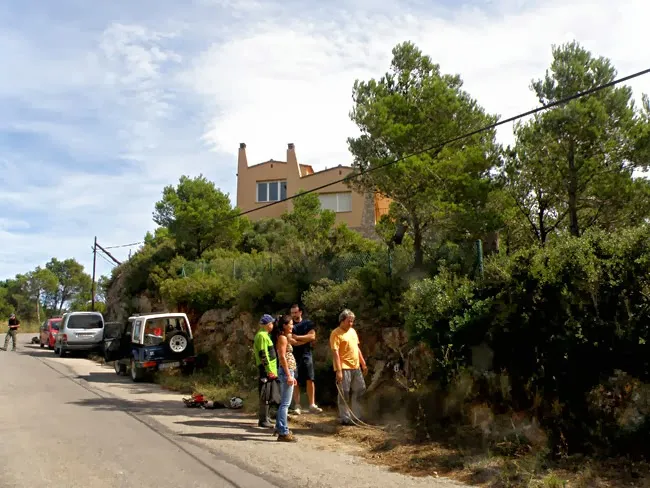
Cova Berta
Bonica cavitat d'uns 10 m. de fondària i 50 m. de recorregut a Begur
EspeleoWorld
Cova Berta
Bonica cavitat d'uns 10 m. de fondària i 50 m. de recorregut a Begur
Begur · Baix Empordà
Length: 50 m · Depth: 10 m
Updated record
https://espeleoworld.com/en/c/cova-berta
Information can change. Always verify coordinates, access, weather, and cave conditions before setting out.
A cavity in Begur about 10 m deep and 50 m long, excavated in Cambrian limestones, with an entrance shaft and a lithogenic process.
Photos
Espeleoindex · CC BY-NC 4.0, https://creativecommons.org/licenses/by-nc/4.0/ · Image © its author.
Description
Morphology
The cavity is excavated in the grey limestones of the Cambrian. It presents an entrance shaft of about 9 metres, which constitutes the largest space of the phenomenon. At its base, following the same generating fracture at both ends, small galleries develop that remain hanging about 3 metres above the floor, evidencing that the floor that gave them continuity has been emptied. The SW sector remains obstructed by fine sediments and blocks within a few metres. On the contrary, the NE extension is resolved by small drops and conduits that allow several superimposed itineraries.
Speleothems
It is in the NE sector that a beautiful lithogenic process develops with various colourations from the purest white to the various ochre tones characteristic of the biodegradation of organic matter from humic acids.
Other details
At present no survey is available, so both the depth and the length must be considered approximate.
History
This cavity was discovered in the 1960's during the construction of a road that gives access to the Puig de Son Ric in the municipality of Begur (Baix Empordà).
At the beginning of the 1980's, members of the Equip d'Espeleologia de Palafrugell (EEP) visited it for the first time and surveyed it, although it was never published and currently the survey sketch that was made has been lost.
The cavity was named COVA BERTA, since there was a house with this name that dumped part of its waste water into it.
Over time the EEP went on making the cavity known to some cavers who passed through the club, among them Angel Cobo, who took part in an initiation course. Years later, and already belonging to the Club Excursionista Els Perduts de Begur, he searched for the cavity that he had explored years earlier with his colleagues from Palafrugell, locating a crack at the roadside near the Puig de Son Ric that was being used as a sewer for a building of the nearby urbanisation. After the appropriate negotiations with the relevant administrations, they managed to redirect the conduit, freeing the cavity from its function as a dump.
Together with his colleagues they prepare the access to the cavity and protect it with a fence and padlock. Immediately afterwards they undertake a task of clearing obstructions and emptying sediments from this small cavity. Finally they end up naming it COVA de L'ANGEL.
Some time later, on 19 September 2013, they accompany members of the Espeleodijous collective to visit the cavity, who make it known from the Espeleobloc. blog.
User Comments (0)
No comments yet.
Be the first to share your experience!
Registered Explorations (0)
No explorations registered yet.
Register your visit to this cave!
Bibliography
- Totes les dades i documentació gràfica ha estat extreta del blog 'Espeleobloc', post del dia 23-9-2013
Nearby caves

Source: Espeleoindex (espeleoindex.com), modified. CC BY-NC 4.0, https://creativecommons.org/licenses/by-nc/4.0/