
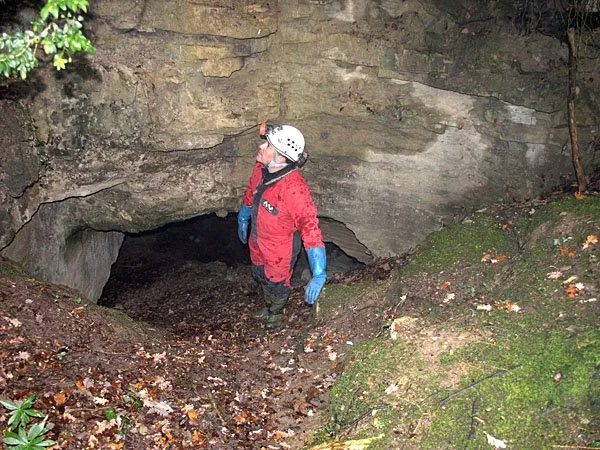
Bora dels Teixidors
A 97-metre-long cave in Cabrerès, Tavertet, known since ancient times and explored speleologically in 1976.
EspeleoWorld
Bora dels Teixidors
A 97-metre-long cave in Cabrerès, Tavertet, known since ancient times and explored speleologically in 1976.
Tavertet · Osona
Length: 97 m · Depth: 3 m
Updated record
https://espeleoworld.com/en/c/bora-dels-teixidors
Information can change. Always verify coordinates, access, weather, and cave conditions before setting out.
A 97-metre-long cave in Cabrerès, Tavertet, known since ancient times and explored speleologically in 1976.
Topographic
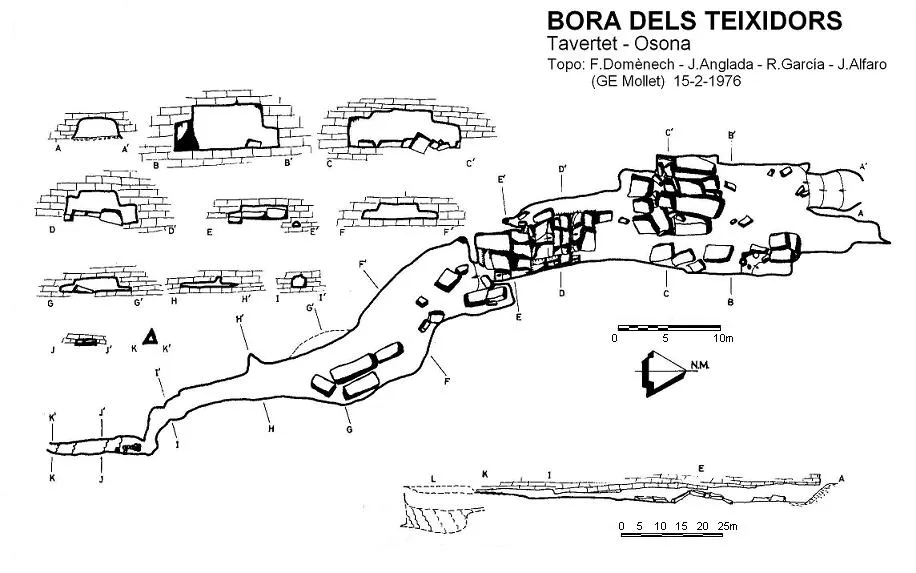
Espeleoindex · CC BY-NC 4.0, https://creativecommons.org/licenses/by-nc/4.0/ · Image © its author.
Photos
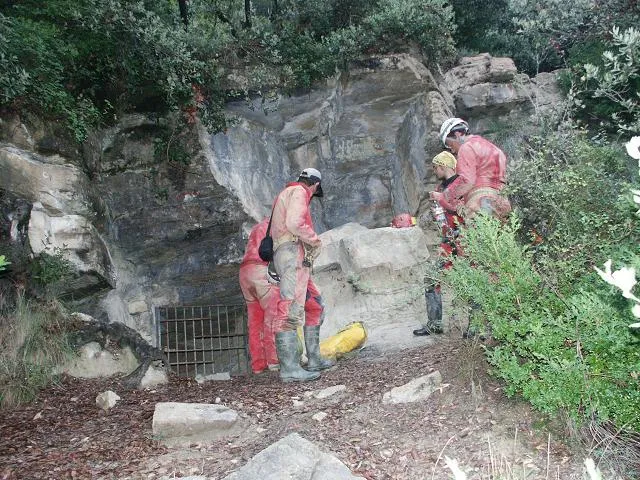
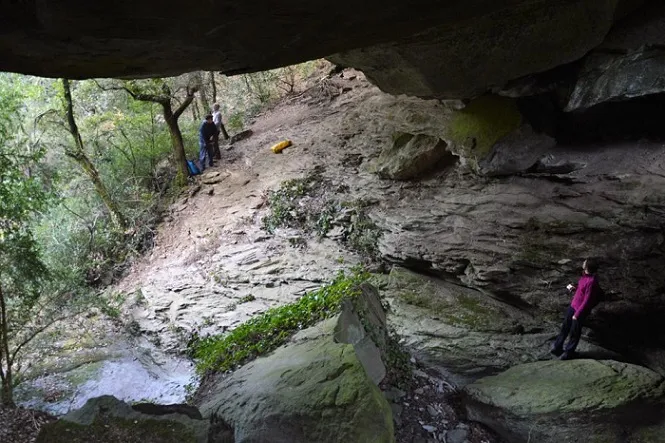
Espeleoindex · CC BY-NC 4.0, https://creativecommons.org/licenses/by-nc/4.0/ · Image © its author.
Description
Morphology
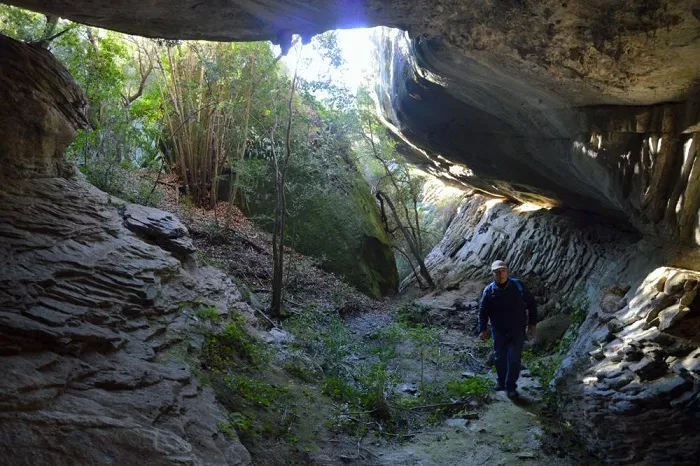
The entrance, 2 by 1 metres, gives way, by means of a ramp with a 3-metre drop, to a room 30 by 10 metres and 4 in height. At the end of this room and, by means of a small corridor, we reach another room 15 metres long by 6 wide and only 1 high. This room continues through a narrow gallery of about 20 metres in length, which leads us to a small crawlway of difficult penetration that gives access to the final room of about 15 metres in length by 5 wide and 1 in height.
Speleothems
In the first room an advanced graviclastic process and some forms of reconstruction can be observed. The floor of the second room is covered by a flowstone and, as in the entrance room, a graviclastic process and some forms of reconstruction are observed. The final room remains closed by a flowstone.
Progression
The entrance gives way, by means of a ramp with a 3-metre drop, to a room. At the end of this room and, by means of a small corridor, another room is reached. This room continues through a narrow gallery of about 20 metres in length, which leads to a small crawlway of difficult penetration that gives access to the final room.
History
Known since ancient times by the people of the area, who had used it as a refuge in times of wars.
Speleologically it was made known by the Grup Espeleològic de Mollet, which explored it in 1976.
User Comments (0)
No comments yet.
Be the first to share your experience!
Registered Explorations (0)
No explorations registered yet.
Register your visit to this cave!
Bibliography
- Domènech, Jordi; Mor, Jordi (1977).- “Avanç al catàleg espeleològic del Collsacabra. Operació Collsacabra 75” Vèrtex (57): 324-327. Federació d'Entitats Excursionistes de Catalunya. Barcelona
- Grup Espeleològic de Mollet (1978).- “Sobre las cavidades de la zona II (Tavertet) de la Operación Collsacabra – 75. Adelanto del Catálogo Espeleológico del Collsacabra”. Exploracions (2): 37-59. Grup Geogràfic de Gràcia. Barcelona.
· Fotografies i altres dades extretes del blog: Espeleobloc (post del 14-1-2009)
Nearby caves


Source: Espeleoindex (espeleoindex.com), modified. CC BY-NC 4.0, https://creativecommons.org/licenses/by-nc/4.0/