
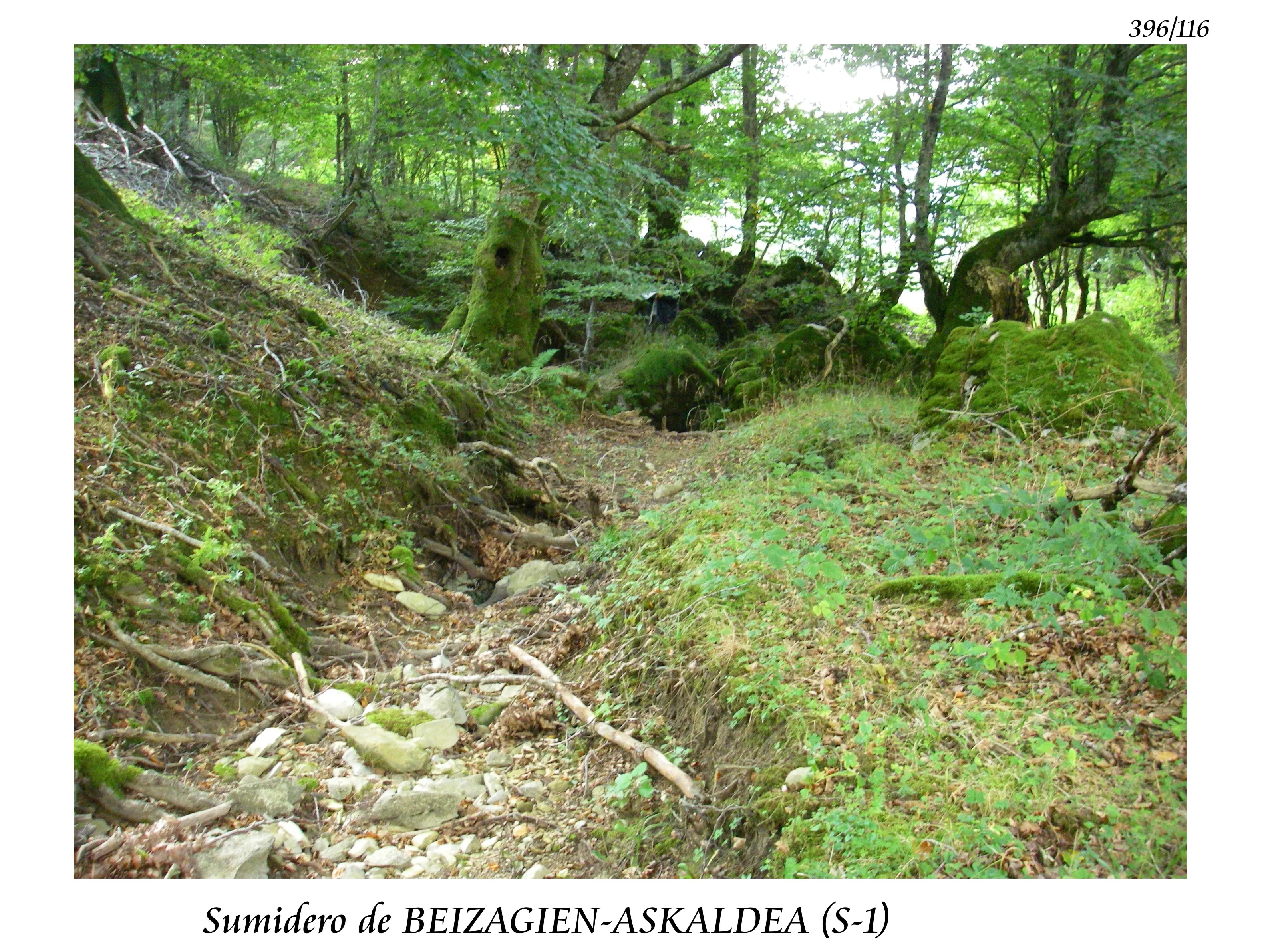
Beizagien Askaldea
Cavity marked S-1 that collects all the water of the homonymous gorge, with 143 m of depth and 1100 m of length.
EspeleoWorld
Beizagien Askaldea
Cavity marked S-1 that collects all the water of the homonymous gorge, with 143 m of depth and 1100 m of length.
Hiriberri/Villanueva de Aezkoa
Length: 1100 m · Depth: 143 m
Updated record
https://espeleoworld.com/en/c/beizagien-askaldea-hiriberri-villanueva-de-aezkoa
Information can change. Always verify coordinates, access, weather, and cave conditions before setting out.
Cavity marked S-1 that collects all the water of the homonymous gorge, with 143 m of depth and 1100 m of length.
Photos

CC BY 4.0, https://creativecommons.org/licenses/by/4.0/ · Información geográfica propiedad del Gobierno de Navarra · https://administracionelectronica.navarra.es/geologiaVisor/?cavity=NA-0396
Description
Morphology
The entrance of the cavity is formed by a chaos of blocks that can be easily overcome at several points. After passing it, there is a descending detrital gallery followed by the river. A small chamber is quickly reached, after which the gallery becomes meandering and canyon-shaped in limestone. At the base of the 8.5 m pit, a climb was made in a joint that resulted in the discovery of an upper level, of considerable dimensions compared with the rest of the cavity; the moderate dissolution of floor and walls is a clear symptom of an ancient erosive activity of the river. The ceiling is completely smooth and the cavity acquires a great length. From the base of the last mentioned pit starts a meander of rather reduced dimensions called meander "despacio"; after overcoming small steps, impracticable lateral inlets appear but with clear air currents, and progression becomes more painful until reaching a wider zone where a lower sumping passage is found. After passing the sumping passage, the meander takes increasingly narrow forms; at 60 m a small 6 m step appears where the relative width allows breathing more calmly. One continues forcing narrow passages together with a great psychological pressure due to the fear of an eventual flood of water, and one manages to continue for about 70 m approximately until abandoning the exploration at the head of a narrow step. The cavity is marked at its entrance with the abbreviation S-1, has 143 meters of depth and 1100 meters of length.
Speleothems
It is worth noting the lack of concretions. Throughout the meander stands out the great quantity of gouge-shaped formations, a clear symptom of a frantic activity of the water.
Hydrology
The cavity collects the totality of the water of the gorge of the same name. The river, except at the entrance of the sinkhole, continuously erodes in limestone rock up to the last point of the exploration. The water sinks gradually from meters before the cavity. It is very important to highlight that the sinkhole collects the totality of the waters of the gorge both in low water and in rainy periods, its descent being very dangerous and the appropriate measures having to be taken with respect to the time and duration of the explorations. Due to the absorption flow of the cavity, it is practically contaminated by waste dragged by the water. The stream that disappears in the sinkhole appears on cartographic maps descending until joining the Auztarri stream (Auztarri-1 sinkhole), which is an important error for a better understanding and location of the cavities.
Progression
Several successive steps lead to an 8.5 m pit where the river forms a dangerous waterfall. The lower sumping passage is accessed by a downclimb to the river, where its difficulty is due to the important deposit of organic materials (branches, humus, clay, rubbish); all these materials come from a sinkhole (it is possible that it is one already located) that after a first exploration inside was abandoned in a narrow crawlway. The cavity is dangerous in the rainy season.
Other details
During one of the explorations of the cavity, in the vicinity of the sumping passage, scratch marks were first found on the wall of what we suppose was a small rodent, and after reviewing the area its bone remains were found.
History
1961: Institución Príncipe de Viana.
2008: Investigación BERRENDI, ABODI NORTE G.Satorrak-CDN.
User Comments (0)
No comments yet.
Be the first to share your experience!
Registered Explorations (0)
No explorations registered yet.
Register your visit to this cave!
Nearby caves
Source: Gobierno de Navarra – Catálogo espeleológico de Navarra (datosabiertos.navarra.es), modified. CC BY 4.0, https://creativecommons.org/licenses/by/4.0/ Gobierno de Navarra · data as of 2022