
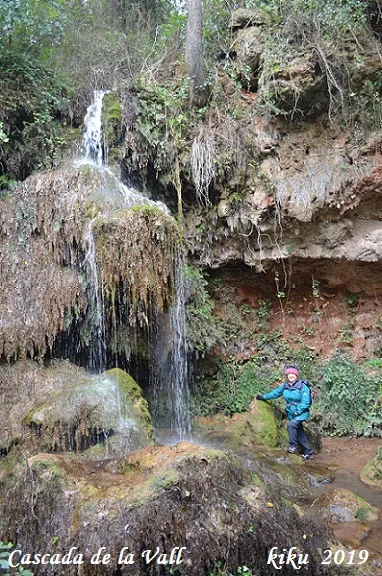
Balma de la Vall
Large rock shelter of archaeological interest (Montblanc), with three loci (LV1, LV2, LV3) and Upper Palaeolithic occupation.
EspeleoWorld
Balma de la Vall
Large rock shelter of archaeological interest (Montblanc), with three loci (LV1, LV2, LV3) and Upper Palaeolithic occupation.
Montblanc · Conca de Barberà
Length: 9 m
Updated record
https://espeleoworld.com/en/c/balma-de-la-vall
Information can change. Always verify coordinates, access, weather, and cave conditions before setting out.
Large rock shelter of archaeological interest (Montblanc), with three loci (LV1, LV2, LV3) and Upper Palaeolithic occupation.
Topographic
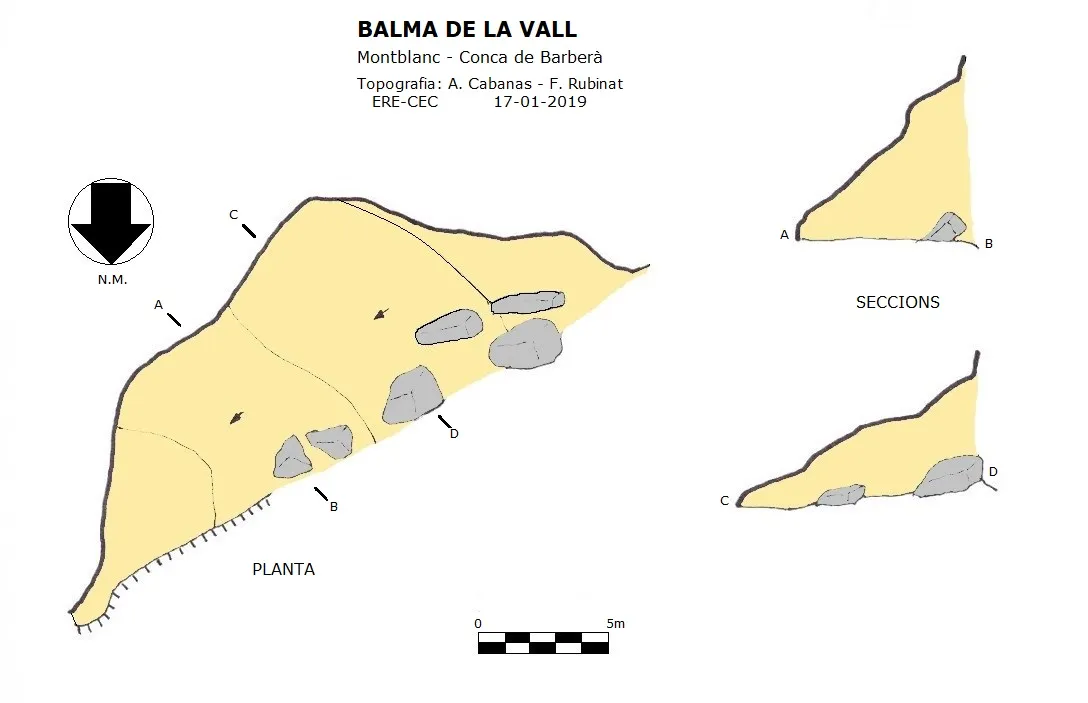

Espeleoindex · CC BY-NC 4.0, https://creativecommons.org/licenses/by-nc/4.0/ · Image © its author.
Photos

Espeleoindex · CC BY-NC 4.0, https://creativecommons.org/licenses/by-nc/4.0/ · Image © its author.
Description
Morphology
LV1: large rock shelter opened in the sandstones and oriented to the south-west, 21 metres long and 10 metres deep at its maximum point. This shelter is the one that gives its name to the complex and the recovered materials were individualised.
LV2: this is a set of materials probably coming from the previous site (LV1), located below, just outside the line of the rock shelter's visor. It has also been called a dump.
LV3: this is a small rock shelter located immediately below and to the left of LV1. It has also sometimes been called Taller de la Vall. It is in this place that the oldest occupation of the complex has been documented, 33000 BC.
Other details
As for the stratigraphy of the rock shelter, it is quite interesting: three levels were located (strata 2, 3 and 4) with intact lithic material attributable to the Upper Palaeolithic, probably the Gravettian or phases of similar typology but of later chronology. These strata were thicker in the central part of the rock shelter, the least excavated.
As for the lithic industry, it should be said that a total of 650 fragments were studied. The raw material used for all of them was flint, a point that is not surprising given the proximity at which outcrops of this material can be found. Very few remains present cortex, and whenever it appears it is a marginal cortex, which leads scholars to deduce that the roughing-out work would have been done outside the site and the cores would have been transported once prepared.
History
The site was discovered in 1975 by members of the archaeology section of the Museu-Arxiu de Montblanc i Comarca, according to a note provided by a member of the Grup Excursionista Montblanc.
In 1976 a surface collection of the material was made and a permit was requested to excavate the complex. For various reasons, it could not be excavated until 1979, and the campaign focused on the upper and larger rock shelter (LV1), the place from which the first identified materials came. An occupation from the Bronze Age was documented. During 1980 the work on the two lower rock shelters began.
In 2011 the excavation and study work at the Balma de la Vall was reactivated. The new intervention at the shelter has made it possible to begin the extensive excavation work of the theoretical western sector of the lower shelter, and the beginning of the study of the archaeological material recovered during the intervention. The datings and the lithic material identified indicate an occupation of the cavity during the Upper Pleistocene.
The 2012 and 2013 campaigns confirmed the chronology framed within the final Upper Palaeolithic, with the recovery almost exclusively of lithic material due to the conservation problems of the faunal remains. In this intervention, the sedimentary deposit of the Balma was exhausted, reaching the geological substrate at a thickness of 1.5m depth.
Bio
As for faunal remains, a set of fragments corresponding to mammal bones was located. The faunal material was divided into two sets: the set of remains corresponding to the intact level of the site, of Palaeolithic chronology, and a whole series of remains corresponding to a disturbed surface level, where in addition to Palaeolithic elements there are remains from various periods. The species represented are quite common in Upper Palaeolithic settlements in Catalonia: deer, wild goats, rabbits and lynx.
User Comments (0)
No comments yet.
Be the first to share your experience!
Registered Explorations (0)
No explorations registered yet.
Register your visit to this cave!
Bibliography
- Soto Quedada, M. L. (2011): Memoria de intervención arqueológica Balma de la Vall (Montblanc). Mem. Núm.10370
- Soto Quedada, M. L. (2013): Memòria d'intervenció arqueològica. Balma de la Vall (Montblanc). Campanyes 2012-2013. Mem. Núm.: 11122.
- Invarque.cultura.gencat.cat
Nearby caves
Cova del Racó de l'hospital
0.9 km · N
Montblanc (Conca de Barberà)
2 topo.10 photos
Cova de l'Eina Perduda
0.9 km · N
Montblanc (Conca de Barberà)
1 topo.4 photos
Avenc de la Figuera
0.9 km · N
Montblanc (Conca de Barberà)
1 topo.6 photos
Avencs Arrel-estret
0.9 km · N
Montblanc (Conca de Barberà)
1 topo.5 photos
Source: Espeleoindex (espeleoindex.com), modified. CC BY-NC 4.0, https://creativecommons.org/licenses/by-nc/4.0/