
Avenc Montserrat
Small cavity with a 38 m passage in the serra del Cairat, near the coll de Cassot (Esparreguera), of bioespeleological interest.
EspeleoWorld
Avenc Montserrat
Small cavity with a 38 m passage in the serra del Cairat, near the coll de Cassot (Esparreguera), of bioespeleological interest.
Esparreguera · Baix Llobregat
Length: 38 m · Depth: 6 m
Updated record
https://espeleoworld.com/en/c/avenc-montserrat
Information can change. Always verify coordinates, access, weather, and cave conditions before setting out.
Small cavity with a 38 m passage in the serra del Cairat, near the coll de Cassot (Esparreguera), of bioespeleological interest.
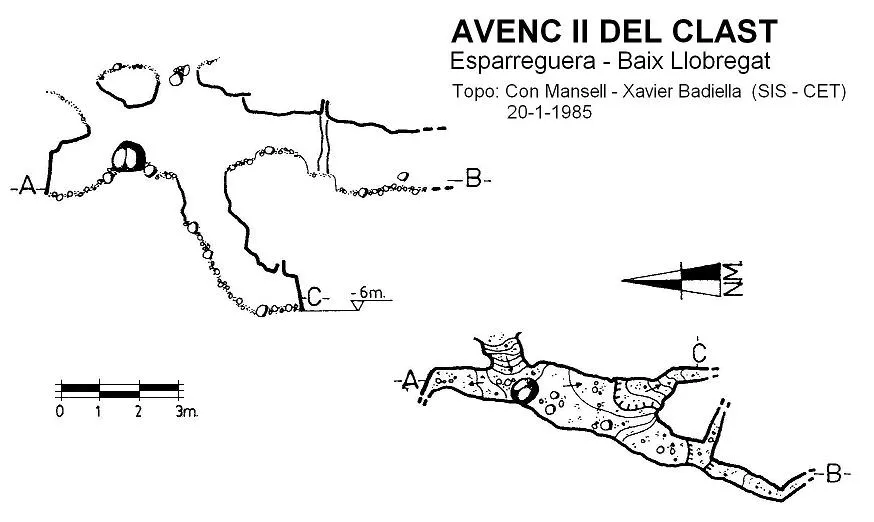
Topographic
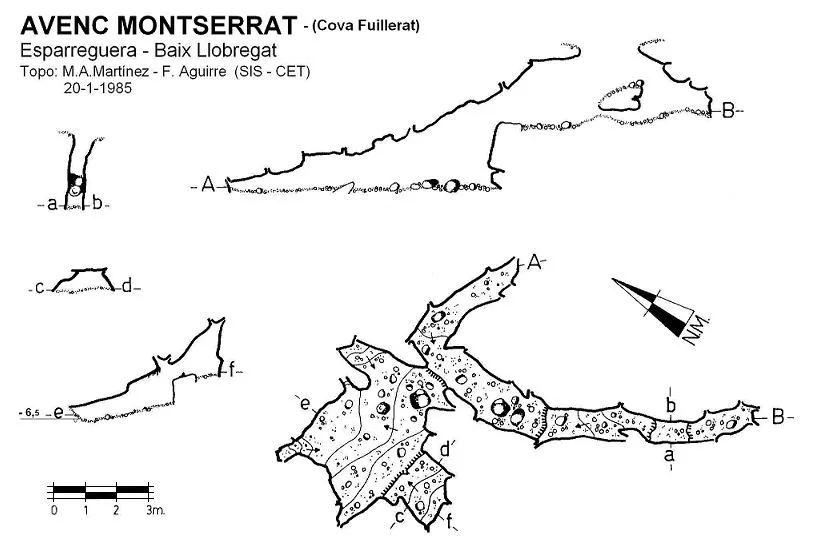
Espeleoindex · CC BY-NC 4.0, https://creativecommons.org/licenses/by-nc/4.0/ · Image © its author.
Description
Morphology
The entrance, in the form of a pit, allows, after descending a small 2 metre shaft, continuing along a gallery that immediately meets another drop. Once past this, we find on the left an opening that leads us to a room of 4 by 3 metres, although the ceiling does not exceed one metre in height. At one of its ends and by means of a raised passage one reaches a smaller chamber although it is a little higher. Before entering the room, on the right side of the entrance gallery, one can continue about 3 metres more of gallery.
History
The avenc Montserrat was found by Vicenç Cusó i Armengou and other members of the ERE – CEC on 24 December 1961. They named it Montserrat because from its entrance a good panorama of the mountain of Montserrat can be seen. They assigned it a depth of 8 metres.
Around 1965, the newly created SIRE – UEC Olesa de Montserrat began its prospections and explorations in the area of Coll de Cassot and among other cavities, they rediscovered the avenc Montserrat which, thinking it was an unpublished cavity, they renamed Cova Fuillerat, although it has always been better known by this name than by the original. When the group disappeared, its members created in September 1969 the delegation of the SIS – CE Terrassa in Olesa de Montserrat and continued working in the area, producing new surveys, magnificently drawn by Joan Morera and which unfortunately remain unpublished forever.
Twenty years later, members of the SIS – CE Terrassa undertook the task of cataloguing the area and once completed it was never published. Its author, our friend Xavier Badiella, has provided us with a copy of the aforementioned work in order to include the cavities in Espeleoindex.
Bio
On 1 January 1962, a few days after its discovery, Vicenç Cusó and Oscar Andrés visited the cavity on Oscar's bioespeleological initiative and collected two beetles Speophilus kiesenwetteri. They are taken to the Museu de Zoologia de Barcelona and already seem a little different from those of Montserrat and Sant Llorenç del Munt.
Dr. Francesc Español takes the opportunity to carry out systematics practice on cave-dwellers with a disciple of his who was then beginning in bioespeleology: Oleguer Escolà. And he locates the cavity (apparently with not very precise indications from Esteve Petit Llongueras, for which reason he climbs up to the very top of Sant Salvador de les Espases) and makes two visits on 30-XII-62 and 4-I-63 with the placement of cheese and beer baits that allow him to gather about twenty specimens of Speophilus, today Troglocharinus kiesenwetteri (Dieck, 1869).
This insect is described in the work of O. Escolà:
Escolà, O., 1966.- “Contribución al conocimiento de los Speophilus del grupo kiesenwetteri Dieck”. International Journal of Speleology (2): 195-205
as Speophilus kiesenwetteri andresi ssp. n., and currently the name that corresponds to it is Troglocharinus kiesenwetteri andresi Escolà.
as a new subspecies of the beetle of the cavities of Montserrat, also different from the species that lives in a single locality, the cova del Petracó (Troglocharinus patracoi Zariquiey, 1922).
Following the teaching of Español it is described as a subspecies of kiesenwetteri, although it has long been thought that if the patracoi deserves the category of species, this one would deserve it even more. The studies of last year and this one with DNA (deoxyribonucleic acid) would seem to confirm this elevation to the category of independent species, although these considerations are very subjective, whether a taxonomic form is a species or subspecies is a thing of very little or no importance and according to the master, it is better to devote oneself to important things and not to these trifles.
The beetle of Montserrat, the Troglocharinus kiesenwetteri, was the first Catalan cave-dweller described from the cova del Salnitre by the great zoologist Dieck, on a visit he made there and he described it as Adelops kiesenwetteri.
Reitter in 1885 (with very good judgement) made it a new genus which he named Perrinia, but Jeannel in 1911 discovered that this name was already preoccupied (by a Trochidae mollusc of the Indian Ocean), he had to change the name, he called it Speophilus ("lover of caves").
We, the disciples of Español, have continued increasing the knowledge of these cave-dwellers, we have added hundreds of new locations of the species and new species for science, and if at first the two genera Speophilus and Troglocharinus had few species and very good characters of separation between them, with the thirty current species the generic characters have been reduced, until in 1978 Speophilus was considered as a subgenus of Troglocharinus and afterwards the two had to be merged; since the denomination that the genus of the first Catalan cave-dweller received, Speophilus, dated not from 1869 but from 1924, and in 1908 Reitter had described the genus Troglocharinus (on the Troglocharinus ferreri collected in 1907 by Faura i Sans in the avenc d'en Roca), this one had priority.
Speophilus has disappeared from zoological nomenclature and is only maintained in the root of another genus of the cova de Rialb, the Perriniella, of which there were only two species (P. faurai from the cova de Rialb and P. bofilli from the cova de les Encantades del Puigmal) until recently a French bioespeleologist found another one in marmot nests in the French Pyrenees: P. fresnedai.
(Information provided by Oleguer Escolà i Boada, ERE del CEC).
User Comments (0)
No comments yet.
Be the first to share your experience!
Registered Explorations (0)
No explorations registered yet.
Register your visit to this cave!
Bibliography
- Badiella, X. (2000).- “ Les cavitats del Coll del Cassot” (treball inèdit). SIS – CE Terrassa.
- Escolà, O., 1966.- “Contribución al conocimiento de los Speophilus del grupo kiesenwetteri Dieck”. International Journal of Speleology (2): 195-205
- SIRE – UEC Olesa (1966).- “Las actividades de la SIRE de Olesa de Montserrat en Coll de Cassot”. Boletín de Información SIRE (2-3): 7-8 (1ª época) SIRE – UEC Sants. Barcelona
- Valles, Jordi de (2016).-”Baix Llobregat”. Catàleg Espeleològic de Catalunya (Vol.6):1-468. EC Gràcia/Federació Catalana Espeleologia.
Nearby caves
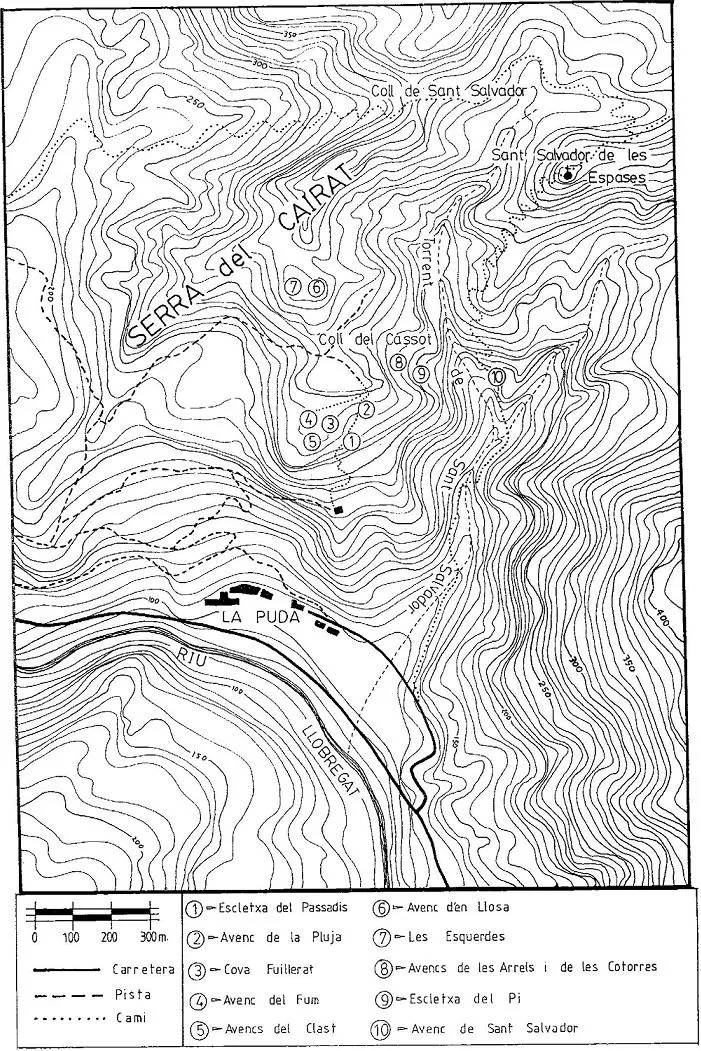
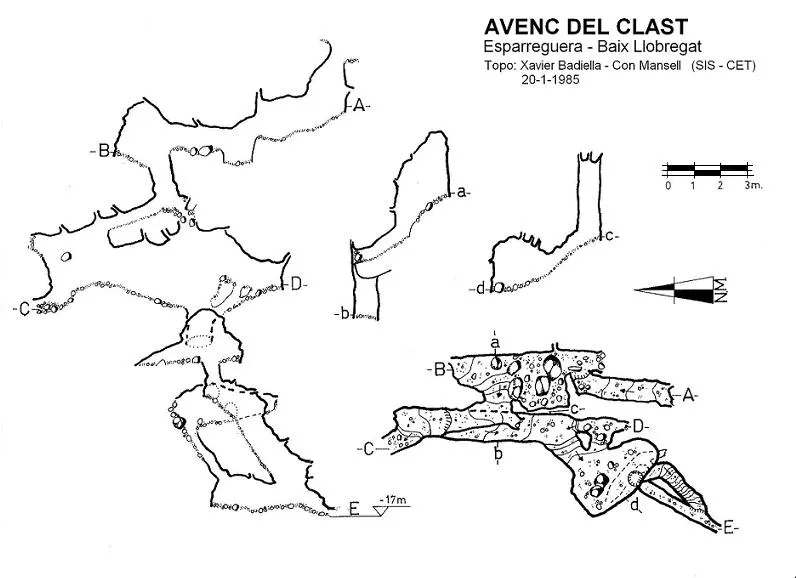
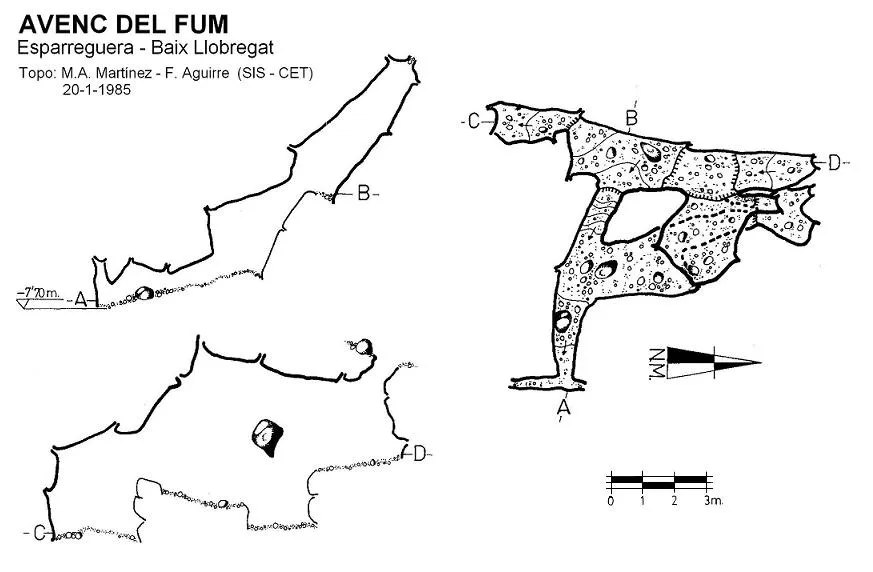

Source: Espeleoindex (espeleoindex.com), modified. CC BY-NC 4.0, https://creativecommons.org/licenses/by-nc/4.0/