
Avenc del Club
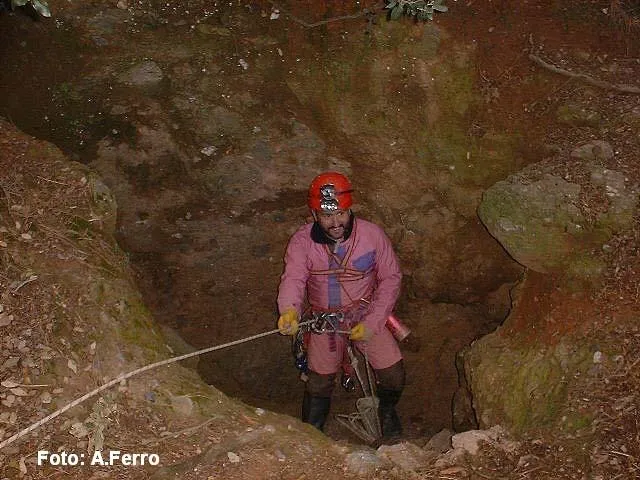
Historic 90 m deep pit in Sant Llorenç del Munt, discovered in 1906, with the Laminador, the Pou GETIM and the Via Pèndol.
EspeleoWorld
Avenc del Club
Historic 90 m deep pit in Sant Llorenç del Munt, discovered in 1906, with the Laminador, the Pou GETIM and the Via Pèndol.
Matadepera · Vallès Occidental
Length: 210 m · Depth: 90 m
Updated record
https://espeleoworld.com/en/c/avenc-del-club
Information can change. Always verify coordinates, access, weather, and cave conditions before setting out.
Historic 90 m deep pit in Sant Llorenç del Munt, discovered in 1906, with the Laminador, the Pou GETIM and the Via Pèndol.
Topographic
Espeleoindex · CC BY-NC 4.0, https://creativecommons.org/licenses/by-nc/4.0/ · Image © its author.
Photos
Espeleoindex · CC BY-NC 4.0, https://creativecommons.org/licenses/by-nc/4.0/ · Image © its author.
Description
Morphology
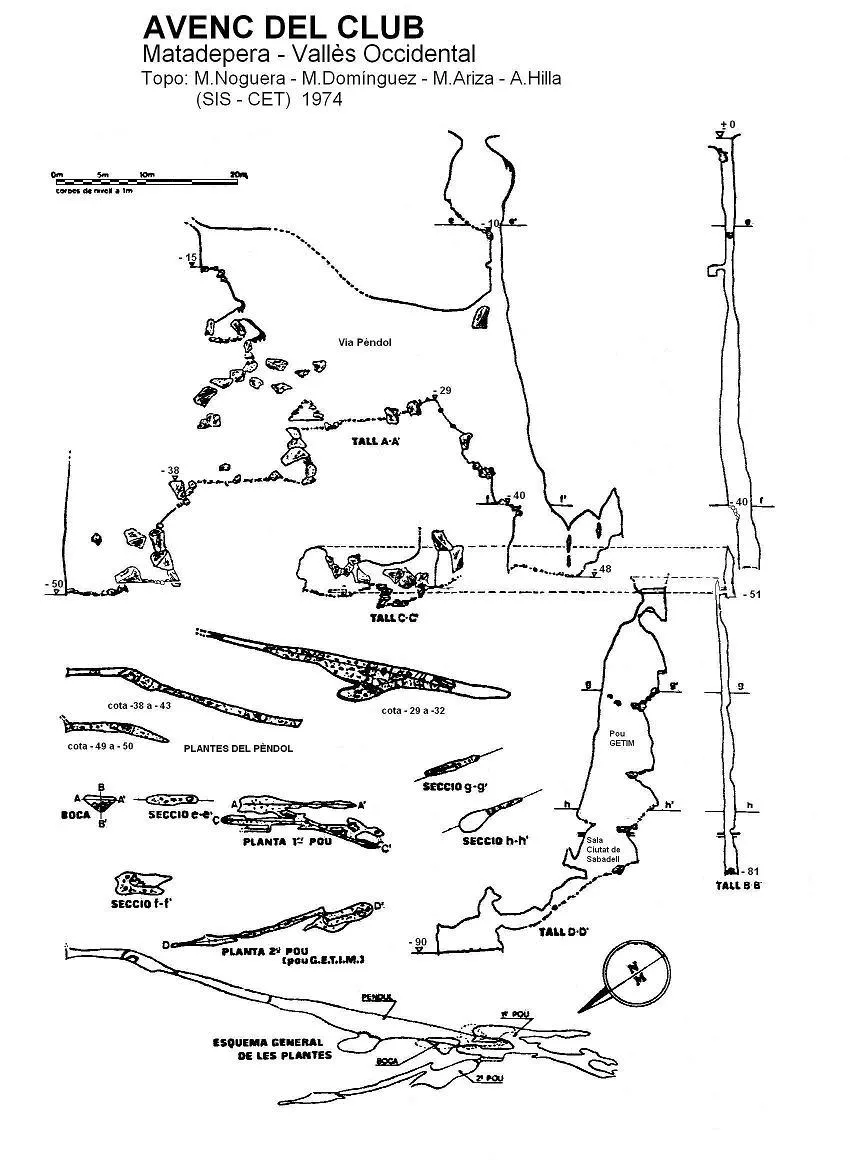
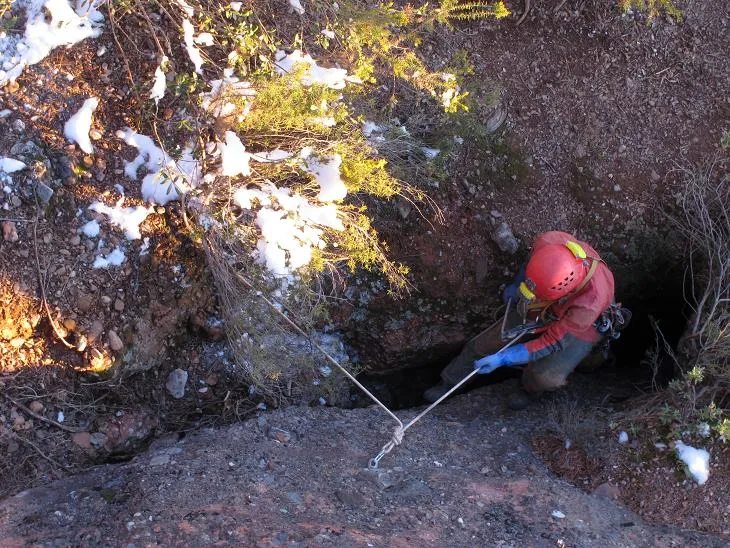
In a small funnel the small entrance of the pit opens, communicating with a shaft that descends to the level -9 where there is a steeply sloping ramp which, at its end, begins a new shaft down to 47 metres of depth, meeting a ledge at -40. At the bottom of this first shaft, on one of the sides, there is an opening to pass through and descend into a small gallery where, also on one of the sides, is the Laminador, which communicates with the second shaft.
The Laminador is a fairly narrow passage that is first horizontal and communicates with a vertical joint where, a few metres down, it widens and one comes out into the second shaft (Pou GETIM) which descends 30 metres, with small ledges at -62, -70 and -76. At its bottom, level -81, one continues along a gallery parallel to the direction of the joint of the shaft and, by a steep slope, reaches a small shaft of 5 metres where the deepest point is reached.
Returning to the entrance shaft, at level -30, when it is just widening, is found the so-called Via Pèndol. One reaches a fairly large ledge, here the joint continues inwards and, after passing a low passage, or climbing over it, we find a short shaft of 5 metres, then three more follow, of which except the last, which is wider, can be climbed in opposition. At the bottom one reaches the end of this route, at 50 metres of depth, more or less the same level as the entrance shaft. Once above these three shafts, before passing the low passage, one can continue ascending the joint in opposition, until reaching a small chamber, situated at level -15 with respect to the entrance of the pit.
Speleothems
In the Via Pèndol, on a fairly large ledge, on one of the sides we can observe large lithogenic processes. A small chamber is beautifully decorated by lithogenic processes.
Progression
The Laminador is a fairly narrow passage that is first horizontal and communicates with a vertical joint where, a few metres down, it widens and one comes out into the second shaft (Pou GETIM). In the Via Pèndol, after passing a low passage, or climbing over it, we find a short shaft of 5 metres, then three more follow, of which except the last, which is wider, can be climbed in opposition. Once above these three shafts, before passing the low passage, one can continue ascending the joint in opposition.
History
Discovered by Josep Mª Cuadras in November 1906 on seeing that his dog was scratching in a burrow and after lifting a stone the entrance of the pit appeared. Once the members of the recently created Club Muntanyenc were informed, they organised the first exploration of the cavity, which was carried out on 11 September 1907, naming the cavity in honour of their club. Josep Colomines and Josep Maria Có de Triola descended to the bottom of the first shaft, and they detected a lack of oxygen in the last stretch of the pit.
In 1911 it was visited by members of the Centre Excursionista de Terrassa and in 1922 they organised another exploration with biospeleological aims.
On 23 February 1964, members of the Grup Espeleològic Terra i Mar (Sabadell) forced a narrow passage at the known bottom of the pit and, passing the so-called Laminador, they descended the Pou GETIM and reached the current bottom of the cavity. The excitement of the discovery made them magnify the find and they named the bottom of the shaft “Sala Ciutat de Sabadell” and on the survey they estimated that the total depth was 115 metres.
Bio
Coleoptera: Speophilus kiessenwetteri. Dieck (M. Noguera, 3-3-1974) (J.Rosaura, 30-12-1973). Armidia umicolor (M. Ariza, 17-12-1972).
Isopoda: Spelaeonetes occidentalis. Vandel (J.Germain, 8-12-1972) (J.Rosaura, 30-12-1973).
User Comments (0)
No comments yet.
Be the first to share your experience!
Registered Explorations (0)
No explorations registered yet.
Register your visit to this cave!
Bibliography
- Cardona, F. (1990).-Grans cavitats de Catalunya, vol 2. 484 pp. EC Gràcia, Barcelona.
- Colomines, J. (1909).- “L'Avenc del Club de Sant Llorenç del Munt” Sota Terra (I): 99-116. Club Muntanyenc. Barcelona.
- GES-CMB (1974).-Catálogo espeleológico de la provincia de Barcelona. 198 pp. Club Montañés Barcelonés /Diputación Provincial de Barcelona.
- GETIM (1968).- “Activitats GETIM (Grup Espeleològic Terra i Mar de Sabadell)” Espeleòleg (7): 239-241. ERE del CEC. Barcelona.
- Noguera, M. (1975).- “Avenc del Club” Arxiu del Centre Excursionista de Terrassa (1): 15-19. CE Terrassa.
- Vives i Jorba, Salvador.(1972).-”Topografies subterrànies al C.E. de Terrassa”. 2º Simposium de Metodologia Espeleològica. VI-f (1-6). SIE-CEA.
Nearby caves


Source: Espeleoindex (espeleoindex.com), modified. CC BY-NC 4.0, https://creativecommons.org/licenses/by-nc/4.0/