
Avenc del Cim de l'obaga del Pollo
A pit of almost 141 m depth in the Serra del Boix (Tivenys – el Perelló), with an old zone and a new zone, and an upper entrance known as Avenc nº 3 del Cim de l'Obaga del Pollo.
EspeleoWorld
Avenc del Cim de l'obaga del Pollo
A pit of almost 141 m depth in the Serra del Boix (Tivenys – el Perelló), with an old zone and a new zone, and an upper entrance known as Avenc nº 3 del Cim de l'Obaga del Pollo.
Tivenys · Baix Ebre
Length: 754 m · Depth: 141 m
Updated record
https://espeleoworld.com/en/c/avenc-del-cim-de-l-obaga-del-pollo
Information can change. Always verify coordinates, access, weather, and cave conditions before setting out.
A pit of almost 141 m depth in the Serra del Boix (Tivenys – el Perelló), with an old zone and a new zone, and an upper entrance known as Avenc nº 3 del Cim de l'Obaga del Pollo.
Topographic

Espeleoindex · CC BY-NC 4.0, https://creativecommons.org/licenses/by-nc/4.0/ · Image © its author.
Photos

Espeleoindex · CC BY-NC 4.0, https://creativecommons.org/licenses/by-nc/4.0/ · Image © its author.
Description
Morphology
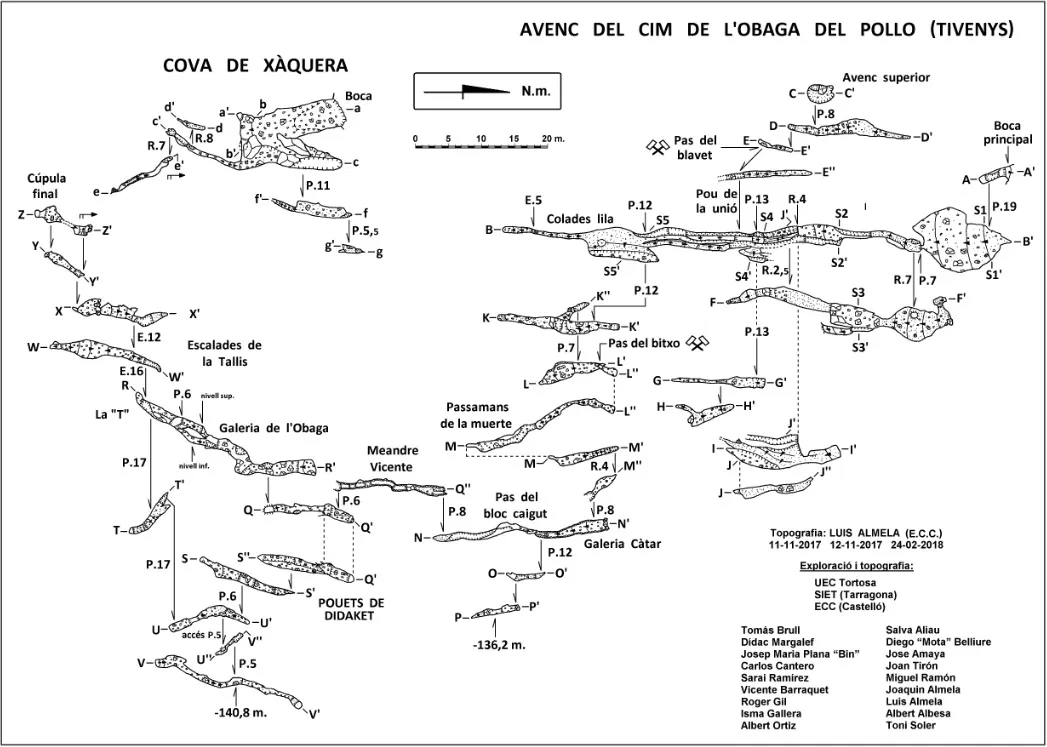
Old zone. The main (lower) entrance gives access to a 19 m pit that leaves us in the largest chamber of the pit, 14.7 x 9.7 m. At the N end the two lower windows that give onto the outside can be seen. At the S end is the continuation of the cavity through a 7 m pit. From this point we enter a fairly complex sector formed by a large joint that, given the strong fracturing, has created various collapsed levels. The section pattern of this whole zone is more or less an inverted Y (sections S2, S4 and S5). Further on we reach a 4 m pit. From its base, descending a new 2.5 m drop, we reach a lower level. Towards the S, however, we will reach the middle of a 13 m vertical that we can descend from the main level. Also at this same point, and against the right-hand wall, there is a collapsed section that is rigged and descends a 13 m pit. Below the pit there is a short passage and a narrow drop that allows descending a few more metres (points G and H on the survey). Just where the 12 m pit is, but on the left-hand side, we find a chamber from which some descending bedding planes emerge (section S5). If we continue straight on we will advance a few more metres where the fracture reduces its width. Descending the P.12, this leaves us on an inclined ramp that gives access to a small 3.5 m pit and a horizontal zone. From here, and through a narrow passage, we reach the head of a P.7. At its base a 9 x 2.5 m chamber opens. At the NW end of the chamber and at mid-height we find a narrow passage that was dug open by the UEC de Tortosa and the SIET de Tarragona. This is the Pas del Bitxo, where the new zone begins. New zone. From the Pas del Bitxo the narrowest and most uncomfortable part of the pit opens up. Further on the fracture widens forming a high joint. Once on the floor, in a S direction there is an ascending drop that takes us to a narrow pit explored on dates after the survey was made. This vertical gives onto an already known place, the Galeria Càtar. In a N direction we will continue along the base of the joint, descending among clastic material until reaching a 4 m drop. At its base we again change direction towards the S, and immediately reach the head of a new 8 m pit. This leaves us in the Galeria Càtar, very decorated and similar to the previous one but wider. The gallery descends in a ramp up to the base of a climb. But, at the foot of the climb and on the floor a small hole opens that gives access to a couple of narrow pits that descend to the level of -136.2 m. At the other end of the handrail the gallery reduces in size and a new climb starts. This is 8 m and leaves us again in a collapsed fracture where we will walk along a ledge with the help of another handrail. This gallery is called “Meandre Vicente”, although it really is a tectonic gallery. Once the collapsed section is passed, the gallery reduces in size and presents concretion-covered walls. We descend until finding the head of a 6 m pit that leaves us in a small chamber. Through the right-hand gallery we ascend a joint of reduced dimensions until reaching a large gallery; we are in the Galeria de l'Obaga. This presents some lower levels formed by the accumulation of large blocks. The chamber, elongated, has dimensions of 18 x 2.1 and some 10 m in height. From its S end one can continue through two different passages that further on join again. The upper passage through a 6 m pit leaves us on a wide ledge between large slabs. The lower passage is accessed over some blocks and is of more modest dimensions. After descending a complicated drop it also leaves us on the same ledge as the upper passage. The Cornisa de les llastres, called “la T”, opens out in the middle of a 33 m vertical excavated following the same joint that forms the whole cavity. We begin by descending a 17 m pit divided in 2 by a ledge. At its base we follow a descending gallery in a N direction. At its N end we will see upwards a drop that gives access to a continuation of the gallery, this is where the route of the pouets de Didaket joins. But to reach the maximum depth level we will take a narrow passage in the floor that leads us to a 5 m pit. At its base we can still descend a drop and access a gallery 25 m long where the level of -140.8 m is located, the maximum depth of the cavity. From the N end of this gallery one can climb to an upper level that turns back towards the S and leaves us at the head of the last 5 m pit. In this lower gallery the sections are more reduced. Returning to the Sala de les Llastres the other option left to us is to climb the climb made by the explorers of the UEC and the SIET. We will climb a 16 m pit that leaves us in a wide fracture 15 m long with a width of 2.8 m and the ceiling at 10.5 m in height. From here a new 12 m climb starts that leads to another upper level. Above the E.12 a wide gallery opens, which further on is almost covered by large-volume clastic material. Once the narrow section is passed we come out into a small chamber from which a chimney emerges. Above it there are still two small chambers where a gentle air current is noticed. On windy days the air current is stronger. The chamber situated further S ends in a dome; the final dome. This is, according to the survey data, only 5 m away in plan and 12 m in height difference from the cova de Xàquera, with which it has not yet been possible to connect but which with all certainty forms part of the same fracture. Upper entrance: Avenc nº 3 del Cim de l'Obaga del Pollo. The upper pit opens in a collapse and its entrance, in a horizontal position and 1.2 x 0.6 m, gives access to an 8 m pit. At its base we find ourselves on top of a cone of debris inside the main fracture that forms the cavity. In a N direction a wide gallery continues that ends after 15 m. It is in this zone that there is a small hole in the ceiling that manages to communicate with the outside, although due to its dimensions it goes unnoticed. Returning to the base of the P.8 and in a S direction, there is a narrow descending gallery that presents us with a series of drops until reaching a point dug open by Carlos Cantero: the pas del blavet. The vertical narrow section, the result of the digging, leaves us on a ledge above a 20 m pit (Pou de la Unió) that at its base communicates with the main gallery of the main pit. But in the initial zone of the pit, and towards the N, we can access an ascending gallery of 12 m.
Speleothems
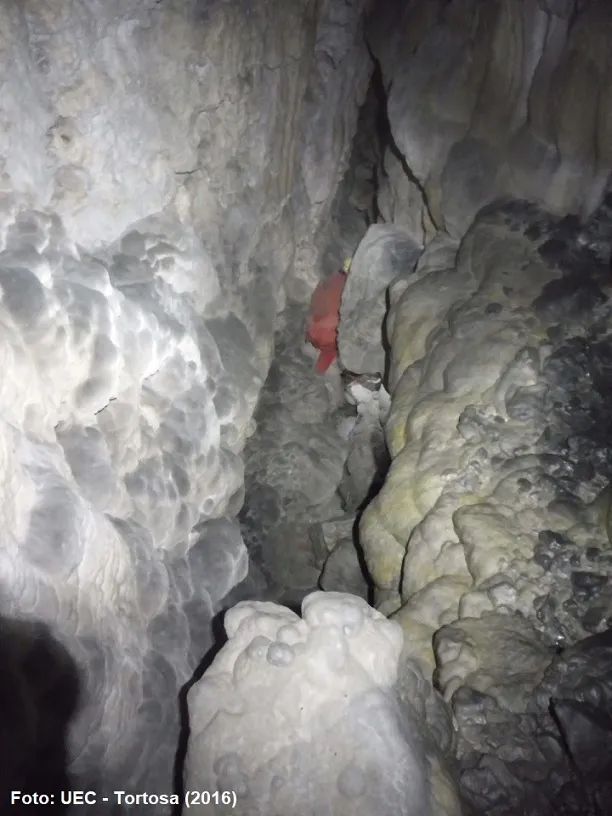
The 9 x 2.5 m chamber is decorated by long stalactites. In the new zone, the fracture widens forming a high joint with the walls decorated by showy flowstone. The Galeria Càtar is very decorated and similar to the previous one but wider. Further on, a gallery also decorated by beautiful flowstone. Finally, a gallery with concretion-covered walls.
Progression
The main (lower) entrance gives access to a 19 m pit. At the base of the P.7 we can: downclimb an R.7 that leaves us on a lower level or continue along the upper level, more direct. Returning to the base of the P.7, along the upper level we will advance descending a ramp with some drops until the gallery widens and presents a collapsed section on each side. From the base of the P.4, continuing along the main level we will climb a few metres up a fixed rope. Just above the rope, the ceiling presents itself at great height, since it is in this place that the pit that joins the upper pit with the main fracture falls, called Pou de la Unió. From the base of the Pou de la Unió: continuing towards the S, on the right we find the last collapsed section of the main gallery, this gives access to a 12 m pit which is how we will be able to reach the rest of the cavity. Through these bedding planes one can reach the aforementioned collapsed sections. And as a third option; if we continue straight on we will still be able to overcome a ramp of stones and a 5 m climb installed on fixed rope, behind which the joint closes. Towards the south one advances through some descending and fairly narrow passages in which we overcome some drops. At this point a descending handrail emerges that leads us to the base of the gallery. This is the handrail of the 'muerte'. Taking the rope of the 6 m climb we enter a gallery. This soon presents a collapsed section that we overcome by a handrail; it is the Pas del bloc caigut. At the start of the handrail we have above us a chimney which is where the aforementioned pit falls. From here and in a S direction we have two possibilities: 1) On the one hand to follow the main route climbing through the right-hand gallery. 2) Or else through the left-hand gallery to descend towards the Pouets de Didaket. This vertical we can travel up or down. First we are going to describe it downwards. As for the pouets de Didaket, these begin in the chamber that is at the base of the 6 m pit. From the chamber and in a S direction we have two possibilities: 1) Climbing through the right-hand gallery we will follow the main route described above. 2) Through the left-hand gallery we will descend towards the pous de Didaket. Although they are called pouets de Didaket they can be descended without rope, since it is a gallery with many blocks and stones, of reduced dimensions and dotted with drops. This route joins the one that descends to the maximum level before the final 5 m pit.
History
The first exploration was carried out by members of the GES – CMB in June 1954 during a first campaign in the area of Rasquera and el Perelló, which continued at Easter 1955. Practically forgotten, we have no news of it until August 1983 when members of the SIE – CEA visit it and make a new survey (maximum level: - 54, m). Many years later it is visited by members of the UEC Tortosa in 2012, who re-rig the cavity and it seems to them that they have got out of the known surveys. They do not return however until 2017 with the intention of reviewing unknowns. At the bottom of the pit they observe a bat that slips through a small hole and at this point they begin a laborious digging that allows opening a passage (Pas del Bitxo) very selective at first. During the following weeks the explorations follow one another: diggings, climbs, ... and the union of what is known as Avenc nº 3 del Cim de l'Obaga del Pollo with the rest of the cavity by means of a curious coloration; pouring a 5 litre bottle of homemade blauet at the bottom of this pit situated a few metres higher up. The next day they were able to observe on the vault of the upper part of the avenc nº 1 the blue trickles and thus be able to dig through to the physical union of both cavities. To the explorers of the UEC were joined members of the SIET (Tarragona) and of the Espeleo Club Castelló, forming a numerous team that throughout 2018 were able to explore the complex set of passages and make a careful survey.
User Comments (0)
No comments yet.
Be the first to share your experience!
Registered Explorations (0)
No explorations registered yet.
Register your visit to this cave!
Bibliography
- Montoriol, J. y Andrés, O. (1955).- Estudio geoespeleológico de varias cavidades del borde oriental de la Sierra del Boix (Tarragona)” Speleon VI (4): 257-277. Universidad de Oviedo.
- SIE (1984).- “Resultat de les exploracions realitzades a la zona del Perelló (Baix Ebre)” EspeleoSie (27): 76-97. SIE – CE Àliga. Barcelona.
- Revisió de coordenades facilitada per Julio Serrano (SIE – CEA) octubre 2017.
- Fotografies extretes del blog (www.espeleobloc.com.es) post del dia 6-11-2017.
- Actualització de dades (2019) extretes de la Memòria del Sistema de l'Obaga del Pollo – Serra del Boix (Secció d'Espeleologia i Barrancs de la UEC – Tortosa), guanyadora del Premi N. Font i Sagué (Edició 2019) atorgat per la Federació Catalana d'Espeleologia (Facilitada per Vicent Barraquet, UEC).
El contingut d'aquesta memòria es pot consultar al blog: cavitats-subterranies.blogspot (de l'Espeleo Club Castelló). Apunt del 23-2-2020 i d'on hem extret algunes fotografies.
Nearby caves
Avenc Nº2 del Cim de l'obaga del Pollo
0.0 km · NW
Tivenys (Baix Ebre)
1 topo.

Cova-avenc del Cim de l'obaga del Pollo
0.1 km · S
Tivenys (Baix Ebre)
4 topo.7 photos

Avenc del Camí de Xàquera
0.2 km · S
Tivenys (Baix Ebre)
4 topo.11 photos
Avenc Solsona
0.6 km · W
Tivenys (Baix Ebre)
1 topo.11 photos
Source: Espeleoindex (espeleoindex.com), modified. CC BY-NC 4.0, https://creativecommons.org/licenses/by-nc/4.0/